 English
 Español
 Português
 Deutsch
 한국어
한국어 日本語
日本語 Italiano
 Français
 العربية
 Türkçe
Two people are wearing something labeled “cooling fabric.” One feels nothing until fifteen minutes into a workout, when sweat finally kicks in. The other lies down on a mattress and feels cold within seconds — no sweat involved at all. Both products carry the same marketing word. Neither is lying. They’re just built on entirely different physics.

“Cooling” is not one technology. It’s a marketing umbrella covering at least three unrelated mechanisms, each triggered by a different condition — moisture, touch, or airflow. Mixing them up in product development is how a mattress ends up feeling lukewarm or a base layer ends up feeling stiff and unremarkable. Understanding which mechanism is actually inside a yarn changes what that yarn should be used for.
“Cool” Is Not One Sensation — It’s Three Different Physics Events
Human skin registers “cold” through a rapid drop in surface temperature, typically measured by Qmax in textile testing. That drop can be caused by moisture evaporating away from skin, by a material’s own thermal conductivity pulling heat away on contact, or by ambient airflow interacting with a conductive fiber structure. Three different starting points, three different products, one overused word.
Moisture-Driven Cool — 8C’s Microporous Channels
8C polyester yarn uses a figure-eight shaped microporous channel running through the fiber. That geometry creates strong capillary action, pulling sweat away from skin and spreading it across a larger surface area for faster evaporation. Evaporation itself absorbs heat, which is where the cooling sensation comes from.
Instant Touch Cool — 8C Pro’s Mineral-Infused Fiber
8C Pro takes the same microporous base structure and embeds jade, crystal, and mica minerals directly into the fiber — not as a surface coating, but built into the polymer itself. These minerals have a different intrinsic thermal response than plain polyester, so skin contact produces an immediate cool-touch sensation before any sweating occurs.
This is the mechanism most people actually mean when they say a fabric “feels cold the moment you touch it.” It’s a material property, not an evaporative process, which is why it works even on dry skin — useful for the first few minutes of a workout before sweat has built up.
Conductive Cool That Gets Colder With Airflow — PECooX®’s HDPE Structure
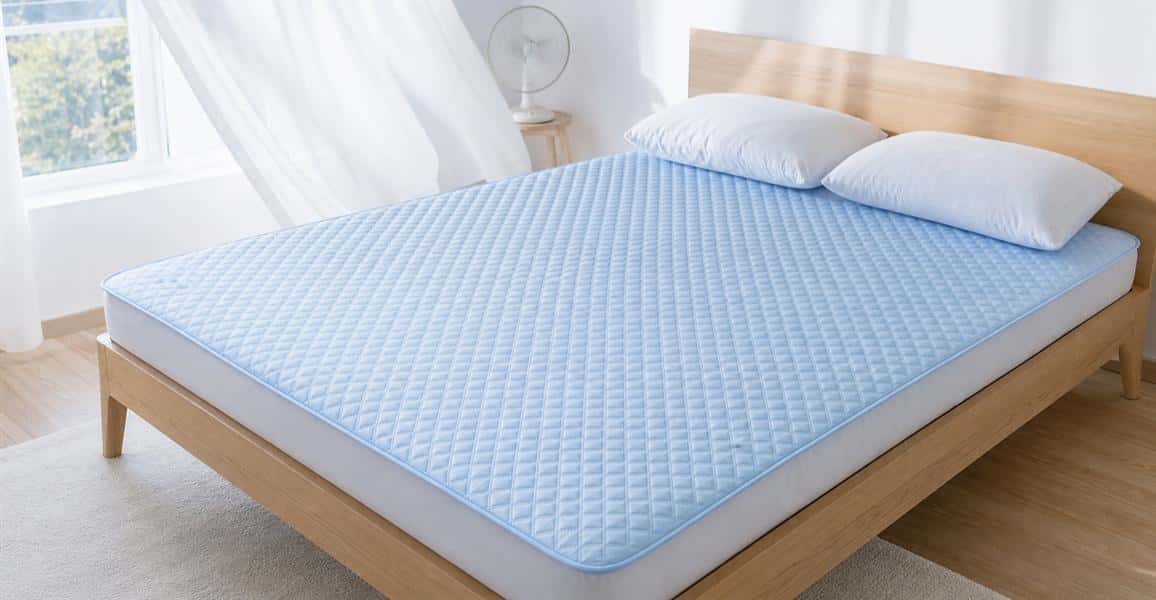
PECooX® is spun from high-density polyethylene rather than polyester or nylon. HDPE’s molecular chain structure gives it notably high thermal conductivity — it moves heat through itself faster than most textile fibers. On its own, that just means it feels neutral rather than warm. Add moving air — a fan, an AC vent, a breeze — and the fiber keeps shedding heat continuously, producing the “gets colder the longer the air moves across it” effect that mattress and bedding brands rely on.
Instant Cool-Touch Choice — Why Nylon Behaves Differently
When a brand specifically needs “cold from the first second,” nylon-based cool-touch yarns like IcSnow® are often preferred over polyester alternatives. Nylon’s crystalline structure responds to skin contact slightly differently than polyester, generally producing a faster initial cool-touch read — one reason nylon shows up more often in base layers and next-to-skin apparel where that first-touch impression matters most. It’s a smaller distinction than the three core mechanisms above, but it explains why fiber choice, not just additive choice, still shapes the final sensation.
Side-by-Side Comparison — Matching Mechanism to Use Case
| Mechanism | Trigger Condition | Needs Sweat? | Needs Airflow? | Best-Fit Use Case | Yarn |
|---|---|---|---|---|---|
| Moisture-driven | Sweat present | Yes | No | High-intensity sportswear, running apparel | 8C |
| Instant touch | Skin contact | No | No | Yoga wear, base layers, first-touch garments | 8C Pro |
| Conductive + airflow | Moving air across fabric | No | Yes | Mattresses, bedding, AC-adjacent textiles | PECooX® |
| Fast first-touch (fiber-level) | Skin contact | No | No | Next-to-skin apparel, underwear | IcSnow® (Nylon) |
Why This Distinction Matters for Product Development
Choosing the wrong mechanism for a product’s actual use context is a common and costly mistake. A yarn built around airflow-dependent conductive cooling will underperform in a tight-fitting base layer with little air circulation. A moisture-driven yarn will feel unremarkable in a mattress cover that rarely accumulates sweat the same way activewear does. Matching the physics to the product’s real operating condition — not just the marketing claim — is what separates a cooling fabric that performs from one that only sounds good on a spec sheet.
Frequently Asked Questions
Building a Product Around a Specific Cooling Mechanism?
Whether the goal is sweat-activated cooling, instant touch response, or airflow-enhanced conductivity, matching the right yarn to the right use case starts with understanding the physics behind it.
Explore 8C Pro & PECooX® Yarns
Related Posts

How to Choose the Right Cooling Fabric: A Buyer’s Guide to PCM Nylon, Cool-Touch Nylon & 8C Pro Polyester
The Problem With “Cooling” as a Category Walk into any trade show in 2025 and half the booths will have...

Dual-Action Cooling Fabric Explained:How IcSnow® Keeps Athletes Coolin Running, Yoga & Beyond
Most cooling fabrics do one thing well. IcSnow® does two — at the same time, from the first rep to...

How NIR-Reflective Cooling Fabric Reduces Solar Heat Gain
Cooling Textile Series | 03 A buyer-focused guide to near-infrared reflection, textile construction, color, testing and the difference between heat...

How PCM Cooling Fabric Works: Phase Change, Thermal Buffering and the Questions Buyers Should Ask
Cooling Textile Series | 02 A practical explanation of what phase change material can do in a textile, where its...