 English
 Español
 Português
 Deutsch
 한국어
한국어 日本語
日本語 Italiano
 Français
 العربية
 Türkçe
Let’s be honest — “sustainable yarn” is one of those terms that gets thrown around so much it’s starting to lose meaning. Walk into any trade show, open any supplier catalog, and everything is suddenly sustainable. Recycled. Eco-friendly. Green. But when you actually try to pin down what that means for the yarn you’re sourcing, things get murky fast. This guide cuts through the noise and gives you the real technical, commercial, and environmental picture — so the next time a supplier hands you a spec sheet with “eco-friendly” printed on it, you know exactly what questions to ask.
What Actually Makes a Yarn Sustainable?
Here’s the honest answer: there’s no single definition. A yarn can be sustainable in one dimension and completely conventional in another. Recycled polyester reduces virgin material demand — but it still sheds microplastics every time you wash it. Organic cotton uses no pesticides — but it can require enormous amounts of water. Biodegradable polyester decomposes in landfill — but it might be made from virgin petroleum. This isn’t a reason to give up on sustainable yarns. It’s a reason to ask better questions.
The most useful way to think about it is through the lifecycle lens. A genuinely sustainable yarn does at least one of the following things meaningfully well — and the best ones do several simultaneously.
It Starts Clean
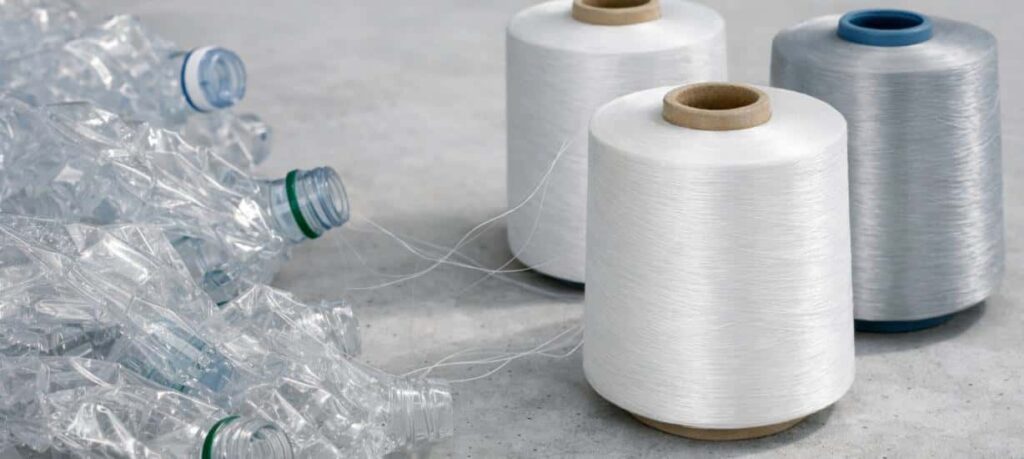
The raw material comes from a source that doesn’t deplete natural resources, pollute ecosystems, or rely on harmful chemicals. Organic cotton, hemp, and pineapple leaf fiber all qualify here. So does recycled polyester, which starts its life as a plastic bottle that would otherwise sit in a landfill for 400 years.
It’s Made Responsibly
The manufacturing process uses less water, less energy, and fewer chemicals than conventional alternatives. This is where certifications like OEKO-TEX® and Bluesign® come in — they verify what happens inside the factory, not just what the fiber is made of.
It Ends Gracefully
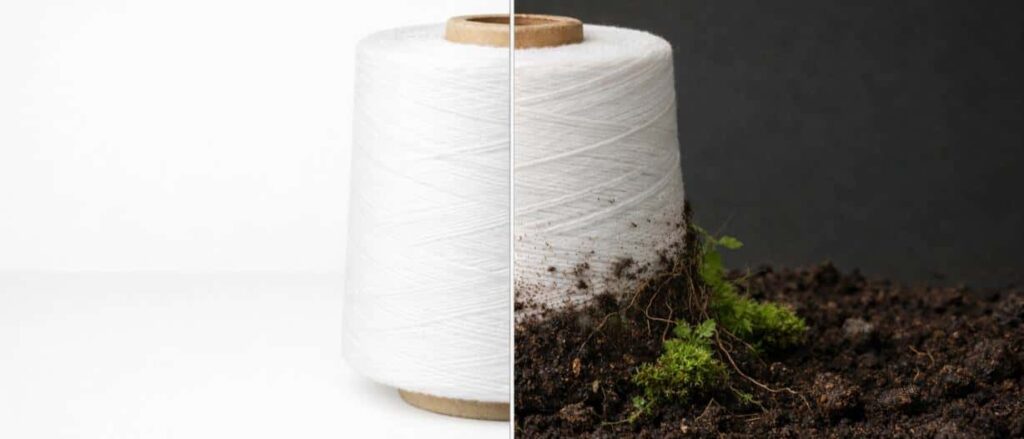
This is the dimension most brands ignore, and it’s increasingly the one regulators care about most. A yarn that performs beautifully for two years and then persists in a landfill for 200 years has a sustainability problem. Biodegradable yarns — engineered to decompose through microbial action without leaving microplastic residue — address this directly.
The Sustainable Yarns You’ll Actually Encounter
Recycled Polyester (rPET)
This is the most common sustainable yarn in commercial use right now, and for good reason. Made from post-consumer plastic bottles or post-industrial textile waste, it performs identically to virgin polyester in most applications, and the supply chain infrastructure to produce it at scale already exists. Producing one ton of recycled polyester generates roughly 63% less CO₂ than virgin polyester and uses about 64% less energy. For a brand running high volumes, that’s not a marginal improvement — that’s a meaningful shift in your product’s carbon footprint. The honest caveat: rPET still sheds microplastics during washing. It’s a significant step forward, not a complete answer.
Recycled Nylon
Similar logic to rPET, but the raw material is often more interesting. Some of the best recycled nylon on the market comes from recovered fishing nets pulled from the ocean. The performance is excellent — particularly for swimwear, activewear, and technical applications where nylon’s natural stretch and recovery properties matter.
Organic Cotton
Grown without synthetic pesticides or fertilizers, organic cotton is genuinely better for soil health, farming communities, and the people who eventually wear it against their skin. The water comparison is striking: conventional cotton uses around 10,000 liters of water per kilogram of fiber. Certified organic cotton can bring that down to under 1,000 liters with the right farming practices. What organic cotton is not: a performance fiber. It’s soft, breathable, and biodegradable — but it won’t give you moisture management or UV protection. Know what you’re buying it for.
Hemp Yarn
Hemp might be the most underrated fiber in this entire category. It grows fast, requires no pesticides, needs a fraction of the water that cotton does, and actually improves soil health through phytoremediation. The fiber itself is naturally antibacterial, durable, and gets softer with every wash. The reason it’s not everywhere yet is largely historical — hemp cultivation was restricted in many countries for decades. That’s changing, and the textile industry is catching up.
Biodegradable Polyester
This one surprises people. Most assume “biodegradable” and “synthetic” are mutually exclusive. They’re not. Biodegradable polyester — like Earth Guard® — is engineered by integrating a biodegradable masterbatch into standard polyester at the molecular level. The result is a yarn that performs exactly like conventional polyester during its useful life, but when it ends up in a landfill, microbial activity breaks it down completely within approximately one year instead of the 200+ years conventional polyester requires. No new equipment. No process changes. Just a direct swap with a fundamentally better end-of-life story.
Pineapple Leaf Fiber
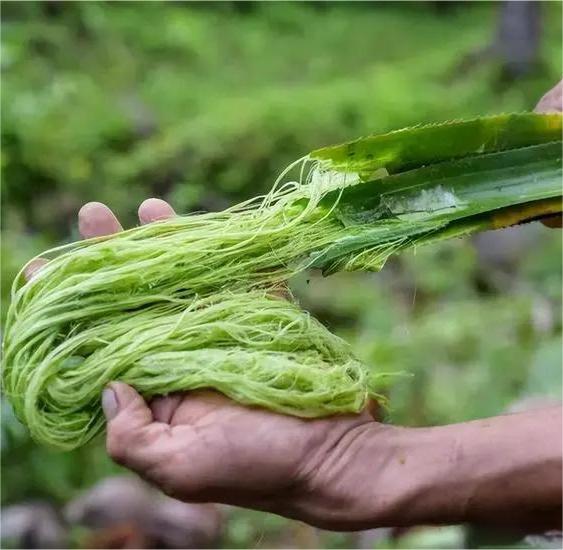
Every year, pineapple farming generates millions of tons of leaf waste that gets burned in the field. We turns that waste into textile fiber — 100% natural, 100% biodegradable, and inherently antibacterial without any chemical treatment. It’s not a mainstream material yet, but it represents exactly the direction sustainable textile innovation is heading: finding high-performance fiber in agricultural waste streams that currently have no value. You’re not growing anything new. You’re using what already exists.
Recycled HDPE Cooling Yarn
This one sits at the intersection of sustainability and performance in a way that’s genuinely exciting. PECooX® is made from 100% recycled high-density polyethylene — post-consumer plastic waste — and delivers measurable cool-touch performance that outperforms standard polyester on thermal conductivity. For activewear and sportswear brands, this breaks the assumption that sustainable yarns require a performance trade-off. You get verified recycled content for your GRS certification and a functional story for your consumer marketing at the same time.
Sustainable Yarn Comparison: At a Glance
| Fiber | Source | Biodegradable | Recycled Content | Standout Property | Best For |
|---|---|---|---|---|---|
| Recycled Polyester (rPET) | Plastic bottles / textile waste | No | Up to 100% | Durable, versatile | Activewear, outerwear |
| Recycled Nylon | Fishing nets / industrial waste | No | Up to 100% | Stretch, recovery | Swimwear, lingerie |
| Biodegradable Polyester | Virgin or recycled base | Yes (~1 year) | Optional | Full polyester performance + end-of-life | Fashion, home textiles |
| Organic Cotton | Certified organic farming | Yes | No | Soft, skin-safe | Apparel, baby products |
| Hemp | Hemp plant | Yes | No | Low water footprint, antibacterial | Workwear, home textiles |
| Pineapple Fiber | Pineapple leaf waste | Yes | No | Natural antibacterial, lightweight | Performance apparel |
| Recycled HDPE | Post-consumer plastic | No | 100% | Cool-touch performance | Sportswear |
| Bamboo | Bamboo plant | Yes | No | Soft, antibacterial | Underwear, bedding |
Recycled vs. Biodegradable: The Confusion That Costs Brands
This is probably the single most common misunderstanding in sustainable textile sourcing. Brands use these terms interchangeably all the time — and getting it wrong creates real problems for both your environmental claims and your compliance documentation.
Recycled yarn solves the input problem. It reduces how much new raw material gets extracted from the earth by using existing waste as feedstock. When you source GRS-certified recycled polyester, you’re directly reducing petroleum extraction and diverting plastic from landfill.
Biodegradable yarn solves the output problem. It doesn’t necessarily change where the raw material comes from, but it fundamentally changes what happens at the end of the product’s life. Instead of persisting in landfill for centuries, it breaks down through natural microbial processes without leaving toxic residue.
Neither is inherently better. They address different parts of the lifecycle. The most sophisticated sustainable yarn programs use both — recycled content to address the input side, biodegradable engineering to address the output side.
| Recycled Yarn | Biodegradable Yarn | |
|---|---|---|
| What it solves | Reduces virgin material demand | Reduces end-of-life waste |
| Raw material | Post-consumer or post-industrial waste | Virgin or recycled base + biodegradable additive |
| End of life | Can potentially be recycled again | Decomposes naturally in landfill |
| Microplastic risk | Present during washing | Eliminated at end of life |
| Key certification | GRS | ASTM D5511 / ISO 14855 test reports |
| Best used for | Circular economy claims | Waste reduction and decomposition claims |
Which Yarn Certifications Can You Actually Trust?
If you’ve ever received a spec sheet that just says “OEKO-TEX certified” with no further detail, you’ve already encountered the problem. Sustainable yarn certifications — GRS, GOTS, OEKO-TEX®, Bluesign® — each cover completely different things, and knowing the difference is the only way to verify whether a sustainability claim is real or just marketing.
GRS — Global Recycled Standard
This is the one you need if recycled content is part of your sustainability story. GRS verifies the actual percentage of recycled material in a product and audits the supply chain for social and environmental responsibility. Every certificate has a number you can verify independently on the Textile Exchange database. If a supplier can’t give you that number, the certification isn’t real.
GOTS — Global Organic Textile Standard
The gold standard for organic fiber. GOTS covers not just the fiber itself but the entire processing chain — dyeing, finishing, manufacturing. A product can only carry the GOTS label if at least 70% of its fiber content is certified organic and every step of production meets the standard.
OEKO-TEX® Standard 100
This one is about chemical safety, not environmental impact. It tells you the finished yarn has been tested and found free from harmful substances. Important — especially for skin-contact applications — but it doesn’t tell you anything about where the fiber came from or how it was grown.
OEKO-TEX® MADE IN GREEN
A step up from Standard 100. This label covers both chemical safety and factory conditions, and includes a traceable product ID that lets anyone — including your end consumer — trace the product back through the supply chain. Increasingly relevant as transparency expectations rise.
Bluesign®
Focused specifically on resource efficiency in manufacturing: water, energy, and chemical use inside the factory. Particularly relevant for performance and outdoor textile supply chains where the manufacturing process itself carries significant environmental impact.
| Certification | What It Actually Covers | Publicly Verifiable |
|---|---|---|
| GRS | Recycled content % + supply chain | Yes — Textile Exchange database |
| GOTS | Organic fiber + full processing chain | Yes — GOTS global database |
| OEKO-TEX® Standard 100 | Chemical safety in finished product | Yes — OEKO-TEX® website |
| OEKO-TEX® MADE IN GREEN | Chemical safety + factory conditions + traceability | Yes — unique product ID |
| Bluesign® | Resource efficiency in manufacturing | Yes — Bluesign database |
Does Sustainable Mean Less Effective? Let’s Put That to Rest.
The assumption that sustainable yarns underperform conventional ones is outdated. It was true ten years ago. It isn’t true now, and continuing to treat it as true is costing brands real opportunities.
Earth Guard® Biodegradable Polyester matches conventional polyester in tensile strength, elongation, dyeability, and processing compatibility. The only difference is what happens after the garment’s useful life ends. PECooX® Recycled HDPE actually outperforms standard polyester on cool-touch performance — its thermal conductivity is measurably higher, which translates to a real, perceivable difference for the person wearing it. BioSay® Balance-Tech Antibacterial Nylon builds antibacterial efficacy into the fiber structure itself — not as a surface coating that washes off after twenty cycles — maintaining performance through 50+ washes with no heavy metals and full OEKO-TEX® certification.
The performance gap has closed. What remains is a sourcing and specification challenge, not a technical one.
| Yarn | Recycled | Biodegradable | Antibacterial | Cool-Touch | Wash Durability | Certification |
|---|---|---|---|---|---|---|
| Earth Guard® Biodegradable Polyester | Optional | Yes (~1 year) | No | No | Standard | OEKO-TEX® |
| PECooX® Recycled HDPE | Yes (100%) | No | No | Yes | Standard | GRS |
| BioSay® Antibacterial Nylon | Optional | No | Yes | No | 50+ washes | OEKO-TEX® |
| PALF | No | Yes | Yes (natural) | No | Natural | — |
| Organic Cotton | No | Yes | No | No | Standard | GOTS |
Where Sustainable Yarns Are Actually Being Used
Sustainable yarns have moved well beyond the slow fashion and craft markets where they started. In activewear and sportswear, recycled HDPE and recycled nylon are now standard specification for major global brands — the combination of GRS-verified recycled content and genuine functional performance makes these materials work commercially, not just ethically. In home textiles, biodegradable polyester is gaining traction as brands respond to consumer demand for end-of-life responsibility in product categories that historically had none. In medical-adjacent applications, antibacterial nylon and chemical-free natural fibers are increasingly specified where both performance documentation and safety certification are non-negotiable. And in circular fashion collections — where brands are building product lines with documented end-of-life pathways ahead of EU Ecodesign compliance deadlines — fully biodegradable or recyclable yarn systems are no longer optional. They’re the foundation.

Frequently Asked Questions
Is “eco-friendly yarn” the same as “sustainable yarn”?
Not exactly. “Eco-friendly” is an informal, unregulated term — any brand can use it without meeting any specific standard. “Sustainable yarn” is broader and more meaningful when backed by certification, but it’s also used loosely. The only way to know whether either claim is real is to ask for the certification documentation behind it.
Is recycled polyester actually better for the environment?
Yes, meaningfully so — on the input side. It reduces CO₂ emissions by roughly 63% compared to virgin polyester and uses about 64% less energy in production. The honest limitation is microplastic shedding during washing, which recycled content alone doesn’t solve. For brands where end-of-life impact matters, pairing recycled content with biodegradable engineering is the more complete answer.
How do I know if a biodegradability claim is real?
Ask for the test report. Legitimate biodegradability claims are backed by standardized testing — ASTM D5511 for anaerobic landfill conditions or ISO 14855 for aerobic composting conditions. A supplier who can only offer marketing language without a test report is not making a verifiable claim.
Can I use sustainable yarns on my existing equipment without modification?
In almost every case, yes. Advanced sustainable yarns including biodegradable polyester and recycled HDPE are engineered as direct replacements for conventional yarns and run on standard industrial knitting and weaving equipment without modification.
What certifications should I prioritize for EU market compliance?
Start with GRS for recycled content verification, OEKO-TEX® Standard 100 for chemical safety, and documented end-of-life pathways — either recyclability or biodegradation with supporting test data. The EU Ecodesign for Sustainable Products Regulation will require all of this as table stakes before 2030. Brands building this documentation now will have a significant advantage over those who wait.

Related Posts
Sustainable Textile Innovation: The 100% Natural Antimicrobial Pineapple Fiber
This article discusses pineapple leaf fibers as sustainable textile alternatives, natural antimicrobial fabrics, and innovative eco-friendly materials in the fashion...

Innovative Textile Solutions for Pet Summer Comfort: Advanced Functional Yarns for Pet Apparel
The pet industry continues to experience remarkable growth, with pet owners increasingly seeking specialized products that enhance their companions’ comfort...

Abrasion-Resistant Innovation: How UHMWPE Yarns Enhance Motorcycle Clothing Durability
Every year, thousands of motorcycle riders face a common yet serious risk – road rash injuries. Studies show that approximately...

Ultimate Guide to Cycling Textiles: How Functional Yarns Enhance Your Ride
Have you ever been on a long summer ride, feeling your jersey sticking to your back, completely soaked with sweat?...