 English
 Español
 Português
 Deutsch
 한국어
한국어 日本語
日本語 Italiano
 Français
 العربية
 Türkçe
There’s a moment every outdoor gear brand dreads: a customer emails in, three months after purchase, saying their “waterproof” jacket is soaking through in the rain. You check the spec sheet. The DWR rating was fine at production. The coating passed the spray test. So what went wrong?
Nothing went wrong — that’s exactly how DWR coatings are supposed to work. They protect the fabric when it’s new, and they degrade with use. That’s not a defect. That’s the design.

The real question is whether there’s a better design. For brands and manufacturers who’ve been asking that question, fiber-level hydrophobic modification — what we call Water-Repellent Yarn — is where the industry is moving. Here’s what it actually means, how it works, and why the performance difference is more significant than most product comparisons let on.
The Real Problem with DWR Coatings (It’s Not What You Think)
Most people assume DWR coatings fail because of poor quality. The reality is more structural than that.
DWR — Durable Water Repellency — works by applying a layer of fluoropolymer or silicone chemistry to the outer surface of a finished fabric. The treatment causes water to bead up and roll off rather than soak in. When it’s fresh off the production line, it works well. The problem is that this layer sits on top of the fiber, not inside it. Every wash cycle, every abrasion from a backpack strap or a car seat, every hour of UV exposure chips away at that surface layer. Most DWR treatments show measurable performance loss after 20 to 30 wash cycles. Many consumer-facing products lose effective water repellency well before that.
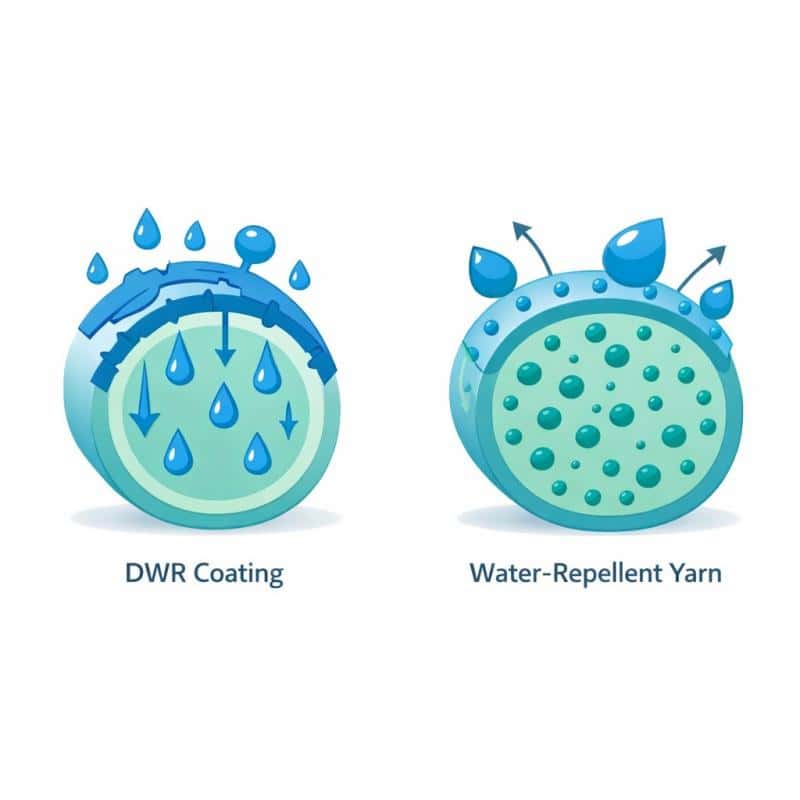
The industry’s response has been to improve the coating — better chemistry, better adhesion, heat-activated reapplication. But these are all workarounds for the same underlying issue: a surface treatment will always be vulnerable to surface wear.
There’s also a chemistry problem that’s harder to engineer around. The most effective DWR formulations have historically relied on PFAS — per- and polyfluoroalkyl substances — which are now under active regulatory restriction across the EU, US, and major Asian markets due to environmental persistence and potential health risks. PFAS-free DWR alternatives exist, but they generally underperform their fluorinated predecessors in both initial repellency and wash durability. Brands are being asked to choose between performance and compliance. That’s not a sustainable position.
What Water-Repellent Yarn Actually Is
Water-Repellent Yarn is a hydrophobic polyester fiber in which water-repellent properties are built into the molecular structure of the fiber itself — not applied to the surface afterward.
The distinction sounds simple, but the implications are significant. With a DWR coating, the waterproofing exists as a separate layer that can be worn away. With Water-Repellent Yarn, the hydrophobic modification is part of the polymer chain. Every cross-section of every filament carries the same repellent property, from the outermost surface to the core. There is no layer to degrade, no treatment to reapply, and no performance curve tied to wash count.
Water-Repellent Yarn(👉click to read) also incorporates solution dyeing — color pigments are introduced into the polymer melt during fiber formation, not applied to finished fabric in an aqueous bath. This means the color is locked inside the fiber structure, not sitting on the surface. The result is a fiber that is simultaneously hydrophobic and colorfast, produced in a single integrated manufacturing process rather than two separate steps.
How the Hydrophobic Modification Works
The manufacturing process begins at polymerization — the stage where raw polymer chips are melted and extruded into filament. Hydrophobic modifying agents are introduced directly into the polymer melt at this stage, bonding with the polymer chain at the molecular level rather than being applied as an external coating.
The effect this creates at the fiber surface is similar in principle to what happens on a lotus leaf. The lotus leaf’s microscopic surface structure causes water droplets to form near-perfect spheres — a contact angle above 120° — and roll off the surface, carrying dust and particles with them. Water-Repellent Yarn achieves the same behavior through molecular chemistry rather than surface texture. Water beads on contact and slides away without penetrating the fiber.
Because the modification happens during extrusion, it is uniform across every filament produced, permanently bonded to the polymer structure, and present whether the yarn is woven, knitted, or processed through standard textile finishing. No secondary waterproofing step is required at the fabric stage.
Solution dyeing happens in the same extrusion step: pigment dispersions are added to the polymer melt alongside the hydrophobic agents. Color penetrates the full cross-section of each filament, which is why solution-dyed fibers hold their color through conditions that would strip a surface-dyed fabric — extended UV exposure, repeated washing, industrial laundering.
Performance Comparison: Water-Repellent Yarn vs. DWR Coating
Rather than describe the difference in abstract terms, here’s how the two approaches compare across the metrics that matter in real product development:
| Performance Metric | DWR-Coated Fabric | Water-Repellent Yarn |
|---|---|---|
| Water repellency (new) | AATCC 22: 90–100 | AATCC 22: ≥90 |
| Water repellency after 30 washes | AATCC 22: 50–70 | AATCC 22: ≥90 |
| Water repellency after 50 washes | AATCC 22: 30–50 | AATCC 22: ≥90 |
| Color fastness (ISO 105-C06) | Grade 3–4 | Grade 4–5 |
| PFAS content | Varies (often present) | None |
| Re-treatment required | Yes (every 20–30 washes) | No |
| Performance after abrasion | Degrades significantly | Unaffected |
| Production water consumption | High (dyeing bath required) | Reduced by ~50% |
The wash durability gap is where the practical difference is most visible. A DWR-coated jacket that performs well at purchase may be functionally non-waterproof within a single season of regular use. A garment made with Water-Repellent Yarn maintains the same repellency rating at wash 50 as it had at wash 1 — because the property isn’t in a coating, it’s in the fiber.
Where Water-Repellent Yarn Makes the Most Sense
Not every application needs permanent hydrophobicity. But for categories where moisture protection is a core performance claim — not just a marketing add-on — the fiber-level approach changes what’s possible.
Outdoor and performance gear is the clearest fit. Tents, technical outerwear, hiking packs, and trail footwear uppers all require moisture protection that holds up through a product’s full lifespan, not just its first season. Brands in this category have been under the most pressure from PFAS regulations, and Water-Repellent Yarn offers a path to maintaining performance claims without fluorinated chemistry.

Workwear and protective apparel often requires both moisture resistance and industrial launderability — two requirements that DWR coatings handle poorly in combination. Garments made with hydrophobic polyester fiber can withstand repeated industrial wash cycles without losing their protective properties, which matters significantly in healthcare, food service, and outdoor work environments.
Luggage, bags, and accessories benefit from the combination of water repellency and color stability. Solution-dyed Water-Repellent Yarn holds color through UV exposure and abrasion in ways that surface-treated alternatives don’t, which is relevant for products that spend extended time outdoors or in variable conditions.
Performance sportswear is an emerging application. Lightweight hydrophobic fibers can be engineered to repel light rain and sweat accumulation on the outer surface while maintaining breathability — a combination that traditional waterproof membranes struggle to achieve without adding weight and reducing airflow.
The Environmental Case (Which Is Also a Business Case)
Sustainability in textiles is often framed as a trade-off: you can have performance, or you can have environmental responsibility, but not both at full strength. Water-Repellent Yarn is one of the cases where that framing doesn’t hold.
The PFAS-free formulation removes the regulatory exposure that’s becoming a real commercial risk for brands selling into EU and US markets. PFAS restrictions are tightening, and brands that have already transitioned their supply chains away from fluorinated chemistry are in a significantly better position than those still managing the switch.
The solution dyeing process eliminates the aqueous dyeing bath that conventional fiber production requires. Traditional polyester dyeing uses large volumes of heated water and generates dye-laden wastewater that requires treatment before discharge. By integrating color into the fiber at the extrusion stage, solution dyeing reduces water consumption by approximately 50% and eliminates the effluent burden almost entirely. For brands with supply chain sustainability targets, that’s a meaningful reduction in Scope 3 emissions.
Water-Repellent Yarn is compatible with OEKO-TEX Standard 100 and REACH compliance frameworks — a baseline requirement for most European retail channels and an increasingly common expectation in North American and Japanese markets.
FAQ
What is the difference between water-repellent fabric and waterproof fabric?
Water-repellent fabric causes water to bead and roll off the surface rather than soaking in — it handles rain and light moisture effectively but is not designed to withstand sustained hydrostatic pressure. Waterproof fabric, typically constructed with a laminated membrane, prevents water penetration entirely and is rated by hydrostatic head pressure (measured in millimeters). Water-Repellent Yarn is used to build water-repellent fabrics and can be combined with waterproof membranes for applications requiring both surface repellency and full waterproofing.
Can water-repellent yarn be blended with other fibers?
Yes. Hydrophobic polyester fiber can be blended with nylon, recycled polyester, and other synthetics to achieve specific performance or aesthetic targets. Blending ratios are adjustable based on the end-use requirements for weight, hand feel, stretch, and moisture management. Custom specifications are available for brands with particular technical requirements.
Does fabric made from water-repellent yarn require any waterproofing finish?
No additional waterproofing treatment is required at the fabric stage. Because the hydrophobic modification is built into the fiber structure, the repellency is present regardless of how the yarn is processed — woven, knitted, or finished through standard heat-setting and calendering. This eliminates the DWR finishing step from the production process entirely.
How do I verify water repellency performance in a fabric sample?
The standard test is AATCC 22 (Spray Test), which rates water repellency on a scale from 0 to 100. A rating of 90 or above indicates strong repellency; 100 is the maximum. For wash durability specifically, the test should be repeated after a defined number of wash cycles — 10, 30, and 50 are common benchmarks. A quick field check: place a water droplet on the fabric surface. If it beads into a near-spherical shape and rolls off without spreading, the repellency is active. If it spreads and absorbs, the surface treatment (if any) has degraded.
Is water-repellent yarn safe for children’s clothing?
Water-Repellent Yarn is produced without PFAS or other restricted substances, making it compatible with the safety requirements for children’s textiles under OEKO-TEX Standard 100 and REACH regulations. The stain-resistant properties are also practically useful for children’s outerwear — coffee, juice, and mud bead off the surface rather than soaking in, which reduces both cleaning effort and the need for chemical stain treatments.
A Note on Where This Technology Is Heading
DWR coatings aren’t going away immediately. The infrastructure for applying them is established, the cost is relatively low, and for applications where wash durability isn’t a primary concern, they remain a functional solution. But the regulatory pressure on PFAS, combined with growing consumer awareness of performance degradation, is accelerating the shift toward fiber-level alternatives.
The brands that are moving fastest on this transition are the ones that have already experienced the customer service and warranty cost of DWR failure at scale. Once you’ve dealt with a season of “my waterproof jacket isn’t waterproof anymore” returns, the argument for permanent fiber-level protection becomes straightforward.
Water-Repellent Yarn isn’t a premium niche product — it’s where functional textile performance is going. The question for manufacturers and brands is whether they get ahead of that shift or catch up to it later.

Related Posts

8C Microporous pro Performance Yarn: 4-in-1 Solution for Moisture-Wicking, Cooling, Antibacterial & UV Protection in Athletic Apparel
You know that moment during a high-intensity workout when your shirt feels damp, your skin feels clammy, and you catch...
Anti-Infrared Fabric: The Game-Changing Privacy Protection You Never Knew You Needed
Picture this: You’re getting changed in your hotel room after a long day, completely unaware that someone with a $200...
Thermal Insulation vs Warmth Retention: Why Aerogel Fiber Outperforms Traditional Insulation
Most people think “thermal insulation” and “warmth retention” mean the same thing. Walk into any outdoor gear store, and you’ll...
Photochromic Yarn Solution for Kids UV Protection Apparel
Visual UV Indicator Technology for Children’s Sun Safety Client Challenge “Parents can’t tell when their kids need sun protection.” A...