 English
 Español
 Português
 Deutsch
 한국어
한국어 日本語
日本語 Italiano
 Français
 العربية
 Türkçe
There is a quiet shift happening in performance apparel development. Brands are no longer asking “how warm is it?” — they are asking “how warm is it relative to its weight, thickness, and feel?” That question changes everything about which materials belong in a modern thermal yarn system.

RecovX™ was engineered to answer that question directly. It brings together three distinct material technologies — aerogel insulation, far-infrared emitting polyester, and natural wool — into a single configurable yarn platform designed for apparel brands that need lightweight warmth without sacrificing comfort, hand feel, or product versatility.
This article explains how each component works, why the combination matters, and where RecovX™ creates genuine product differentiation across base layers, knitwear, T-shirts, homewear, and refined apparel.
What Is Aerogel Thermal Yarn — And Why It Performs Differently
Aerogel is not a new material. It was first developed by American scientist S. Kistler in 1931 and has been used by NASA as a thermal insulation material since 1993 — most notably in Mars rover missions, where extreme cold and minimal weight are non-negotiable constraints.
What makes aerogel exceptional is its structure. More than 90% of aerogel is composed of nano-scale air pockets — 10 to 30 nanometers in diameter — trapped within a silica framework. This nano-porous architecture is what gives aerogel its insulation performance: a thermal conductivity as low as 0.017 W/m·K, which is lower than static air (0.026 W/m·K) and significantly lower than any conventional textile insulation material.
To bring aerogel into yarn, silica aerogel is ground into superfine powder and compounded with polyester fiber. The resulting aerogel polyester retains the core thermal properties of the raw material — low thermal conductivity, low density, and high insulation efficiency — while being processable on standard textile machinery.
In practical terms, one inch of aerogel insulation delivers the thermal equivalent of 20 to 30 layers of ordinary glass. In a yarn context, that means a fabric can achieve meaningful warmth at half the thickness of conventional insulating constructions. The density of aerogel is as low as 0.003 g/cm³, which directly translates to lightweight fabric construction without the bulk that traditional warm-weather yarns require.
This is why aerogel thermal yarn performs differently: it does not rely on trapped air within a fiber loft structure — it relies on engineered nano-porosity that is inherent to the material itself.
How Far Infrared Polyester Works Inside a Yarn System
Far-infrared (FIR) polyester introduces a second, fundamentally different mechanism of warmth into the RecovX™ system — one that is active rather than passive.
Standard insulation materials work by slowing heat loss. They create a barrier between the body and the environment, reducing the rate at which warmth escapes. FIR polyester works differently: it absorbs the body’s own radiant heat and re-emits it as far-infrared energy in the 8–14 μm wavelength range — a spectrum that interacts directly with human tissue and is associated with a gentle, sustained warming sensation.
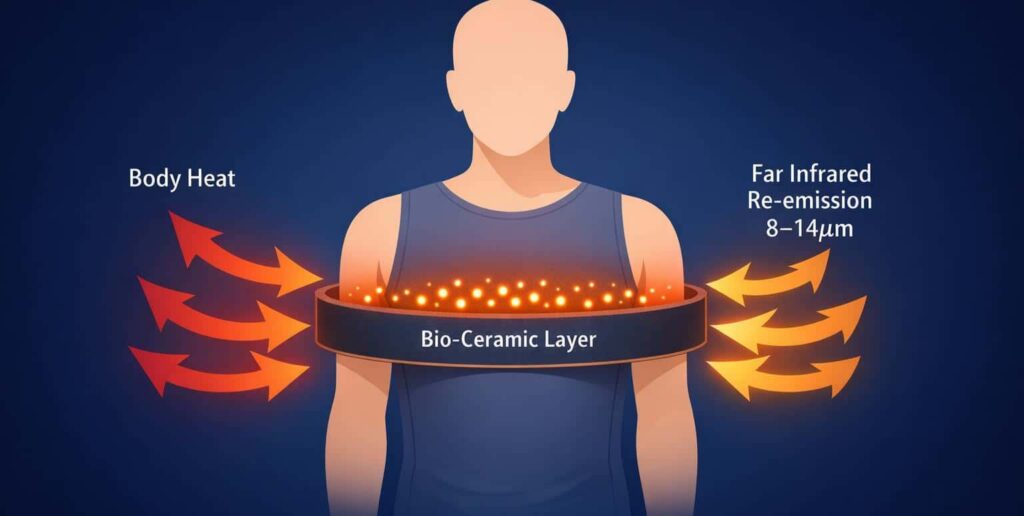
The bio-ceramic powder embedded within the polyester fiber is the functional agent. These ceramic particles have a high far-infrared emissivity, meaning they efficiently convert absorbed thermal energy back into FIR radiation directed toward the wearer’s body. The result is a microclimate effect — the space between fabric and skin maintains a warmer, more stable temperature than the ambient environment alone would allow.
This active warming mechanism is particularly valuable in close-to-skin applications. In a base layer or a T-shirt, where the fabric is in direct contact with the body, FIR polyester responds continuously to body heat — making it more responsive than passive insulation in low-activity or transitional-temperature scenarios.
FIR technology has a well-established presence in wellness and comfort-oriented textiles, and its inclusion in RecovX™ adds a credible, scientifically grounded positioning story for brands operating in the premium performance or recovery-inspired apparel space.
Why Wool Completes the Thermal Balance — Not Just Softness
Wool’s role in RecovX™ is often reduced to hand feel. That undersells it significantly.
Natural wool fiber has a unique combination of properties that neither aerogel polyester nor FIR polyester can replicate. Wool actively manages moisture — it can absorb up to 30% of its own weight in moisture vapor without feeling wet, and it releases that moisture gradually as conditions change. This moisture-buffering behavior is critical during physical activity, where the body’s heat and perspiration output fluctuates rapidly.
Equally important: wool maintains its insulation performance even when damp. Most synthetic insulation materials lose significant thermal efficiency when wet. Wool’s crimped fiber structure continues to trap air and retain warmth in humid or perspiration-heavy conditions — making it the most reliable insulating component in the system during active use.
Wool also brings natural odor resistance through its inherent antimicrobial properties, reducing the buildup of odor-causing bacteria during extended wear. For base layers, loungewear, and any garment worn close to skin for extended periods, this is a meaningful functional benefit.
And yes — wool delivers the next-to-skin softness that makes RecovX™ fabrics feel premium rather than technical. For brands building a comfort-first positioning, wool is the material that makes the hand feel immediately recognizable as quality.
The three-component logic of RecovX™ is not additive — it is complementary. Aerogel blocks heat loss. FIR polyester generates active warmth. Wool manages the moisture and comfort environment that allows both to perform consistently across activity levels and wearing conditions.
Aerogel vs Hollow Fiber vs Down: A Thermal Performance Comparison
Understanding where aerogel thermal yarn sits relative to conventional insulation options helps clarify why it is gaining traction in performance apparel development.
| Property | Aerogel Yarn | Hollow Fiber | Down Fill |
|---|---|---|---|
| Thermal Conductivity | ≤ 0.020 W/m·K | ~0.040 W/m·K | ~0.030 W/m·K |
| Weight | Extremely low (density ≥ 0.003 g/cm³) | Low | Very low |
| Insulation Thickness | ~½ of conventional materials | Standard | Depends on fill power |
| Wet Performance | Good (especially with wool blend) | Poor | Very poor |
| Processability in Yarn | Yes — standard textile machinery | Yes | No — fill material only |
| Knittable / Weavable | Yes | Yes | No |
| Washability | Yes | Yes | Limited |
| Positioning Story | Aerospace-derived, premium tech | Functional, commodity | Natural, luxury |
The critical differentiator for apparel brands is processability. Down and aerogel insulation panels are fill materials — they require specific construction methods and cannot be knitted or woven directly into a fabric. Aerogel yarn can be processed on standard knitting and weaving equipment, which means it integrates into existing production workflows without requiring new machinery or construction methods.
Hollow fiber yarn is the most common alternative in the performance knitwear space, but its thermal conductivity (~0.040 W/m·K) is roughly double that of aerogel yarn. Achieving equivalent warmth requires more fiber volume — which means more weight, more bulk, or both.
For brands building lightweight thermal apparel where construction thickness is a design constraint, aerogel yarn delivers insulation performance that hollow fiber simply cannot match at equivalent weight.
Six Apparel Categories Where Lightweight Thermal Yarn Changes the Product Story
RecovX™ is most effective when the development conversation starts with a wearing scenario rather than a yarn specification. Here is how the technology translates across six distinct apparel categories.
Base Layers and Thermal Underwear
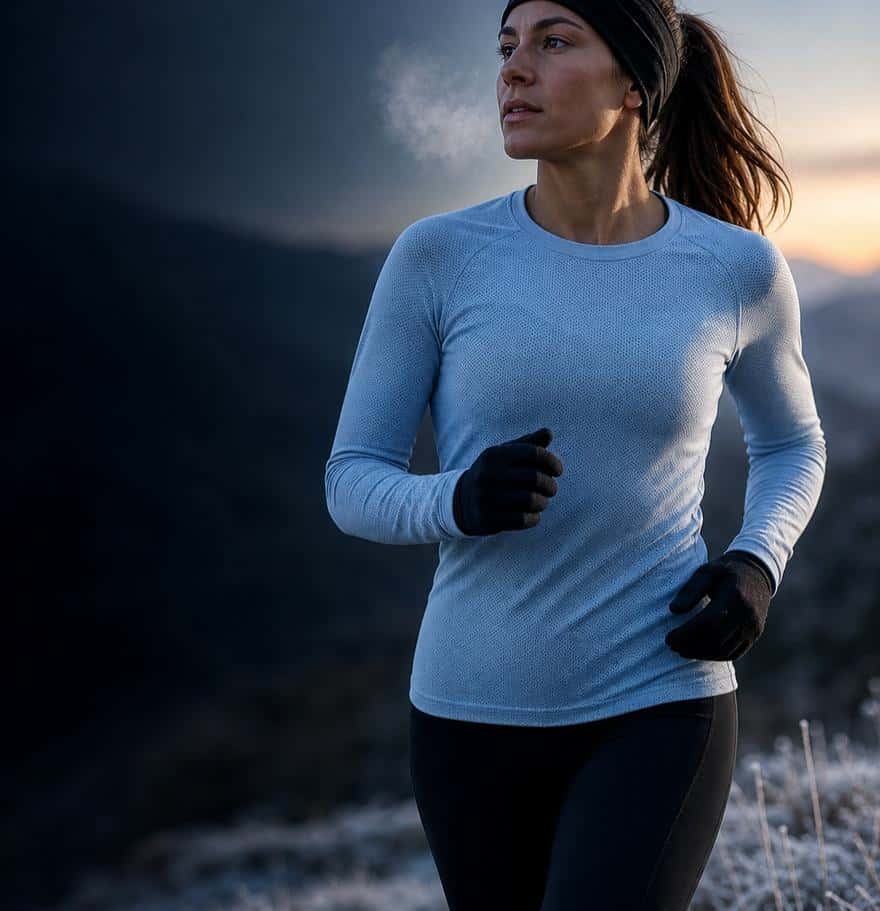
The base layer category has the most direct alignment with RecovX™’s core properties. Thin construction, dry comfort during movement, and consistent warmth against skin are the three performance requirements that define a premium base layer — and they map precisely to aerogel’s low thermal conductivity, wool’s moisture management, and FIR polyester’s active warming response. For brands developing next-to-skin thermal layers for outdoor, athletic, or everyday wear, RecovX™ supports a genuine performance story without requiring a heavy or stiff fabric construction.
T-Shirts and Light Daily Layers

The challenge with thermal T-shirts is maintaining a clean, familiar garment aesthetic while adding functional warmth. RecovX™ addresses this directly — the aerogel component provides subtle insulation without changing the fabric’s visual weight or drape, while FIR polyester adds a warming effect that is felt rather than seen. A RecovX™ T-shirt looks like a regular T-shirt. It performs differently on a cold morning or in an air-conditioned environment.
Knitwear and Dailywear
Sweaters, casual knits, and transitional layers built with RecovX™ yarn benefit from warmth that responds to changing environments — outdoor air to indoor spaces, morning commute to office temperature. The aerogel component reduces the construction thickness needed to achieve a given warmth level, which means RecovX™ knitwear can be lighter and less bulky than traditional warm knits while delivering equivalent or superior thermal comfort. This is a meaningful product differentiation in a category where “warm but not heavy” is a consistent consumer demand.

Homewear and Loungewear

The premium homewear market is growing, and the product story in this category is built around softness, light warmth, and all-day wearability. RecovX™’s wool component delivers the natural hand feel that defines quality loungewear, while aerogel keeps the construction light enough for extended home wear without overheating. FIR’s gentle warming effect is particularly well-suited to low-activity wearing scenarios — sitting, reading, early mornings — where passive insulation alone may not maintain comfort.
Outdoor and Cold-Weather Performance Gear
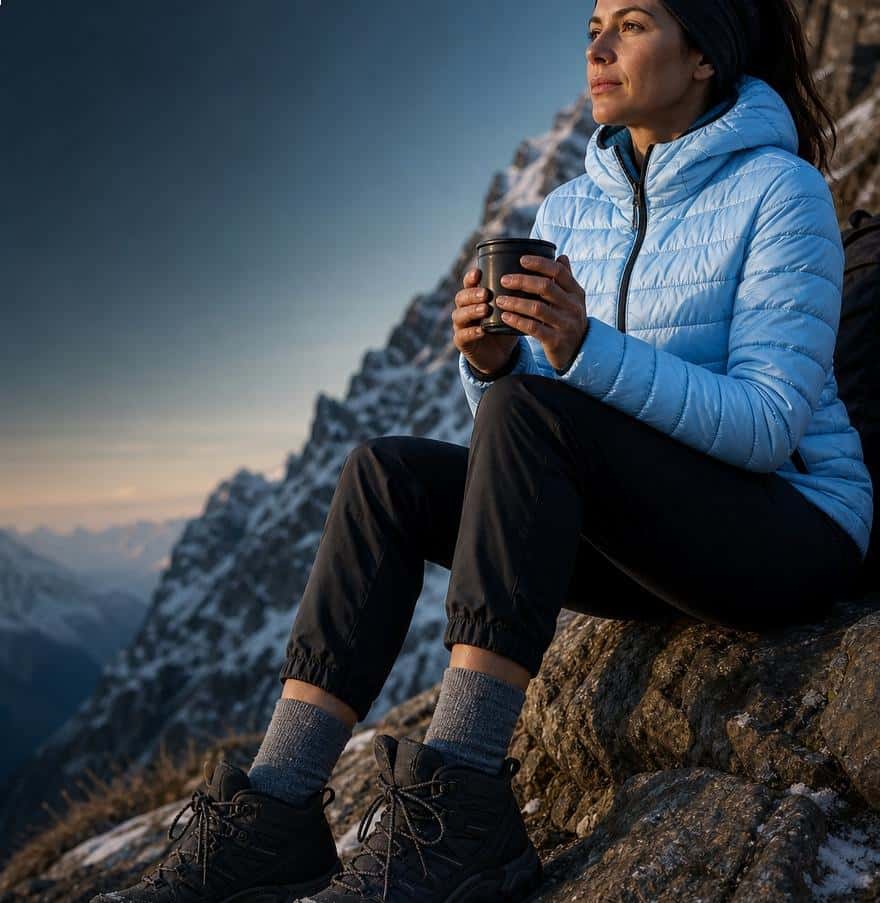
For hiking, skiing, trail running, and cold-weather outdoor activities, RecovX™ supports a premium thermal story built on aerospace-derived insulation technology. The aerogel component performs in sub-zero environments where conventional hollow fiber loses efficiency, while wool’s wet-weather insulation ensures the system continues to function during high-intensity activity when perspiration is a factor. The lightweight construction is particularly valuable in layering systems where every gram and every millimeter of thickness has a functional consequence.
Refined Shirts and Smart Casual Apparel

This is perhaps the most underexplored opportunity in the RecovX™ application portfolio. Subtle thermal comfort in a garment that looks completely non-technical — a dress shirt, a smart casual layer, a travel shirt — is a genuine product differentiation that most performance yarn systems cannot support without compromising the fabric’s appearance or drape. RecovX™’s lightweight construction and the non-visual nature of its thermal function make it a viable yarn platform for refined apparel brands looking to add hidden functional value to premium everyday garments.
What “Configurable Thermal Yarn” Means for Apparel Brands
One of RecovX™’s most commercially significant features is its configurability. RecovX™ is not a fixed formula — it is a performance platform with adjustable parameters.
Fiber ratio, yarn count, and wool grade can all be modified based on the target application, performance requirement, and price point. A lightweight T-shirt and a heavy outdoor knitwear piece have fundamentally different construction requirements. RecovX™ can be engineered for both while maintaining a consistent technology identity and brand story across a product portfolio.
This matters for brands building multi-category collections. Rather than sourcing different specialty yarns for each product line, a brand can anchor its thermal comfort positioning to a single yarn platform — RecovX™ — and adjust the specification for each category. The technology story remains consistent. The aerogel insulation, FIR warming, and wool comfort narrative applies equally to a base layer, a knitwear piece, and a refined shirt, even though the yarn construction differs between them.
For private label and OEM development, this configurability also means that RecovX™ can be positioned as a brand-owned technology — a proprietary thermal yarn system with a consistent identity across a product range — rather than a commodity performance fiber that any competitor can source.
Detailed technical specifications, fiber ratio options, and yarn count ranges are available during qualified development discussions.
How to Start a RecovX™ Development Project
The most effective way to develop a RecovX™ application is to start with the wearing scenario, not the yarn specification.
Define the target garment category, the primary wearing environment (outdoor cold, indoor comfort, active movement, or everyday layering), and the desired hand feel and fabric weight. From that starting point, Annie’s Smartex can support yarn direction, swatch development, and performance storytelling tailored to the specific application.
The development process typically follows four stages: selecting the target category and performance priorities, defining the yarn direction and fabric construction parameters, developing physical swatches or sample garments for evaluation, and validating the performance story for the intended market positioning.
RecovX™ is available for qualified brand development partnerships, private label programs, and OEM collaboration.
Frequently Asked Questions
Q: What is aerogel thermal yarn? Aerogel thermal yarn is a performance fiber made by compounding superfine silica aerogel powder with polyester. The resulting yarn inherits aerogel’s nano-porous insulation structure, achieving a thermal conductivity as low as 0.017 W/m·K — lower than static air and significantly more efficient than conventional hollow fiber insulation. It can be processed on standard knitting and weaving equipment, making it suitable for a wide range of apparel applications.
Q: How does far infrared yarn generate warmth? Far infrared (FIR) yarn contains bio-ceramic particles with high infrared emissivity. These particles absorb the body’s radiant heat and re-emit it as far-infrared energy in the 8–14 μm wavelength range. Rather than simply blocking heat loss like passive insulation, FIR yarn actively returns warmth toward the wearer’s body, creating a sustained and responsive warming effect — particularly effective in close-to-skin applications.
Q: Is aerogel yarn suitable for base layers and T-shirts, or only heavy outerwear? Aerogel yarn’s primary advantage is its ability to deliver significant insulation at very low weight and thickness — density as low as 0.003 g/cm³ and insulation thickness approximately half that of conventional materials. This makes it well-suited for lightweight applications including base layers, T-shirts, and knitwear, where warmth without bulk is the core design requirement. It is not limited to heavy outerwear constructions.
Q: What is the difference between aerogel yarn and hollow fiber yarn? Hollow fiber yarn achieves insulation by trapping air within a tubular fiber structure, with a typical thermal conductivity of around 0.040 W/m·K. Aerogel yarn achieves insulation through nano-scale silica porosity, reaching thermal conductivity as low as 0.017 W/m·K — roughly half that of hollow fiber. At equivalent weight, aerogel yarn delivers significantly higher thermal performance. At equivalent warmth, aerogel yarn requires less fiber volume, resulting in lighter and thinner fabric constructions.
Q: Why is wool included in the RecovX™ system? Wool addresses two limitations of synthetic-only thermal yarn systems: moisture management and wet-weather insulation. Wool can absorb up to 30% of its own weight in moisture vapor without feeling wet, and it maintains insulation performance even when damp — a critical property during physical activity. Wool also contributes natural odor resistance and the next-to-skin softness that defines premium apparel hand feel. Its inclusion makes RecovX™ a balanced system rather than a single-function thermal fiber.
Q: Can RecovX™ yarn be customized for different applications? Yes. RecovX™ is a configurable yarn platform, not a fixed formula. Fiber ratio, yarn count, and wool grade are all adjustable based on the target application, performance requirement, and price point. This allows brands to develop RecovX™ specifications for multiple product categories — from lightweight T-shirts to heavy knitwear — while maintaining a consistent technology identity across their range.
Q: What apparel categories is RecovX™ suitable for? RecovX™ is suitable for any apparel category where lightweight warmth, moisture comfort, and soft hand feel are performance priorities. Validated and recommended applications include base layers, thermal underwear, T-shirts, knitwear and dailywear, homewear and loungewear, outdoor and cold-weather performance gear, and refined shirts and smart casual apparel.

Related Posts
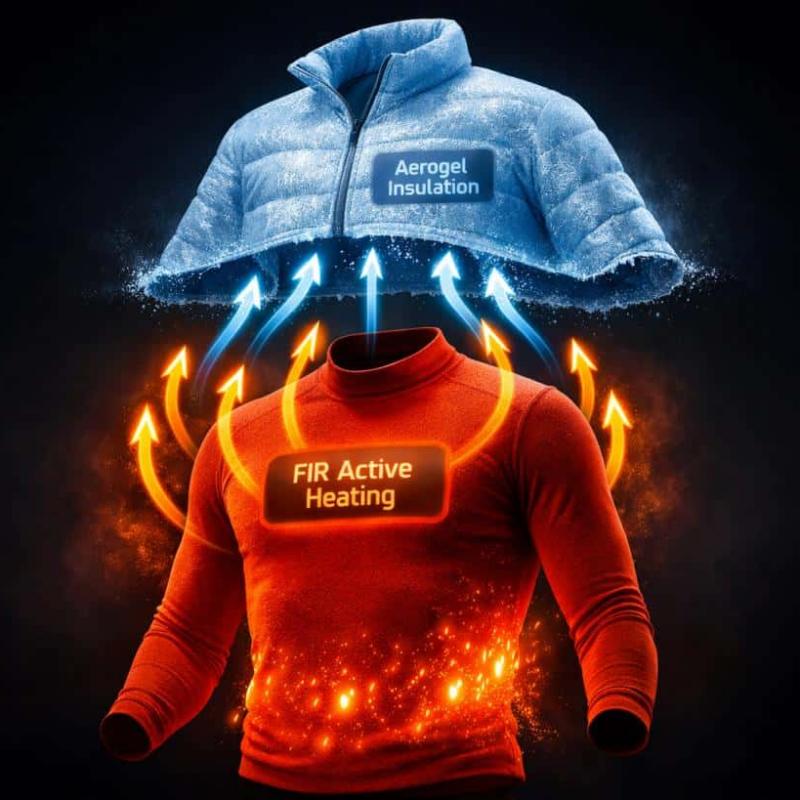
The Warmest Lightweight Winter Technologies in 2026: Aerogel Insulation vs Far Infrared Yarn (And Why You Need Both)
Picture this: it’s -15°C at the trailhead. You’re wearing a jacket rated for extreme cold, layered over a thermal base,...
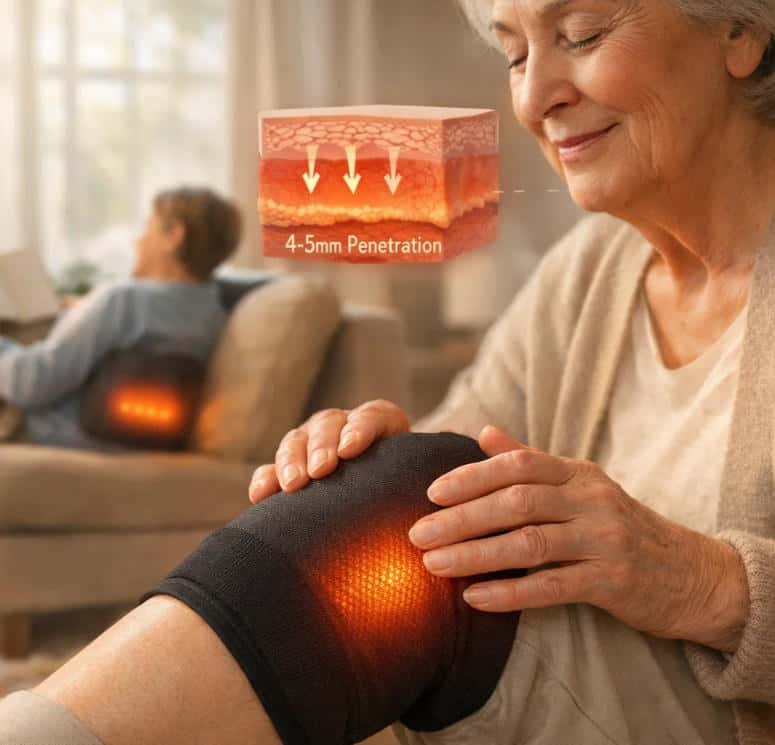
Far Infrared Fabric Applications: Beyond Winter Warmth to Year-Round Performance
When most people hear “far infrared fabric,” they immediately think of winter base layers and heated clothing. But here’s what...
The Future of Lightweight Warmth: Exploring Aerogel Paddings Applications
Have you ever found yourself shivering on a ski slope, despite layers of bulky clothing? Or perhaps you’ve experienced the...
Aerogel Fabric for Summer Apparel: How Heat Blocking Outperforms Every Cooling Treatment on the Market
I’ve been in functional textiles for over 20 years. In that time, I’ve seen a lot of “breakthrough” cooling materials...