 English
 Español
 Português
 Deutsch
 한국어
한국어 日本語
日本語 Italiano
 Français
 العربية
 Türkçe
If you’re sourcing or developing cooling sleeves, sun masks, or UV-protective summer apparel, you’ve probably run into the same wall every serious product developer hits: the cooling treatments work in the lab and fail in the field. This article breaks down why conventional cooling fabrics have a physics ceiling—and how aerogel heat-blocking fabric removes that ceiling entirely. If you want to understand how aerogel fabric works for summer apparel and why it outperforms every chemical cooling treatment on the market, this is the technical case for it.
I’ve been in functional textiles for over 20 years. In that time, I’ve seen a lot of “breakthrough” cooling materials come through the textile lab. Xylitol-treated nylon. Jade-infused polyester. Graphene-coated everything.
They all share one thing in common: brands launch them with strong Q-max numbers, and six months later, the customer reviews say the same thing. “Felt cool for a minute. Then useless.“
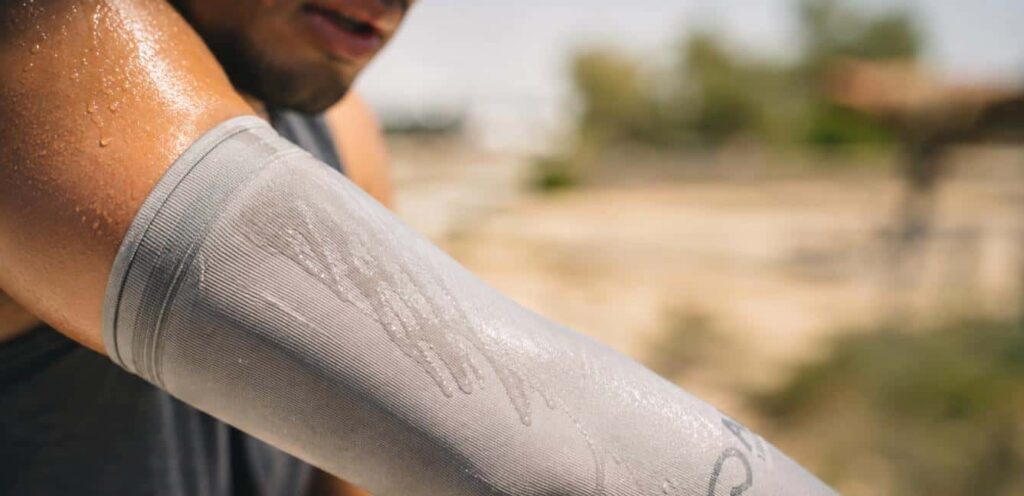
The problem was never the finishing chemistry. The problem was that nobody was stopping the heat from getting in.
That’s the conversation I want to have with product developers who are building cooling sleeves, sun masks, UV-protective hats, and summer outerwear—and who are tired of launching products that work in a climate-controlled showroom but disappoint in the field.
The Core Problem With Every Cooling Fabric on the Market
Standard cooling fabrics—whether polyester, nylon, or blended—conduct heat at approximately 0.25 W/mK. On a 38°C summer day, that thermal conductivity means solar radiation and ambient heat transfer straight through the fabric and onto the skin. The cooling mechanism, whatever it is, gets overwhelmed within 20 to 30 minutes because it’s managing heat from two directions at once: the sun pushing in, the body pushing out.
We tested over 40 competitor fabrics under controlled solar simulation. Every single one followed the same degradation curve. Strong initial cooling response. Rapid heat saturation. Net warming effect by the 45-minute mark. No finishing treatment changes the underlying thermal conductivity of the base fiber—and that’s the number that actually determines performance in real outdoor conditions.
Aerogel textile technology has solved this problem.
Why Aerogel Heat-Blocking Fabric Works for Summer Apparel
The most common pushback we hear from brand developers when we introduce aerogel fabric for summer apparel: “Aerogel blocks heat. Heat blocking means warmth. Why would I put it in a summer product?”
Insulation doesn’t generate heat. It resists heat transfer—in both directions.
NASA originally developed aerogel for Mars Rover missions, where equipment had to survive temperature swings between -100°C and +200°C. The material’s structure—99.8% air trapped within a silica nanopore matrix—achieves thermal conductivity as low as 0.013 W/mK. That’s roughly 20 times more thermally resistant than conventional apparel fabrics. When aerogel sits between direct sunlight and the wearer’s skin, solar radiation cannot pass through efficiently. The outer fabric surface heats up. The inner surface stays significantly cooler.
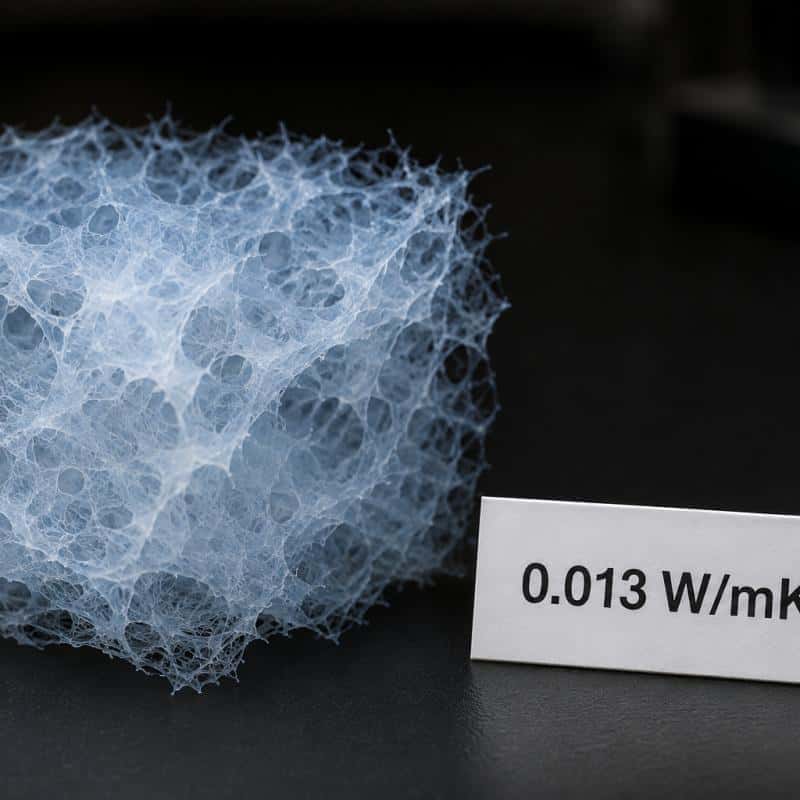
Our lab data: at 38°C ambient with direct solar simulation, the inner surface of aerogel insulation fabric measures approximately 28°C. That 10-degree differential is not a marketing claim. It’s a repeatable physical property of the material structure—measurable with a contact thermometer on any sample we send you.
The same nanopore architecture that resists heat transfer also physically scatters UV radiation. This is a structural UV block, not a chemical coating. UPF 50+ protection that doesn’t wash out after 20 laundry cycles—because it’s built into the fiber geometry, not applied to the surface.
Dual-effect solution for ice sleeves
Outer Layer: Aerogel Thermal and UV Barrier
Aerogel particles—ground to superfine powder—are integrated into polyester fiber at the yarn production stage. This is not a coating or a laminate that can delaminate or wash away. The aerogel is embedded within the fiber structure itself. The resulting yarn produces fabric with thermal conductivity between 0.017 and 0.020 W/mK and a fiber density of 0.003 g/cm³—making ShowarmX® aerogel fabric one of the lightest thermal barrier fabrics available for cut-and-sew apparel production.
The outer layer blocks two things simultaneously: thermal radiation from the sun, and UV radiation across UVA and UVB spectrums. UPF 50+ is achieved through material structure, not chemical treatment—which matters significantly for brands making wash-durability claims to retail buyers.
Inner Layer: Cooling Nylon Contact Surface
While the outer aerogel layer prevents external heat from reaching the skin, the inner cooling nylon layer manages body-generated heat. High-conductivity nylon yarns with Q-max values exceeding 0.25 W/cm² absorb and disperse skin surface heat on contact.
The critical performance difference: because the aerogel outer layer is blocking ambient heat, the cooling nylon is only managing the body’s own heat output—not fighting incoming solar radiation at the same time. That’s a manageable thermal load it can sustain for hours. This is why the performance window is measured in hours rather than the 20-to-30-minute window of single-layer cooling fabrics.
Application Categories for Brand Developers
Cooling Sleeves and Arm Guards
The cooling sleeve category has a credibility problem. Consumers have been burned by products that promise all-day cooling and deliver 20 minutes. Brands that can demonstrate sustained performance—with real temperature data, not just Q-max specs—have a clear differentiation story in a crowded market.
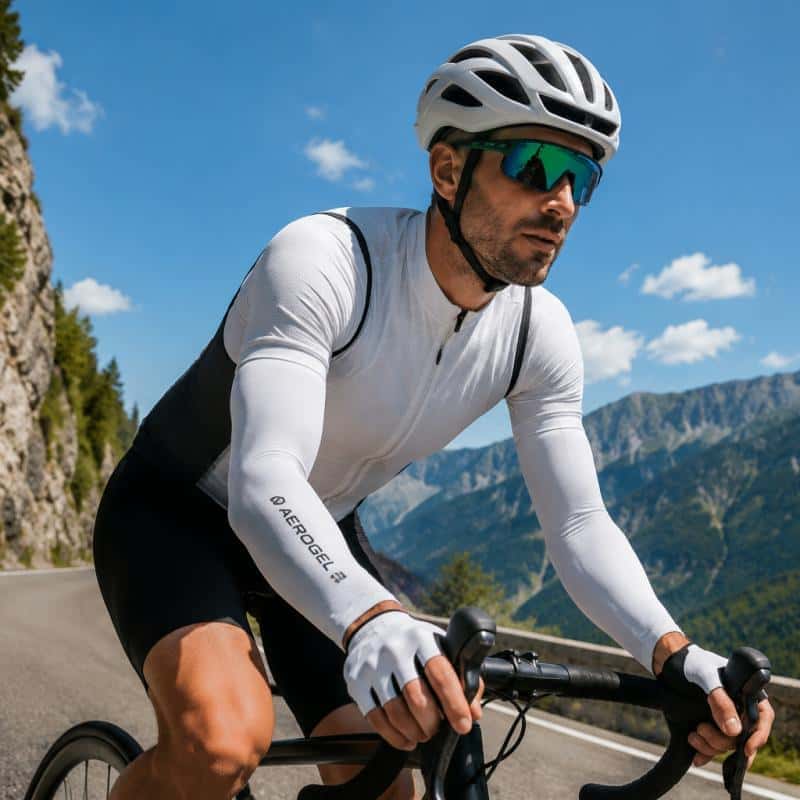
For brands looking for the best cooling sleeves for summer outdoor markets, our aerogel cooling sleeve fabric delivers something no chemical treatment can: a measurable 10°C inner surface differential that holds throughout extended outdoor wear—not just the first 20 minutes. For brands targeting professional outdoor workers, serious cyclists, tournament anglers, or construction PPE markets, this is a specification that supports premium positioning and justifies the product story at retail.
Sun Masks and Face Covers
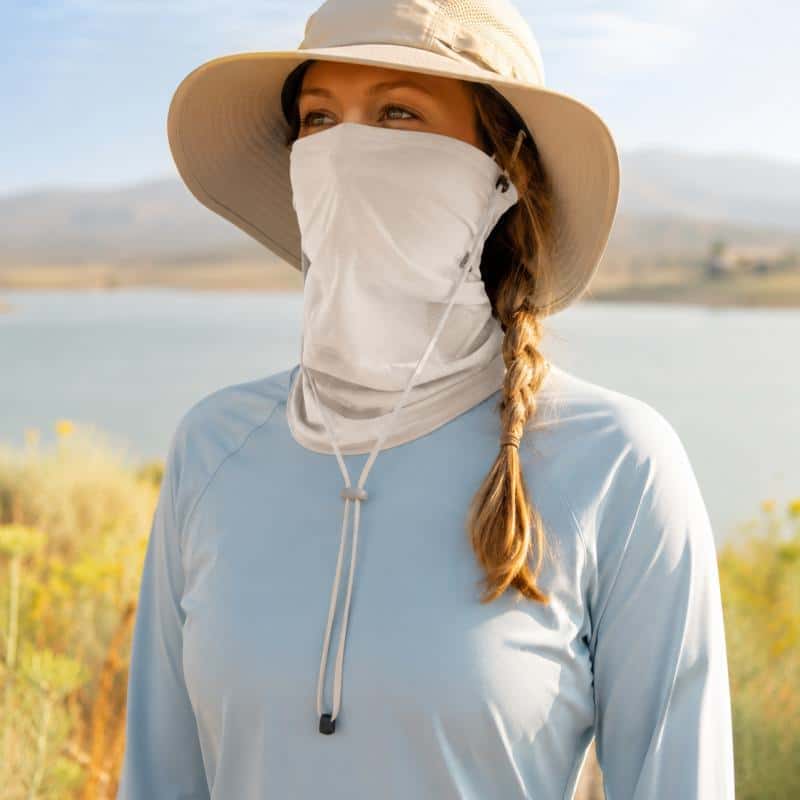
The face mask category is growing rapidly across Asian outdoor markets and increasingly in Western cycling and hiking segments. The challenge is acute: the face has high skin sensitivity, significant perspiration output, and sustained direct sun exposure. Conventional sun masks trap heat against the face, creating a suffocating experience that limits wear time to exactly the conditions where protection matters most.
Aerogel fabric’s ultra-low density and soft hand feel make it viable for face-contact applications. The aerogel barrier blocks solar heat before it reaches facial skin. The breathable construction allows moisture vapor transmission. Brands developing premium sun masks for outdoor, cycling, or daily urban commute markets have a genuine performance story here—not just a UPF number.
Sun-Protective Hats and Cap Liners
The crown of a hat sits in direct, sustained solar radiation for hours. Standard hat fabrics—even those with UPF ratings—conduct heat through to the scalp, creating the familiar discomfort that causes consumers to remove hats exactly when protection matters most. Integrating aerogel textile technology into hat crown panels or as a full cap liner creates a measurable thermal barrier that extends comfortable wear time.
For golf, outdoor, and cycling hat brands, this is a category-level differentiation. Not a marginal improvement on existing UPF hats—a fundamentally different performance claim.
Sun-Protective Jackets and Shirts
The sun-protective outerwear market is expanding, driven by rising UV awareness across Southeast Asia, the Middle East, Southern Europe, and the American Southwest. The current product landscape is dominated by lightweight woven UPF fabrics that block UV adequately but do nothing to manage heat. Consumers in hot climates consistently report that sun-protective jackets make them feel hotter than going without—which undermines the entire product category.
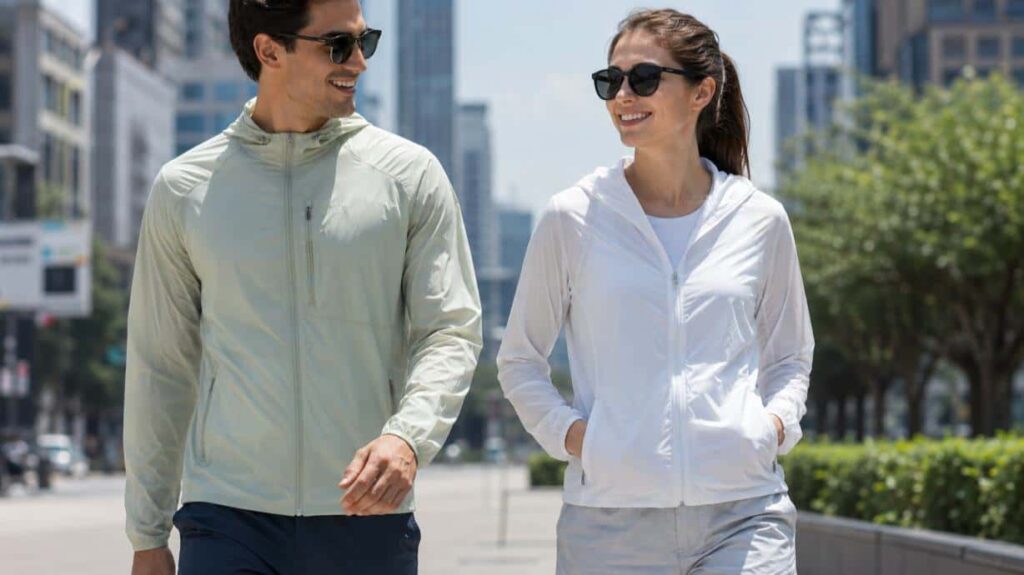
Our aerogel textile technology addresses this directly. The aerogel layer blocks both UV radiation and thermal radiation simultaneously. A sun-protective jacket built on this fabric doesn’t just prevent sunburn—it keeps the wearer measurably cooler than ambient conditions would otherwise allow. For brands targeting markets where summer heat is a genuine daily challenge, this is a product that solves a real problem rather than creating a new one.
Technical Specifications for Product Development
| Property | Aerogel Textile Performance |
|---|---|
| Thermal Conductivity | 0.017 – 0.020 W/mK |
| Aerogel Fiber Density | 0.003 g/cm³ |
| UV Protection | UPF 50+ (structural, not coated) |
| Inner Surface Temp at 38°C Ambient | ~28°C |
| Cooling Performance Duration | Hours (sustained dual-layer function) |
| Wash Durability | Permanent (fiber-integrated, not surface treatment) |
| Construction | Cut-and-sew compatible, no special equipment required |
Samples are available for lab testing and product development evaluation. Technical datasheets with full test methodology are available on request.
Frequently Asked Questions from Brand Developers
Q: Is aerogel fabric safe for direct skin contact? We places the aerogel layer on the outer face of the fabric construction. The inner layer—the surface in contact with skin—is cooling nylon, which has an established safety and comfort profile for apparel applications. The aerogel layer does not contact skin directly during normal wear.
Q: How does the UPF protection hold up after repeated washing? Because our aerogel fabric’s UPF 50+ protection comes from the physical structure of the aerogel fiber—not from a chemical surface treatment—it does not degrade with washing. Chemically-treated UPF fabrics can lose significant protection after 20 to 30 wash cycles. Structural UV protection is permanent for the life of the garment.
Q: How does aerogel cooling performance compare to phase-change materials (PCM)? PCM fabrics store and release thermal energy within a defined temperature range, providing active cooling for a limited window until the phase-change capacity is exhausted. Aerogel heat-blocking fabric works differently: it passively blocks external heat from reaching the skin, so the cooling mechanism is never overwhelmed by incoming solar radiation. The result is sustained performance rather than a finite cooling window.
Q: Does aerogel fabric add significant weight or bulk to finished garments? No. At 0.003 g/cm³, aerogel fiber is one of the lightest materials used in apparel construction. Aerogel fabric adds negligible weight compared to conventional technical fabrics and does not add bulk that would affect garment drape or packability.
Q: Is aerogel fabric breathable enough for high-activity outdoor use? The nanopore structure of aerogel allows moisture vapor transmission while blocking thermal and UV radiation. Our aerogel fabric is designed for active outdoor use—the inner cooling nylon layer handles perspiration management while the aerogel outer layer handles heat and UV blocking. The two functions are separated by design.
Working With US on Your Summer Line
We supply fabric and yarn—not finished garments. That means our aerogel fabric(or yarn) integrates into your existing product development and manufacturing workflow. You bring the design, the brand, and the market knowledge. We bring the material performance that makes the product story credible.
If you’re developing a new cooling sleeve SKU, redesigning your sun-protective outerwear line, or building a premium outdoor face mask, the aerogel insulation fabric platform gives your product development team a performance foundation that holds up under real-world testing—not just lab conditions.
Request fabric samples and technical documentation through our product page, or contact our development team directly to discuss your specific application requirements.

Related Posts

Beyond Cooling: Why UV Protection and Solar Heat Management Matter in Next-Generation Summer Textiles
“Cool touch” solves what happens the instant fabric meets skin. It does not solve what happens after — sustained sweat,...
Lightweight Warmth Without Bulk: The Aerogel + Far Infrared Yarn System Built for Base Layers, Knitwear and Everyday Apparel
There is a quiet shift happening in performance apparel development. Brands are no longer asking “how warm is it?” —...

Why Cool Touch Yarn Is Redefining Summer Apparel in 2026
Quick Answer: Cool touch yarn is a functional fiber engineered to reduce skin-contact temperature by actively drawing heat away from...
How NIR-Reflective Cooling Fabric Reduces Solar Heat Gain
Cooling Textile Series | 03 A buyer-focused guide to near-infrared reflection, textile construction, color, testing and the difference between heat...