PECooX® HDPE Mattress Case Study

The Challenge
“We’ve upgraded our foam layers, added ventilation channels, and improved our spring system — but customers still complain about sleeping hot. The problem isn’t the core. It’s the surface.”

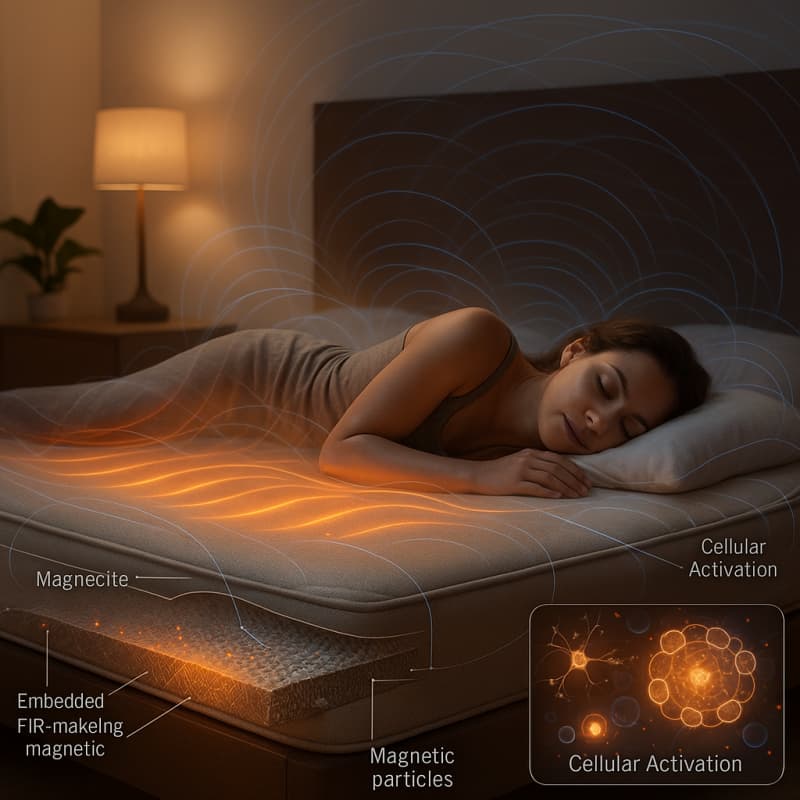
A mid-tier mattress brand had invested heavily in internal engineering: open-cell memory foam, zoned airflow cores, and hybrid spring systems. Yet post-purchase surveys consistently flagged the same issue — heat buildup at the sleep surface. The root cause was invisible to consumers but clear to engineers: conventional polyester knit fabric, the industry default for mattress ticking, has a thermal conductivity of approximately 0.05 W/m·K. It doesn’t transfer heat — it traps it. No amount of foam engineering can compensate for a surface layer that behaves like an insulating blanket. The brand needed a fabric solution that addressed heat dissipation at the point of contact, without sacrificing the softness, durability, and printability that premium mattress construction demands.
Our Innovation Journey
1
Why “Breathable” Polyester Fabric Cannot Solve Sleep Heat Buildup
Breathability and thermal conductivity are fundamentally different material properties. A breathable polyester fabric allows air to pass through — but it does not actively transfer heat away from the skin. Conventional polyester’s thermal conductivity sits around 0.05 W/m·K, meaning it acts as a passive insulator rather than a heat dissipator. When body temperature rises during sleep — typically peaking between 1–3 AM — a low-conductivity surface layer traps that heat against the skin, elevating the microclimate temperature and disrupting sleep quality. Ventilation channels in the mattress core only help if the surface layer allows heat to reach them. A high-conductivity surface fabric is the missing link that most mattress engineering overlooks.
2
How PECooX® Works — Cooling Built Into the Molecular Structure
PECooX® is made from 100% high-density polyethylene (HDPE), a material with a thermal conductivity of 0.5 W/m·K — ten times higher than conventional polyester. This is not a surface treatment, a phase-change coating, or a chemical finish. The cooling performance is an intrinsic property of the polyethylene polymer chain structure, which facilitates rapid heat transfer from the skin surface into the fabric and away from the body. When woven into mattress ticking, PECooX® fabric creates an immediate, perceptible cool-touch sensation at first contact — and continues to dissipate heat throughout the sleep cycle, maintaining a lower surface microclimate temperature without relying on active cooling systems.
3
Performance Beyond Cooling: What Mattress Brands Actually Need From a Ticking Fabric
A cooling fabric that degrades after six months of use, pills under body pressure, or harbors odor-causing bacteria is commercially unacceptable for a product category where warranties run five to ten years. PECooX® addresses the full performance profile required for mattress ticking. The polyethylene molecular chain structure is chemically stable, providing inherent resistance to acids, alkalis, and microbial growth — reducing mold and mildew risk in the humid microclimate of a mattress surface. The yarn’s low coefficient of friction delivers a smooth, silk-like hand feel that enhances perceived product quality. The permanent antibacterial series achieves 99.9% antibacterial efficacy under AATCC-100, without relying on wash-off chemical treatments. Available in 150D/24F through 400D/192F ATY constructions, PECooX® is engineered for the structural demands of woven and knit mattress ticking at production scale.
4
The Sustainability Angle: Sleeping Cooler Means Running the AC Less
PECooX® cooling fabric carries a sustainability narrative that goes beyond material composition. When a mattress surface actively dissipates body heat, sleepers maintain thermal comfort at higher ambient room temperatures — reducing reliance on air conditioning during sleep hours. Data from PECooX® thermal performance modeling suggests that effective sleep-surface cooling can support a 2°C increase in air conditioning set temperature without compromising perceived comfort. For brands targeting ESG-conscious consumers or building products around energy efficiency claims, this positions PECooX® mattress fabric as a material choice with a measurable downstream environmental benefit — not just a comfort feature. For brands pursuing GRS certification pathways, the 100% Recycled PECooX® series offers an additional sustainability credential built into the fiber itself.
The Result: PECooX® HDPE Cooling Mattress Ticking Fabric
Instant cool-touch at first contact. Sustained heat dissipation through the sleep cycle. Permanent antibacterial protection, mold resistance, and silk-smooth hand feel — engineered into the fiber, not applied to the surface.
✓ Thermal conductivity 0.5 W/m·K — 10× higher than conventional polyester
✓ 100% HDPE — intrinsic cooling, not a surface coating or chemical finish
✓ Inherent anti-mold & anti-mildew properties from stable PE molecular structure
✓ Permanent antibacterial series: 99.9% efficacy under AATCC-100
✓ Home textile specs: 150D/24F, 150D/48F, 200D/96F, 300D/96F, 400D/96F, 400D/192F
✓ Recycled PECooX® series available — GRS certified, 75D to 600D
📋 A Note on Cooling Performance & Application Conditions
PECooX® HDPE Cooling Yarn delivers cooling performance through high thermal conductivity inherent to the polyethylene polymer structure. The cool-touch effect is most pronounced at initial skin contact and in conditions where body heat generation exceeds ambient dissipation — typical of sleep environments. Cooling performance is a passive, conductive mechanism and does not replace active climate control in extreme heat conditions. Antibacterial efficacy data (99.9% under AATCC-100) applies to the permanent antibacterial series; standard PECooX® series does not carry this certification. Fabric construction, weave density, and finishing processes will influence final thermal and hand-feel performance. Sample evaluation under your specific construction parameters is recommended before production commitment.
Why It Matters: The Science Behind the Comfort
0.5
W/m·K Thermal Conductivity
of PECooX® HDPE Fiber
10×
Higher Heat Transfer Rate
vs. Conventional Polyester Ticking
99.9%
Antibacterial Efficacy
AATCC-100 (Antibacterial Series)
+2°C
AC Set Temperature Increase
Supported Without Comfort Loss
Developing premium mattress ticking, cooling bedding, or sleep-comfort textiles? Let’s discuss how PECooX® HDPE Cooling Yarn can give your product a genuine, material-level cooling story — not just a marketing claim.
Request Yarn Samples →

Leave a Comment

Your email address will not be published. Required fields are marked *

Scroll to Top