 English
 Español
 Português
 Deutsch
 한국어
한국어 日本語
日本語 Italiano
 Français
 العربية
 Türkçe
Cooling Textile Series | 03
A buyer-focused guide to near-infrared reflection, textile construction, color, testing and the difference between heat shielding and cool touch.
NIR-reflective fabric is engineered to send part of the sun’s near-infrared energy away from the textile before that energy becomes heat. It is most useful in direct sun. It does not refrigerate the wearer, and its real benefit depends on spectral reflectance, color, fabric construction, fit, airflow and the test setup.
Why near-infrared reflection targets the heat before it enters the garment
A garment in sunlight receives energy across ultraviolet, visible and near-infrared wavelengths. Visible light determines most of what we perceive as color, but near-infrared radiation carries a large share of terrestrial solar energy. Once absorbed by dyes, fibers or the skin, that radiation is converted into heat.
This makes NIR reflection a preventive strategy. Instead of trying to move heat after the textile becomes warm, an NIR-reflective fabric aims to reduce one important incoming heat load. Rounded engineering references often describe the terrestrial spectrum as roughly 5% ultraviolet, 43% visible and 52% near infrared; the exact shares vary with the reference spectrum and integration method, so product evaluation should use measured spectral data rather than those rounded percentages.

NIR reflection and UV protection are related—but not interchangeable
UV protection is concerned mainly with how much ultraviolet radiation passes through a fabric to the skin. NIR heat shielding is concerned with how much near-infrared energy is reflected, transmitted or absorbed. A textile can have a high UPF and still absorb considerable solar heat. Conversely, an NIR-reflective construction still needs separate evidence before a UPF claim is made.
| Claim | What it describes | Evidence to request |
|---|---|---|
| UPF / UV protection | Resistance to UVA and UVB transmission | UPF value, UVA transmittance, test standard and sample color/construction |
| NIR reflectance | Fraction of NIR radiation reflected by the textile | Wavelength-resolved spectrum and integrated wavelength range |
| Heat-shielding rate | Temperature or energy difference under a defined irradiation method | Apparatus, irradiance, distance, exposure time, backing, ambient conditions and calculation |
| Q-max cool touch | Initial transient heat flow when fabric touches a warmer surface | Q-max method, specimen conditioning, contact temperature difference and exact fabric |
How reflective particles work inside a fiber or coating
When particles and pores have optical dimensions suited to the incident wavelengths, differences in refractive index can scatter light. In an NIR textile, the goal is to raise back-scattering and reflectance across a useful part of the near-infrared band while preserving spinnability, strength, hand feel and color.
Particle chemistry alone does not determine performance. Size distribution, particle loading, dispersion, polymer refractive index, fiber diameter, pigment system, fabric density and surface geometry all contribute. A high-performing powder in isolation may lose value if it agglomerates during spinning, weakens the filament or produces an unacceptable appearance.
Mie theory helps engineers understand how particle size and refractive-index contrast affect scattering. It does not create one universal “best particle size” for every yarn. The useful design range changes with material, particle distribution, polymer matrix and the wavelengths being optimized.
Why white is easier—and why dark colors are harder
White textiles naturally reflect much of the visible spectrum and can often be engineered for strong overall solar reflectance. Dark colors require visible absorption to create the desired appearance. That absorption increases heat gain, even if NIR reflectance is improved.
The practical target for colored products is therefore selective behavior: maintain the intended visible color while reducing avoidable absorption in the NIR band. This can involve cool pigments, reflective particles, multilayer yarns, printed layers or fabric-side asymmetry. Each route changes cost, shade matching, durability and process compatibility.
Do not compare a white laboratory sample with a dark commercial fabric and attribute the whole temperature difference to NIR technology. Compare like with like: same color family, similar mass and construction, same irradiance and the same backing.
Fiber-level integration and surface coating make different trade-offs
| Route | Potential advantage | Development question |
|---|---|---|
| Functional particles integrated in the polymer | Reflective function can be built into the filament rather than sitting only on the surface | How do loading and dispersion affect strength, dyeing, shade and spinning stability? |
| Surface coating or print | Can deliver a strong optical layer and may be applied to an existing fabric | How does reflectance change after washing, flexing, abrasion and contamination? |
| Multilayer or Janus fabric | Different inner and outer surfaces can separate skin comfort from solar management | Does lamination reduce breathability, softness, stretch or recyclability? |
| Porous or hollow structure | Can add scattering and insulation without relying on one additive | Does the pore system remain stable through finishing, use and care? |
A practical Annie’s Smartex reference point
IcSnow® Cooling-NIR Reflective Nylon Yarn
Annie’s Smartex presents this nylon filament as a combined route for solar heat shielding, cool touch and UV protection. The product page reports Q-max of 0.32 J/(cm²·s), UPF50+, and heat-shielding results of 43.9% before washing and 45.8% after five wash cycles under T/CTES 1054-2023 AAA-grade testing.
These figures are product-specific reference data, not universal values for every fabric made with the yarn. Buyers should confirm the current report, sample construction, color, test conditions and production specification before using them in a finished-garment claim.
Where NIR-reflective fabric creates the clearest value
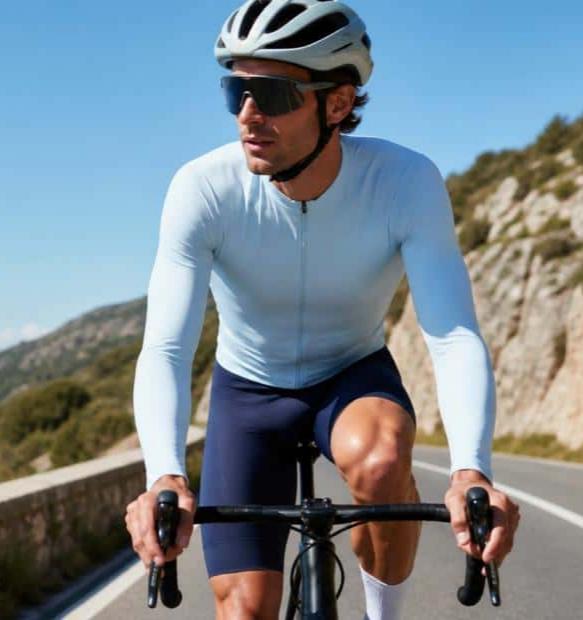
NIR reflection is relevant when solar exposure is a major part of the heat load: cycling jerseys, running tops, sun sleeves, hiking shirts, workwear, hats, tents, vehicle textiles and outdoor equipment. It is less decisive indoors or in deep shade, where direct solar load is limited.
Garment architecture still matters. Ventilation panels, fit, fabric mass, moisture transport and coverage can amplify or cancel part of the benefit. For high-output sport, NIR reflection reduces incoming heat while a moisture-management construction supports sweat transport. These are complementary jobs, not competing explanations.
How to test an NIR textile without being misled by an infrared camera
Thermal images are persuasive, but emissivity, viewing angle and background can change the apparent surface temperature. A useful comparison controls the specimen color and construction, mounting, backing, irradiance, exposure time, air temperature, air movement and measurement location.
- Review UV–Vis–NIR spectral reflectance and transmittance for the exact fabric.
- Run a controlled heat-shielding comparison against a relevant baseline fabric.
- Repeat after the required washing, abrasion and weathering sequence.
- Evaluate color difference, handle, tensile properties and breathability alongside the thermal result.
- Validate the complete garment in the target climate and activity profile.
NIR reflection is not the same as radiative cooling
NIR reflection primarily rejects incoming short-wave solar energy. Passive radiative cooling manages outgoing long-wave thermal radiation, often through the 8–13 μm atmospheric window. A high-performance outdoor textile may use both ideas, but the material requirements and measurements are different. The next article explains when a textile can approach—or under suitable conditions fall below—ambient temperature.
Need a mechanism-by-mechanism sourcing framework?
The paid Cooling Textile Technology Guide compares Q-max, NIR reflection, radiative cooling, PCM and evaporative structures, including evidence checklists and climate-selection tools.
Get the Complete Guide
Related Posts

Beyond Cooling: Why UV Protection and Solar Heat Management Matter in Next-Generation Summer Textiles
“Cool touch” solves what happens the instant fabric meets skin. It does not solve what happens after — sustained sweat,...

Best Cooling Fabric Technology: The Ultimate Guide (Beat Heat by 3-5°C)
Have you ever felt like your clothes were sticking to you during a workout? Or maybe you’ve experienced that uncomfortable,...

How to Choose the Right Cooling Fabric: A Buyer’s Guide to PCM Nylon, Cool-Touch Nylon & 8C Pro Polyester
The Problem With “Cooling” as a Category Walk into any trade show in 2025 and half the booths will have...
Dual-Action Cooling Fabric Explained:How IcSnow® Keeps Athletes Coolin Running, Yoga & Beyond
Most cooling fabrics do one thing well. IcSnow® does two — at the same time, from the first rep to...