 English
 Español
 Português
 Deutsch
 한국어
한국어 日本語
日本語 Italiano
 Français
 العربية
 Türkçe
Cool-touch textile sourcing guide
If you are choosing fabric for a summer sports top, arm sleeve or pillowcase, Q-Max can help you compare the first cool sensation against skin. The number becomes useful only when the test method, fabric face and sample construction are disclosed.
What is a good Q-Max value for cooling fabric?
A good target is one that creates a noticeable first-touch sensation in your finished fabric without compromising the hand feel, stretch, durability and moisture management the product also needs. The official listing for GB/T 35263-2017 describes the method as testing and evaluating the cool feeling at the instant of textile contact. That scope matters: Q-Max is not an all-day cooling score.
For a report explicitly produced under GB/T 35263-2017, 0.15 W/cm² is the evaluation line used in Annie’s Smartex’s published product test material. Values above that line can support a cool-touch claim under that test framework, but the practical target still depends on the application. A close-fitting nylon top may need a different balance from a polyester sports jersey or a summer pillowcase.

What does the Q-Max test actually measure?
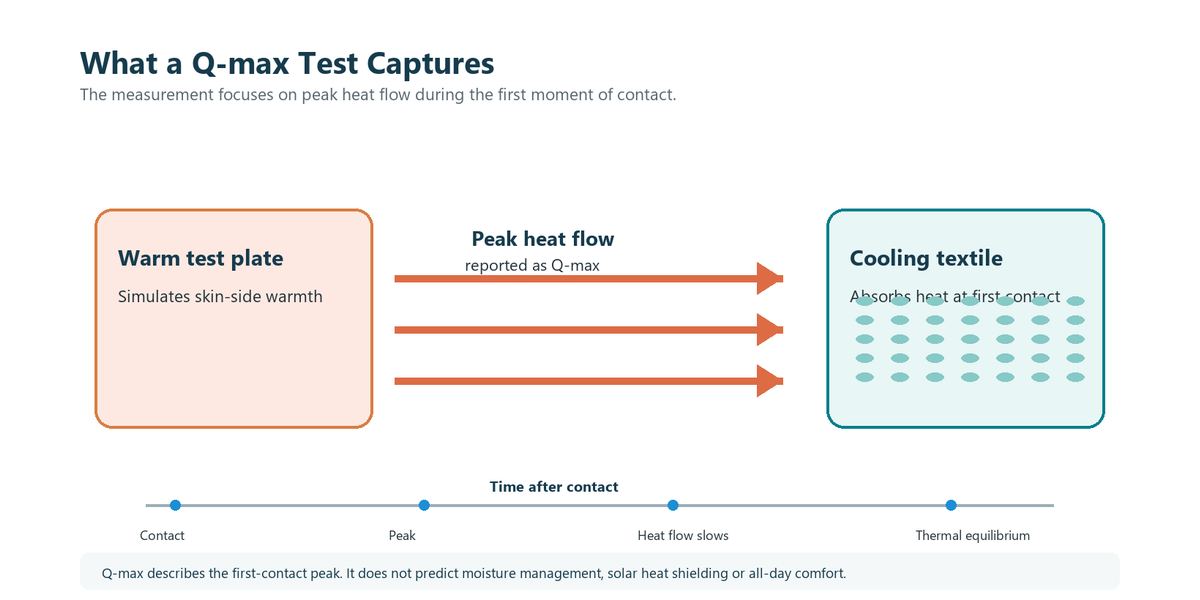
Q-Max is the maximum heat flux recorded when a warmer test plate contacts a cooler textile. Heat moves rapidly from the warm surface into the fabric at the moment of contact, producing the sensation people describe as cool to the touch. As the two surfaces move closer in temperature, that heat flow slows.
This is why a fabric can feel strikingly cool when you first touch it but ordinary a short time later. The original research that established qmax as an objective warm/cool-touch measure also found relationships with fabric thickness, weight and compression properties. A recent controlled study using JIS L 1927 likewise treated Q-Max as a fabric-level contact measurement rather than proof of cooling during complete garment use.
Why can two identical Q-Max numbers mean something different?
If a supplier sends you only the number, you do not yet have a comparable result. The temperature difference between the plate and specimen, sample conditioning, contact pressure, instrument, tested face and fabric moisture can all change the reading. Kato Tech, the manufacturer of widely used warm/cool-feeling instruments, describes qmax as peak heat flux and also notes that China and Taiwan use related but distinct standards.
The construction must be named as precisely as the method. A yarn value cannot be treated as a promise for a dyed fabric, and a fabric result cannot automatically be transferred to a finished garment. GSM, thickness, knit density, elastane content, brushing and finishing can change the surface that actually touches skin.

How should a buyer set a Q-Max target?
Begin with the moment the user is expected to notice. A bedding customer repeatedly touches the surface with the face and arms, so an immediate cool sensation has clear value. A runner notices the first touch too, but soon depends more on moisture movement and ventilation. For outdoor arm sleeves, contact cooling may need to sit beside UV protection and solar heat management.
| End product | What Q-Max can help specify | What must be checked separately |
|---|---|---|
| Summer pillowcase or bedding | Noticeable cool touch on the face and arms | Air permeability, moisture behavior, pilling, hand feel and care durability |
| Yoga top or base layer | Cool sensation at close skin contact | Stretch recovery, opacity, moisture transfer, drying and seam comfort |
| Running shirt or jersey | Initial cool touch without excessive weight | Sweat spreading, drying, air exchange and garment fit |
| Outdoor arm sleeve | Cool-touch skin side | UPF, solar heat gain, stretch, color and post-wash performance |
Which yarn and fabric variables influence cool touch?
Fiber chemistry is only one part of the result. Nylon often gives a smooth, cool hand, while mineral-modified polyester can offer a practical route when a program also needs color flexibility, dimensional stability or additional moisture-management structures. Yarn cross-section, filament count, fabric cover factor and surface smoothness affect the effective contact area against skin.
Annie’s Smartex publishes IcSnow cooling polyester options at Q-Max 0.20–0.30 and cooling nylon options at 0.27–0.37. These are product-route figures, not automatic results for every finished fabric. The selected yarn, knit construction, dyeing and finishing must be developed and tested together.
Where the garment is worn in direct sunlight, the IcSnow NIR-reflective nylon route adds a published Q-Max result alongside separate heat-shielding and UV test information. Keeping those claims separate is important: Q-Max addresses contact, while NIR and UPF tests address different parts of outdoor performance.
Why does a high Q-Max not guarantee all-day cooling?
The first-contact peak fades as the fabric surface warms. A sleeper also needs heat and moisture to escape over time. An athlete needs sweat to move away from the skin and the garment to exchange air. Someone outdoors may be receiving strong solar radiation even while the inside face of the fabric feels cool at first touch.

If the design brief requires a longer buffer against a short temperature rise, read the separate guide to PCM cooling fabric. If the priority is choosing among contact cooling, moisture-driven cooling and thermal buffering, the cooling fabric buyer’s guide maps those mechanisms to different product briefs.
What should be included in a supplier Q-Max report?
A useful report lets another laboratory understand what was tested. Ask for the standard, instrument, temperature difference, conditioning environment, contact settings, tested fabric face, sample specification, individual readings and average. The report should also identify whether the specimen was greige, dyed, finished, unwashed or tested after a defined care cycle.
When durability matters, compare the same construction before and after the wash method in your brand protocol. Avoid the phrase “permanent cooling” unless the claimed performance and intended care life are supported by suitable repeated testing. For bulk production, confirm the agreed acceptance method on production fabric rather than relying only on an early development swatch.
Q-Max cooling fabric FAQ
Is a higher Q-Max always better?
No. A higher value under the same test conditions usually means stronger initial cool touch, but an excessively dense, smooth or heavy construction may conflict with breathability, stretch or the desired hand feel. Choose the complete fabric balance.
Can Q-Max values from JIS and GB/T reports be compared directly?
Not safely without confirming that the test conditions are equivalent. Record the complete method and temperature difference beside every value used in a comparison.
Does Q-Max measure moisture wicking?
No. Q-Max measures transient heat flow at contact. Moisture wicking, directional liquid transfer and drying require separate tests and should be specified separately.
Should the yarn or finished fabric be tested?
Use yarn information to select a development route, but approve the claim on the dyed and finished fabric that represents production. Garment panels may require additional verification when lamination, printing or lining changes the contact surface.
Prepare a comparable cool-touch fabric sample request
Tell us the end product, target market, preferred polyester or nylon route, yarn count, fabric construction, GSM range, skin-facing side, Q-Max test method, target value, color, wash protocol and any separate moisture, UV or NIR requirements.
Discuss a cool-touch yarn or fabric sampleTechnical references
GB/T 35263-2017: Textiles—Testing and evaluation for cool feeling in contact instant
Kato Tech: What is qmax? Understanding contact cool feeling testing
Senoo, Yoneda and Niwa: qmax as an objective measure of fabric warm/cool feeling
Kim and Chae: contact cooling performance measured under JIS L 1927

Related Posts
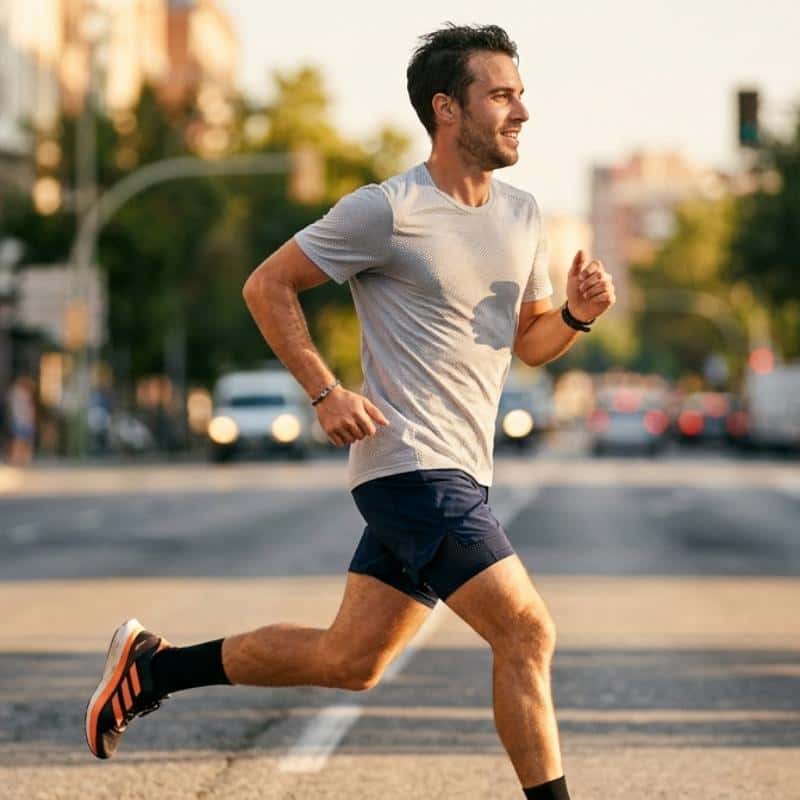
How to Choose the Right Cooling Fabric: A Buyer’s Guide to PCM Nylon, Cool-Touch Nylon & 8C Pro Polyester
The Problem With “Cooling” as a Category Walk into any trade show in 2025 and half the booths will have...
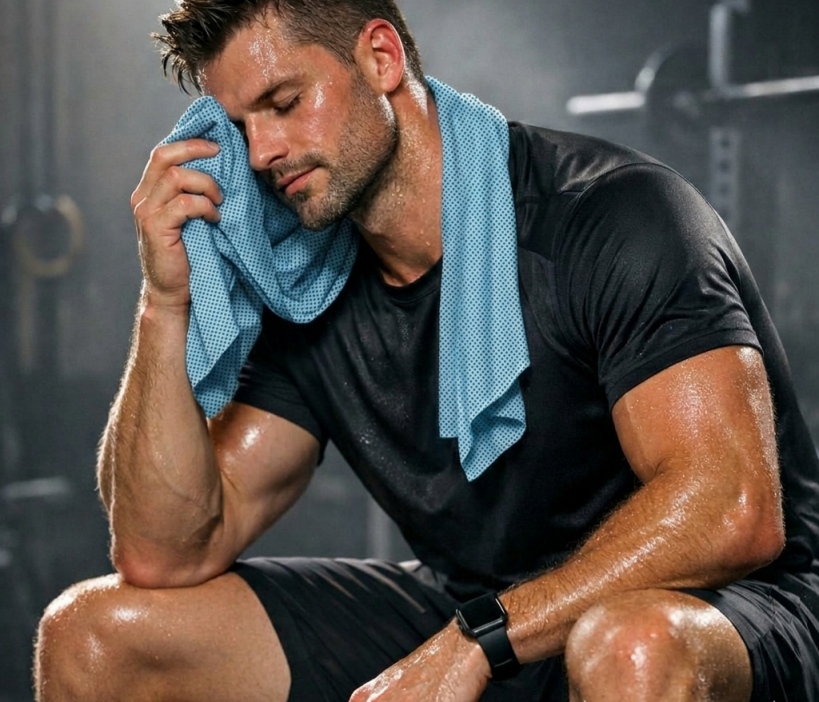
Dual-Action Cooling Fabric Explained:How IcSnow® Keeps Athletes Coolin Running, Yoga & Beyond
Most cooling fabrics do one thing well. IcSnow® does two — at the same time, from the first rep to...
How NIR-Reflective Cooling Fabric Reduces Solar Heat Gain
Cooling Textile Series | 03 A buyer-focused guide to near-infrared reflection, textile construction, color, testing and the difference between heat...
How PCM Cooling Fabric Works: Phase Change, Thermal Buffering and the Questions Buyers Should Ask
Cooling Textile Series | 02 A practical explanation of what phase change material can do in a textile, where its...