 English
 Español
 Português
 Deutsch
 한국어
한국어 日本語
日本語 Italiano
 Français
 العربية
 Türkçe

Why a Cleanroom Garment Needs More Than an Anti-Static Label
Consider a common electronics-workwear development brief: a garment may be described as anti-static, yet the team still lacks the information needed to qualify it for the intended ESD-controlled area. This scenario focuses specifically on translating carbon fiber + polyester/nylon anti-static filament yarn—also searched as antistatic yarn—into a cleanroom and ESD garment specification. For broader yarn-selection criteria, see our anti-static yarn buyer’s guide.
Which conductive yarn should be used? How should it be distributed in the fabric? Will the fabric remain comfortable enough for an eight-hour shift? And, most importantly, how will the finished garment be validated as part of the facility’s electrostatic discharge control program?
How to Specify Anti-Static Yarn for Cleanroom and ESD Workwear
The answer did not begin with yarn color or denier. It began with the operating environment and the validation target. Cleanroom particle control and electrostatic control overlap, but they are not the same requirement—and neither can be guaranteed by yarn alone.
Define the actual risk and the operating environment
For electronics manufacturing, the fabric and garment sit inside a wider ESD control program that may also include grounding, footwear, flooring, work surfaces and handling procedures. IEC 61340-5-1:2024 is a relevant program-level reference for organizations handling electrostatic-sensitive electronic parts. It is not a product certificate that automatically transfers to a yarn.
Select a base yarn that fits the fabric construction
Annie’s Smartex offers carbon fiber + polyester/nylon anti-static filament yarn in 50D, 75D, 100D, 150D and 300D options. The correct choice depends on fabric weight, hand feel, loom or knitting setup, end use and the conductive network required by the fabric designer.
Engineer the intended conductive network
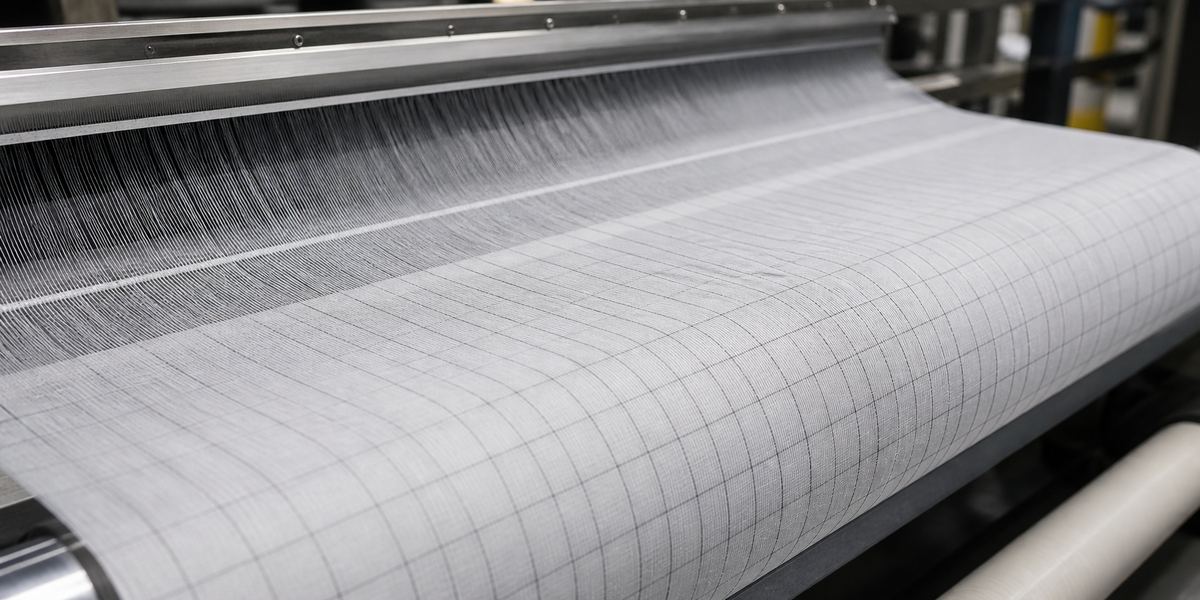
The anti-static filament can be introduced in a stripe or grid arrangement within the base fabric. Grid spacing is not a universal recipe: a tighter pattern may change conductivity, appearance, cost and fabric feel, so the mill should prototype more than one construction rather than copy an arbitrary spacing from another garment.
Qualify yarn, fabric and garment as separate layers
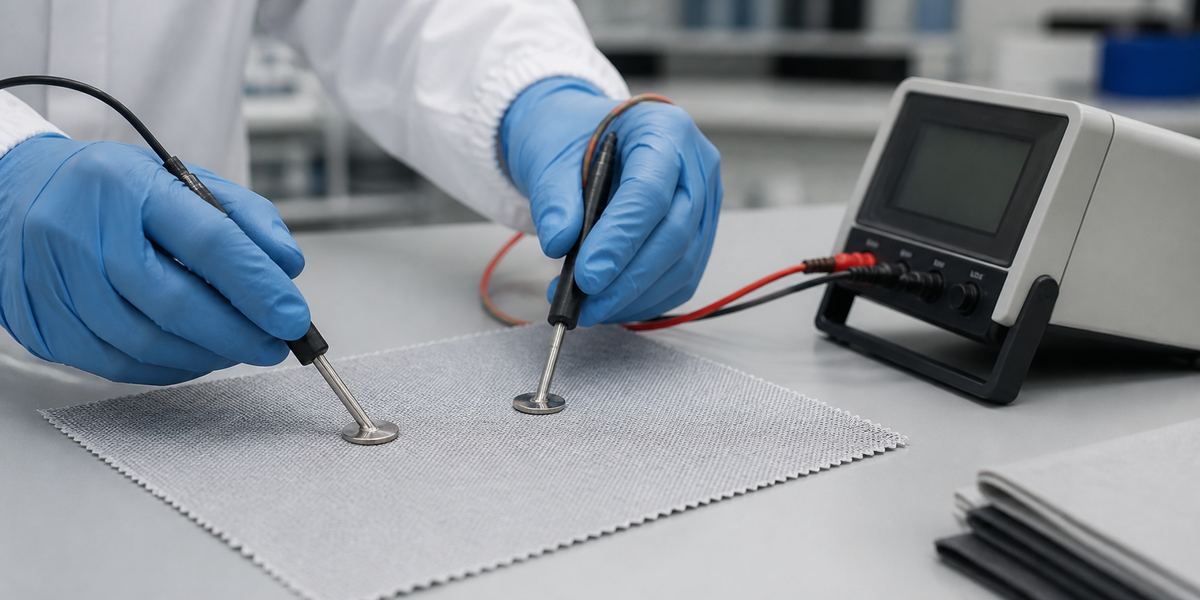
Test the incoming yarn, then the woven or knitted fabric, then the sewn garment in the configuration it will actually use. Seam construction, closures and garment-grounding design can interrupt an otherwise promising conductive network. If cleanroom suitability is also required, particle shedding and consumable suitability need their own evaluation. ISO 14644-1 classifies room air cleanliness, not yarn, while ISO 14644-18:2023 provides guidance for assessing the suitability of personal and non-personal consumables used in cleanrooms. Functional performance still needs separate testing.
Case Outcome: A Testable Cleanroom Garment Fabric Brief
The proposed outcome is a development brief that a yarn supplier, fabric mill, garment maker and ESD manager can all review. It does not promise a resistance value before a sample exists. Instead, it locks the variables that must be controlled and leaves performance claims to the agreed test method.
What Should Be Written into an Anti-Static Garment Fabric Specification?
Before requesting samples, buyers need enough detail to compare constructions and define the test plan. These fields make the RFQ actionable.
| Specification field | What to define | Why it matters |
|---|---|---|
| End-use environment | Electronics assembly, semiconductor handling, laboratory workwear or another controlled area | Different risks lead to different garment systems and tests. |
| Base polymer and yarn size | Polyester or nylon construction; evaluate available 50D, 75D, 100D, 150D or 300D options | Changes weight, hand feel, processing and fabric design. |
| Conductive layout | Stripe or grid concept, proposed spacing and continuity across panels | The conductive path must survive the move from fabric roll to sewn garment. |
| Fabric requirements | Weight, width, weave/knit, color, air permeability, abrasion and care conditions | ESD performance is only useful if the garment remains wearable and manufacturable. |
| Verification plan | Test method, conditioning, sample size, acceptance limits and responsible laboratory | Prevents supplier and buyer from using the same words for different measurements. |
| Cleanroom suitability | Particle-shedding evaluation and facility-specific consumable requirements | “Anti-static” and “cleanroom compatible” are not interchangeable claims. |
Why Not Rely Only on a Topical Anti-Static Finish?
A finish can be appropriate for some products, and a conductive-yarn construction can be appropriate for others. The decision should be based on the care process, required lifetime, comfort target, appearance and qualification data—not on a blanket claim that one approach is always permanent or always better.
For this scenario, specifying where and how the carbon-fiber anti-static filament is incorporated makes the conductive layout defined and controllable during sampling. Durability after laundering still needs to be tested under the buyer’s actual wash protocol. For a broader material comparison, see what textile material is anti-static.

Common Buyer Questions About Anti-Static Yarn for ESD Workwear
Is carbon fiber anti-static yarn the same as ESD-safe fabric?
No. The yarn is one component. Fabric construction, conductive-yarn placement, garment design and the test result determine whether the finished system meets the buyer’s requirement.
Which denier should a cleanroom garment use?
There is no single correct denier. Start from the target fabric weight, comfort, machine compatibility and conductive layout, then compare prototypes. Annie’s Smartex lists 50D, 75D, 100D, 150D and 300D running options for this product.
Does anti-static yarn make a garment ISO cleanroom certified?
No. ISO 14644-1 classifies air cleanliness by particle concentration. A garment or yarn does not inherit a room class. Cleanroom users should separately evaluate particle shedding and suitability within their operating procedures.
What information should I send before requesting a sample?
Share the end use, fabric construction, target weight, base fiber, color, wash method, conductive layout idea, test standard or method, required acceptance limits and expected sampling quantity. If those details are not final, our team can help turn the application into a sampling matrix.
Developing ESD or Cleanroom Workwear?
Send your base polymer, target fabric weight, construction, wash method and validation requirement. We can recommend a starting yarn size and help your mill build a practical sampling and validation plan.

Related Posts

How to Choose Anti-Static Yarn for Industrial Workwear: A Buyer’s Guide
Choosing the wrong anti-static yarn can cost your business more than just money. I’ve seen electronics manufacturers lose entire production...

One-Way Moisture-Transfer Soccer Jersey Fabric: A SiPHONiX® Development Case
A practical development case for specifying SiPHONiX® one-way moisture-transfer soccer jersey fabric, from yarn placement and knit construction to testing...

Solving Odor, Static & Skin Irritation in Post-Surgical Recovery Garments
Graphene Poly/Viscose Antibacterial Anti-Static Spun Yarn · Ne32s/1 Client Challenge “Our recovery garments trap odor, cause static cling, and patients...

What textile material is anti-static?
Have you ever pulled off a sweater only to have your hair stand on end? Or reached for a doorknob...