 English
 Español
 Português
 Deutsch
 한국어
한국어 日本語
日本語 Italiano
 Français
 العربية
 Türkçe
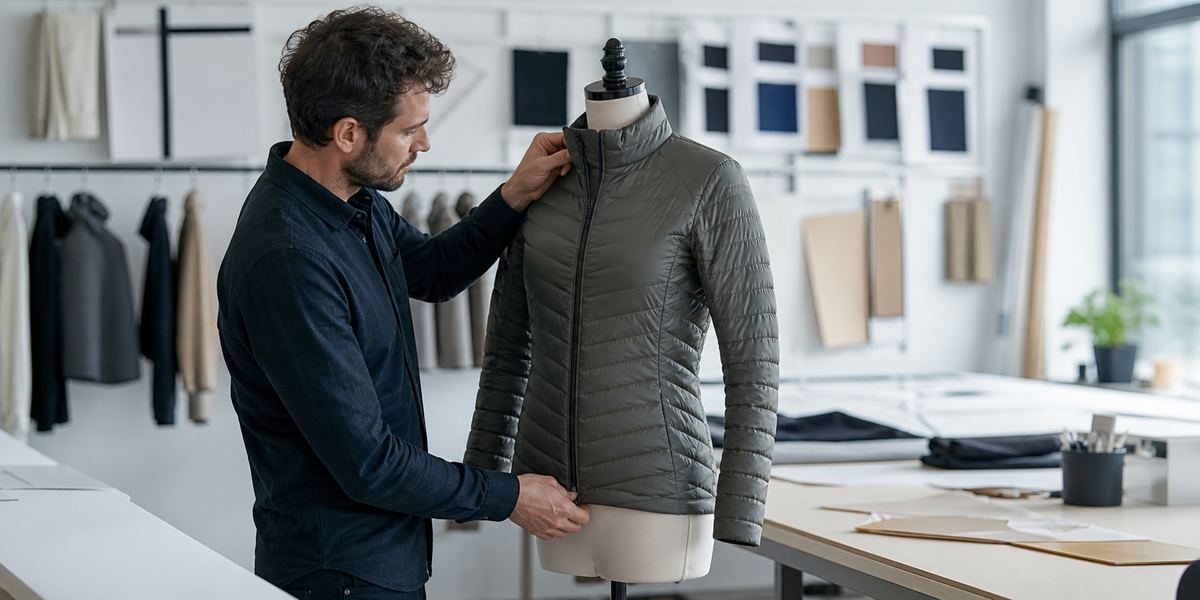
Is Aerogel Insulation Right for a Winter Jacket?
It can be—especially when a brand wants a slim silhouette, reduced bulk or targeted insulation in a technical jacket. The decision still depends on the complete jacket construction: fiberfill structure, areal density, thickness, shell and lining fabrics, quilting pattern, moisture management, care method and the temperatures and activity levels for which the garment is designed.
This guide focuses on turning an aerogel concept into a purchasable and testable jacket specification. It does not repeat our broader aerogel fiber vs down insulation comparison. If you already know you want a synthetic fill, use the sections below to build an RFQ and sample matrix.
How Aerogel Fiber Filling Works in a Jacket
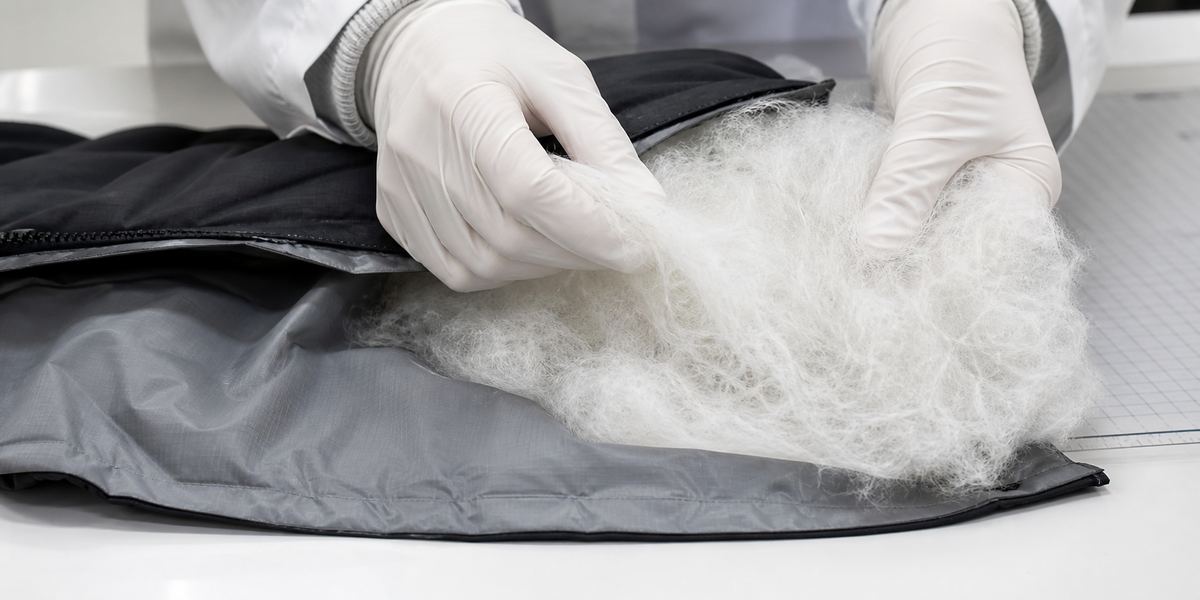
Aerogel’s porous structure can reduce heat transfer in the material, but a jacket’s measured insulation still depends on the complete fiberfill, shell, lining, quilting and garment construction. The insulating material has to be integrated into a textile-friendly fiber or padding structure that can be cut, quilted, sewn, compressed, worn and cared for.
The ShowarmX® hollow-star aerogel fiber filling currently lists a running specification of 3D × 32 mm. However, 3D × 32 mm describes the starting fiber—not the finished insulation layer. A buyer still needs the padding construction, target GSM, measured thickness and test conditions for the actual sample being quoted.
Which Aerogel Insulation Specifications Should Buyers Compare?
A useful data sheet lets your pattern team, sourcing team and laboratory discuss the same sample. Ask suppliers to report these fields in one table so your team can compare like with like.
| Specification | What to request | Why it changes the jacket |
|---|---|---|
| Fiber/fill construction | Fiber type, linear density, cut length, cross-section and how the aerogel component is incorporated | Influences loft, migration, hand feel, processing and consistency. |
| Areal density | Actual GSM of each sample, including tolerance | Warmth, weight and cost cannot be compared without mass per area. |
| Thickness and compression | Conditioned thickness, test pressure, compression and recovery procedure | A slim sample can behave differently after packing, quilting and wear. |
| Thermal performance | Thermal resistance or Clo, specimen build-up, conditioning and test method | A number without sample construction and method is not reproducible. |
| Water-vapour resistance | Result for the proposed multilayer assembly, not an isolated raw fiber | Helps assess heat-and-moisture comfort during movement. |
| Care durability | Agreed wash/dry or professional-care cycles; thickness, migration and thermal retest after care | Shows whether the garment can retain its intended structure in use. |
| Cut-and-sew behavior | Recommended quilting distance, edge control, needle setup and handling guidance | Reduces shifting, cold spots and production-line surprises. |
| Commercial terms | Sample size, sample lead time, production MOQ, color options, width/form and production tolerance | Separates a laboratory sample from a scalable material program. |
Aerogel vs Down vs Synthetic Fill: Which One Fits Your Jacket Brief?
The best option depends on the jacket’s warmth target, thickness, care route and price point. Down, conventional synthetic batting and aerogel-enhanced fiberfill solve different product briefs. A sourcing comparison should use separate equal-weight and equal-thickness panels and hold the remaining construction variables constant.
| Decision factor | Aerogel-enhanced fiberfill | Down | Conventional synthetic fill |
|---|---|---|---|
| Best reason to shortlist | Low-profile or weight-sensitive insulation development | High loft and established premium-outdoor positioning | Familiar processing, broad supply options and predictable care routes |
| Main qualification question | Does the finished batting retain performance after quilting, compression and care? | What fill power, down/feather ratio, traceability and moisture protection are specified? | What GSM and thickness are required to reach the target thermal resistance? |
| Construction risk | Fiber migration, uneven distribution or a claim based only on raw-material data | Down leakage, baffle design and sensitivity to wet conditions | Bulk, compression set and performance variation by fiber architecture |
| How to compare fairly | Build complete jacket panels to the same dimensions and target use, then measure weight, thickness, thermal resistance and post-care condition. | ||
How Should Aerogel Jacket Insulation Be Tested?
Use a layered test plan. Raw-fiber data can screen suppliers, but it does not replace testing of the batting, jacket panel and finished garment.
Test the padding assembly
Measure GSM, conditioned thickness, thermal resistance and water-vapour resistance. ISO 11092:2026 covers steady-state thermal and water-vapour resistance for fabrics and multilayer assemblies; its conditions are not themselves a promise of wearer comfort. Confirm specimen thickness and the laboratory apparatus range before testing bulky padding.
Build representative jacket panels
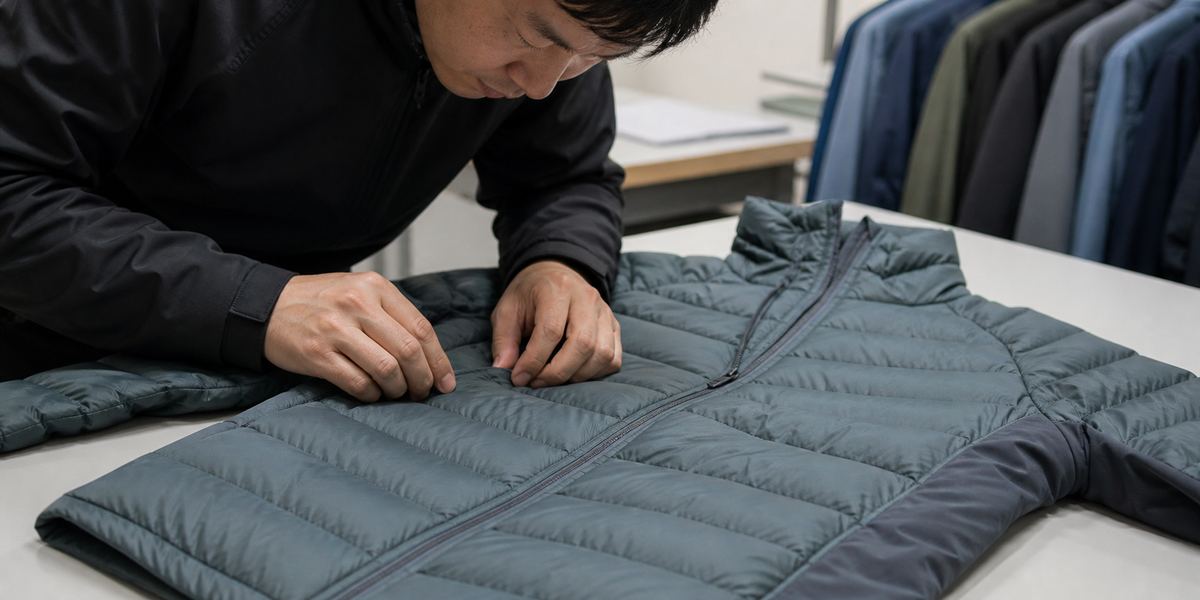
Use the intended shell, lining, quilting distance, seam type and fill density. Inspect for migration, clumping, stitch-line cold spots and changes in thickness.
Run the intended care sequence
Define the exact wash and drying process rather than saying “washable.” ISO 6330:2021 provides domestic washing and drying procedures for textile testing. Select and record the procedure that represents the intended care route; completing that procedure does not by itself establish wash durability.
Evaluate the finished garment
For an apparel-level result, ISO 15831:2004 measures the thermal insulation of a clothing ensemble on a thermal manikin in a relatively calm environment, with the manikin standing or moving. Wear trials can then address fit, movement, moisture and real product comfort.

How to Build a Useful Aerogel Jacket Sample Matrix
Do not start with one “hero” jacket and hope it works. Ask the supplier and garment factory to prepare a small controlled matrix. Keep the shell, lining and quilting pattern constant while changing one insulation variable at a time.
Baseline construction
Your current down or synthetic-fill panel, documented by total fill mass, thickness and construction.
Equal-weight aerogel candidate
An aerogel-enhanced fill at the same total panel weight, used to compare thickness and thermal resistance.
Equal-thickness aerogel candidate
A construction matched to the baseline thickness, used to see whether weight or thermal performance changes.
Post-care repeat
Retest the preferred panel after the agreed wash/dry or professional-care sequence before approving bulk production.
What Should an Aerogel Insulation RFQ Include?
Before asking for a price, tell the supplier what jacket you are developing. A supplier can quote and sample more accurately when the brief includes:
| Jacket use | Urban commute, ski midlayer, mountaineering shell, workwear or another defined scenario |
| Target construction | Shell and lining composition, panel dimensions, quilting style and current benchmark fill |
| Performance target | Required garment or panel test, target thermal resistance, thickness and total weight |
| Care route | Domestic wash, tumble dry, line dry or professional care, including intended cycle count for validation |
| Commercial details | Development quantity, annual forecast, delivery market, color and required certifications or restricted-substance documents |
MOQ is not a universal material property. It changes with padding form, width, GSM, color, finishing, packaging and whether the request uses a running specification. Ask for separate sample MOQ and production MOQ, plus the surcharge and lead time for a custom construction.
Frequently Asked Questions About Aerogel Insulation for Jackets
Does aerogel insulation replace down?
Sometimes, but not automatically. It can be developed as a down-alternative filling, yet the correct answer depends on the target warmth, silhouette, weight, care method, price and construction. Compare finished panels, not material names.
Is aerogel jacket insulation washable?
It depends on the fiberfill and garment construction. Ask for the exact care procedure and post-care data. Validate thickness, migration, appearance and thermal performance after the intended washing and drying sequence.
How thick should aerogel insulation be?
There is no standard thickness for every jacket. Specify a thermal target and silhouette, then compare controlled GSM/thickness samples. Test pressure and conditioning must be recorded because soft insulation compresses.
Is aerogel insulation breathable?
The complete assembly determines water-vapour resistance. Aerogel content alone cannot predict comfort. Test the fill together with the selected shell, membrane and lining.
What is the MOQ for aerogel filling?
It varies by running or custom specification. Send the target GSM, width/form, quantity, color and certification needs so the supplier can separate sample terms from bulk-production terms.
Turn Your Jacket Brief into a Testable Aerogel Sample
Send us your target GSM, thickness, shell/lining construction, care method, thermal test requirement and forecast quantity. Contact us to discuss a starting ShowarmX® sample specification and a practical panel-comparison matrix.
Request an Aerogel Filling Sample

Related Posts
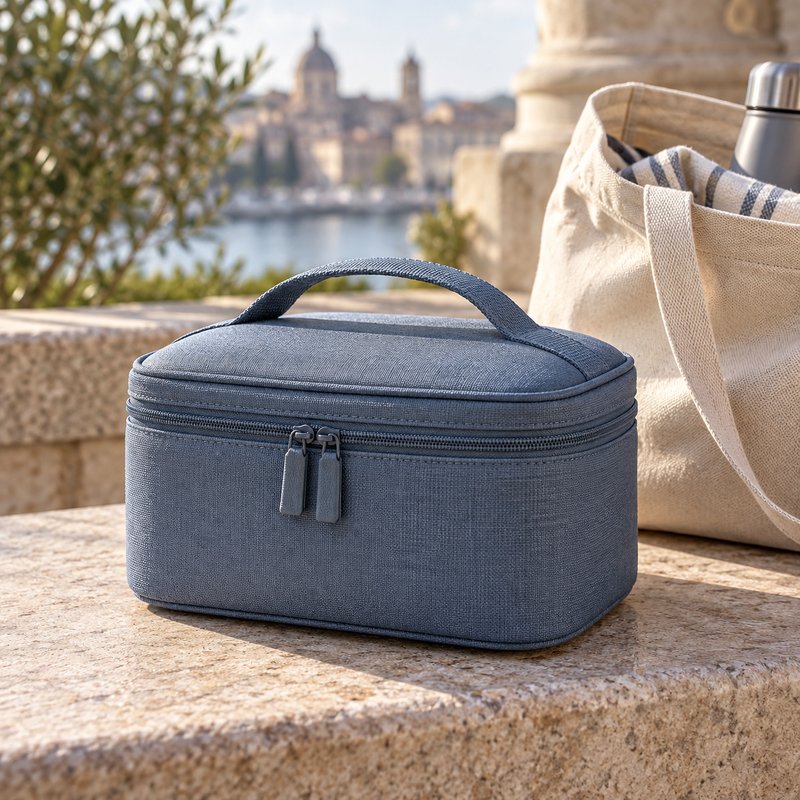
Aerogel Insulation for Medical Cooler Bags: A Thinner Alternative to XPE?
Aerogel can help you make a medical cooler bag thinner when the finished liner delivers more thermal resistance per millimeter...

ShowarmX® Aerogel Thermal Fabric: The Lightest Insulation Fabric That Works in Both Summer and Winter
Key Takeaways Here’s a question most fabric buyers never think to ask: What if the same fabric keeping you warm...
Low-Density Aerogel Fiber Padding: An Ultra-Light Alternative to Down Insulation
Aerospace-Grade Insulation Yarn Innovation · ShowarmX® Ultra-Light Aerogel Thermal Padding Technology The Challenge “Our down jackets keep climbers warm until...
The Warmest Lightweight Winter Technologies in 2026: Aerogel Insulation vs Far Infrared Yarn (And Why You Need Both)
Picture this: it’s -15°C at the trailhead. You’re wearing a jacket rated for extreme cold, layered over a thermal base,...