 English
 Español
 Português
 Deutsch
 한국어
한국어 日本語
日本語 Italiano
 Français
 العربية
 Türkçe
Aerogel can help you make a medical cooler bag thinner when the finished liner delivers more thermal resistance per millimeter than the foam it replaces. That makes it worth considering if insulation is taking up space you need for medication, cold packs or a cooling unit.
The first decision is what you want to gain: a smaller bag or more room inside it. Then comes the material comparison. A thinner sheet only helps if it fits the construction and supports the temperature performance your product needs.
This guide explains how to evaluate aerogel insulation for medical cooler bags against XPE foam. The ShowarmX® paddings and fillings page covers the textile material route behind that discussion.

What Is XPE Foam, and Why Replace It?
XPE means cross-linked polyethylene foam, also called XLPE. It has a closed-cell structure: small pockets of gas are enclosed within the foam, helping slow heat transfer. Depending on the grade, it can also provide cushioning and support.
That combination is useful in a cooler bag. A single layer can contribute to insulation, protect the contents and help the case retain its shape. Manufacturers offer cross-linked polyethylene foam in different densities and thicknesses, with options for cutting and laminating it into finished products.
The reason to consider a replacement is often space. If your existing XPE liner already occupies much of the wall, adding more insulation makes the bag bulkier. Reducing the foam thickness moves the thermal performance in the opposite direction, all else being equal.
If the current bag meets its size, weight, cost and temperature requirements, XPE may still be the right choice. Aerogel becomes interesting when the insulation layer is holding back a specific design improvement.
Why Consider Aerogel Insulation for Medical Cooler Bags?
A material with lower thermal conductivity can provide the same thermal resistance in a thinner layer. For a compact cooler, that creates room to rethink the wall thickness.
Aerogel’s very small pores help reduce heat transfer through the gas inside them. NASA’s description of aerogel insulation explains this mechanism. In a textile liner, the carrier fibers, bonding and overall construction also contribute to the result.
The opportunity is straightforward: use the saved space for a smaller exterior, a larger payload compartment or a different cooling arrangement. Choose one priority first. Changing the wall, payload and cold packs together makes it much harder to tell which change helped.
Aerogel also makes sense beyond winter clothing because insulation slows heat transfer in either direction. In a warm environment, a cooler-bag liner reduces heat entering the cold compartment. The cold pack or powered unit still supplies the cooling capacity.
Can 6 mm of Aerogel Replace 12 mm of XPE?
It can match the material’s thermal resistance if its effective thermal conductivity is half that of the XPE control, measured under comparable conditions.
Here is the calculation for a uniform flat layer under a one-dimensional, steady-state approximation:
R = t / λ
Thermal resistance = thickness ÷ effective thermal conductivity.
Use metres for thickness, W/(m·K) for conductivity and m²·K/W for thermal resistance.
Halving the thickness therefore requires halving the conductivity to keep the same R-value. A more aggressive thickness reduction requires a correspondingly lower conductivity.
| Candidate thickness | Maximum conductivity relative to XPE | What this means |
|---|---|---|
| 6 mm | 50% | The candidate needs half the XPE control’s conductivity or less. |
| 4 mm | One-third | A larger reduction is needed to retain the same material-layer R-value. |
| 3 mm | 25% | The candidate needs one-quarter of the control’s conductivity or less. |
These are calculated selection thresholds, not measured ShowarmX results or a list of available thicknesses. The comparison assumes relevant, comparable test conditions and installed thicknesses. Seams, closures and the cooling system are evaluated at the finished-bag stage.
This is a useful way to narrow your sample request. A candidate that falls short can be evaluated at a greater thickness before you invest in a complete prototype. One that meets the threshold is a credible option for the next stage.
Choose the Material Behind the “Aerogel” Label
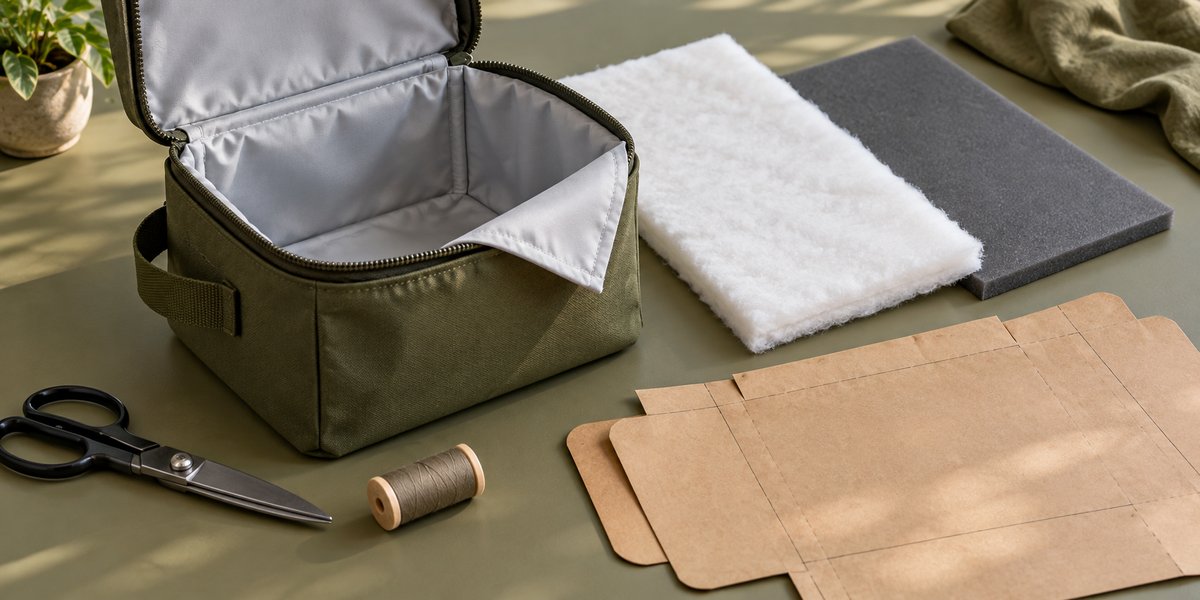
An aerogel insulation blanket and an aerogel fiber padding can look similar in a photograph while using different constructions. Some industrial blankets use fiberglass carriers. The ShowarmX route described on this site combines silica aerogel with polyester fiber for textile applications.
For your bag, the relevant question is how the supplied layer will behave between the shell and liner. Its fiber or carrier, bonding method, surface covering and edge finish all affect cutting, assembly and repeated handling. A stabilized padding can be supplied as a sheet; the word “padding” does not necessarily mean loose fill.
The specsheet should identify that finished construction. Thickness, mass per unit area and thermal data are most useful when they refer to the same sample. For a compressible material, the pressure used to measure thickness also matters: a lofty sheet on a worktable may be thinner once sewn into the bag.
ASTM C518-21, Standard Test Method for Steady-State Thermal Transmission Properties by Means of the Heat Flow Meter Apparatus, is a method for characterizing flat specimens. A report using this method should be read with its sample details and test conditions, and the laboratory should confirm that the setup suits the proposed material. The result describes the tested layer, rather than a complete cooler’s hold time.
For related construction discussions, see our air-laid cold-chain liner article and garment insulation guide. Their processing and use conditions differ from those of a reusable medicine bag.
Keep the Space Savings Through Assembly
Suppose your thinner liner needs an extra support layer to give the bag its shape. Add a facing, adhesive and seam allowance, and some of the saved thickness may disappear.
Compare the assembled wall as well as the insulation sheet. The final panel weight matters too, particularly if lower weight is part of the product brief.
Then follow the insulation around the lid, corners and base. A compressed seam or a gap near the zipper can become a weak point. If those areas dominate heat entry, upgrading only the broad side panels may produce a disappointing improvement.
Repeated use introduces a different set of questions. The facing and sealed edges need to contain the material after bending and abrasion, while the liner has to cope with condensation and the intended cleaning routine. These details belong in the construction discussion before the pattern is finalized.
Compare Prototypes Before Redesigning the Whole Bag
Your current XPE bag provides a useful baseline. Pair it with a prototype using the selected aerogel-containing liner. Where possible, include a second candidate with a little more insulation thickness to see how much thermal margin you gain.
For the first comparison, keep the usable compartment size, payload or suitable thermal surrogate, cooling source and opening schedule comparable. Record the wall geometry, including any space left when thicker foam is removed. Once the liner performs as intended, evaluate the smaller exterior or expanded interior as a separate change.
In a passive cooler, cold-pack quantity, placement and conditioning are part of the test setup. In an active cooler, power settings and battery conditions matter as well. A claimed power-off period needs its own evaluation.
The acceptance criteria should cover the required duration, ambient profile and payload range, with calibrated monitoring at representative warm and cold points. Both temperature limits matter. The medication manufacturer’s requirements determine the target range; 2–8°C applies only where specified.
WHO’s Qualification of shipping containers, Technical Supplement 13 (May 2015) to TRS 961 (2011), Annex 9, provides a system-level reference for pharmaceutical distribution containers. Its qualification framework should not be confused with certification of a textile sheet or a personal travel bag. Material safety documentation and application-specific requirements also need to match the actual construction and intended contact pathway.
Common Questions About Switching from XPE
Will a thinner liner make the bag lighter?
It depends on the assembled construction. Density, facings, adhesive and any added support all affect weight. Comparing finished panels gives you a more useful answer than comparing thickness alone.
Can an aerogel-lined bag hold 2–8°C for 24 hours?
It depends on the complete bag and cooling system. A 24-hour claim needs a test result for the specified payload, ambient profile and use pattern. A sheet’s conductivity value cannot establish that duration.
Should you request the thinnest sample available?
No. Start with a thickness supported by the material comparison. A second, thicker option can show whether a small increase in bulk gives you a worthwhile performance margin.
Start with Your Current XPE Liner
Aerogel insulation for medical cooler bags is worth exploring when you have a clear reason to reduce wall thickness. Your existing liner gives that exploration a measurable starting point.
To discuss ShowarmX material and sample options with Annie’s Smartex, send:
- The current XPE grade, thickness and available thermal data.
- A bag drawing, compartment dimensions and target wall thickness.
- The cooling arrangement, payload, required temperature range and duration.
- The assembly and cleaning requirements, plus the sample dimensions and quantity you need.
Those details make it easier to discuss a relevant construction and supporting data. Available specifications, sample charges and dispatch timing can then be confirmed for that request.

Related Posts
Low-Density Aerogel Fiber Padding: An Ultra-Light Alternative to Down Insulation
Aerospace-Grade Insulation Yarn Innovation · ShowarmX® Ultra-Light Aerogel Thermal Padding Technology The Challenge “Our down jackets keep climbers warm until...

How Jacket Manufacturers Specify Aerogel Insulation Material: GSM, Testing and MOQ
Learn how to specify aerogel insulation for winter jackets by GSM, thickness, thermal testing, quilting, washability, samples and MOQ.

ShowarmX® Aerogel Thermal Fabric: The Lightest Insulation Fabric That Works in Both Summer and Winter
Key Takeaways Here’s a question most fabric buyers never think to ask: What if the same fabric keeping you warm...
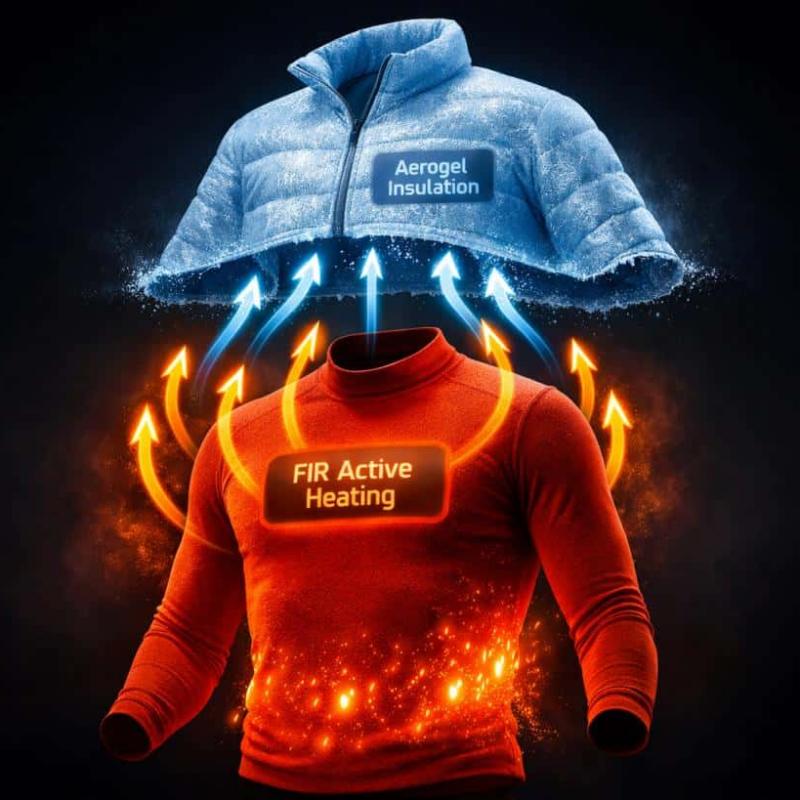
The Warmest Lightweight Winter Technologies in 2026: Aerogel Insulation vs Far Infrared Yarn (And Why You Need Both)
Picture this: it’s -15°C at the trailhead. You’re wearing a jacket rated for extreme cold, layered over a thermal base,...