 English
 Español
 Português
 Deutsch
 한국어
한국어 日本語
日本語 Italiano
 Français
 العربية
 Türkçe
A visitor rests a hand on a service robot’s forearm. The surface should feel welcoming, yet the fabric also has to come off for cleaning and leave the machine’s cooling paths clear. That is a useful starting point for cooling and easy-clean textiles for humanoid robots: choose the yarn for the job of each panel, rather than dress every part in the same fabric.
PE cooling yarn offers a starting point for a smooth contact face. Easy-clean polyester puts stain removal at the center of the design. Graphene composite yarn is another option to investigate where its documented properties fit the part. Here is how those choices can become thin, soft covers—and where a seam, opening or air gap matters as much as the yarn.

Textiles for Humanoid Robots: Start with the Contact Surface
When developing humanoid robot clothing, you do not have to begin with a full outfit. A forearm panel, a torso contact area or a removable pad gives the textile a defined job. On a forearm, the visitor encounters the surface. Around an elbow, the assembly needs clearance. Beside an air outlet, an opening may do more for heat removal than a different fiber.
Figure’s Figure 03 introduction describes soft textile coverings and washable soft goods that can be removed without tools. It shows why robot clothing belongs in the maintenance discussion as well as the appearance discussion. It does not identify Smartex as a material supplier.
For your design, mark the places people touch, the parts that move and the panels an operator needs to open. That drawing turns “soft wearables for embodied AI” into a set of manageable material decisions. A soft contact fabric and a clear service opening can work together without becoming one continuous garment.
A Cool Touch Is Only the Beginning
A surface can feel cool when your hand touches it because heat moves from the warmer hand into the textile. Whether the same textile helps a working robot release heat is a separate question: heat from the casing needs a path to a cooler surface or moving air.
A kitchen countertop offers a familiar comparison. Its initial feel can be cooler than a towel in the same room because they exchange heat with your hand differently. That sensation does not tell you how a textile cover will handle a motor’s sustained heat load. For the robot, thickness, contact with the shell, backing and ventilation all belong in the design.
If the cover sits across a warm shell, consider where the heat can go after reaching the fabric. An insulating backing may interrupt the path you were trying to create. A textile that carries more heat to its outer face may also make that face warmer during operation. The goal is a useful heat path and an appropriate touch temperature together.
MIT’s polyethylene-textile research explains the interest in engineered PE fabrics for thermal comfort and moisture transport. Its human-wear research samples are not PECooX robot-cover results. A dry robot casing also lacks the sweating wearer’s source of evaporative cooling.
PE Cooling Yarn: Build Around a Smooth Contact Face
PECooX PE cooling yarn gives you a specific material to discuss with a knitting supplier. The range includes Super Soft, dope-dyed, slight-stretch and PE/PA options. If you are choosing cooling yarn for humanoid robots, Super Soft is a candidate when frequent contact makes surface feel the leading requirement.
Think of a thin forearm wrap with a smooth outer face and an opening underneath. The yarn supplies the material direction; knit density and edge construction shape the contact experience. A dense knit may look tidy but change thickness and airflow. A bulky edge can spoil the feel of an otherwise soft panel.
Color and processing belong in that conversation too. Dope-dyed yarn introduces color during fiber production; compare the proposed shade with a physical reference. PE/PA can mean different constructions, including bicomponent filament or plied yarn. Their arrangement changes the processing question, so agree the chosen yarn’s finishing and care conditions rather than borrowing a nylon-only recipe.
Where Does Graphene Yarn Fit?
A polymer yarn containing graphene behaves as a composite. The host polymer, additive distribution and finished fabric all influence the result. A conductivity value for pure graphene cannot tell you which robot cover will work better.
Smartex’s graphene filament range includes polyester and nylon options. Its antibacterial or anti-static functions may be relevant to a particular brief; they answer different questions from heat removal. A warming or far-infrared application also does not establish lower component temperatures.
For a warm torso panel, you could compare a graphene-containing fabric with a PE fabric using similar mass, thickness and backing. Keep the operating cycle and airflow the same. If their surface temperatures differ, the recorded construction helps explain why. This is a proposed comparison, not a reason to put graphene into every panel or rank it above PE without fabric-level evidence.
Easy Cleaning Starts with the Stain
A reception robot may collect hand oils. A robot carrying food may encounter grease or sauce. The stain tells you more about the cleaning requirement than a broad “washable” label does.
For a washable fabric for robot covers, separate three questions: does a liquid wet the surface, does the mark come out during cleaning, and does the panel still fit afterward? Repellency, soil release and washability describe those different tasks. Antibacterial activity does not remove the visible stain.
Cleenzo easy-clean polyester filament yarn offers a material option when stain removal is the main problem. For a frequently handled forearm, compare it with conventional polyester under the intended care routine. The soil-release fabric guide explains the broader mechanism; here, the useful question is whether the cleaned cover remains suitable for the part.
AATCC TM130-2025, Soil Release: Oily Stain Release Method, addresses oily stain release after home laundering. That can inform a laundering brief. A disinfectant wipe is a different exposure, with its own agent, concentration and contact time.
| Design idea | Yarn candidate | Choice that shapes the fabric |
|---|---|---|
| A smooth forearm contact panel | PECooX Super Soft PE | A thin knit and low-bulk contact-side edges. |
| A frequently stained removable panel | Cleenzo easy-clean polyester | The representative soil, care routine and fit after cleaning. |
| A panel with a defined color | Dope-dyed PECooX | The physical shade reference and selected filament specification. |
| A heat-spreading comparison | Graphene composite and PE fabrics | Comparable fabric construction and an actual path for heat to leave. |
Use these as starting ideas. You may give a contact area one fabric and a stain-prone removable section another. Combining every function in the first sample makes it harder to learn which choice helped.
A Thin Fabric Can Still Feel Hard at the Seam
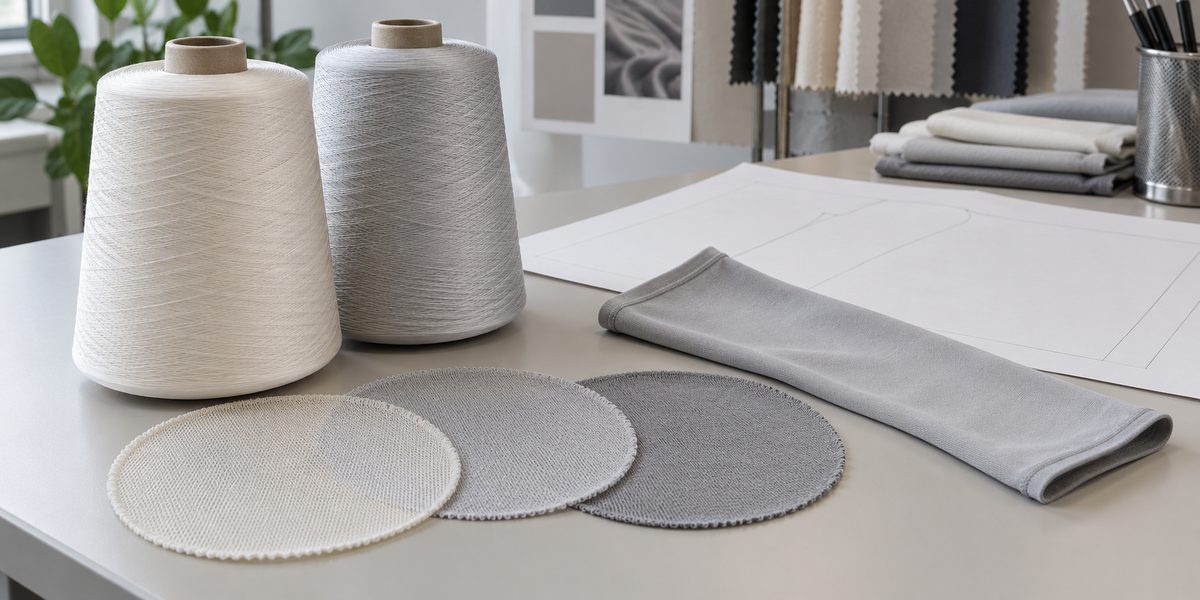
A shirt cuff can feel comfortable across its fabric and firm at a folded seam. A robot panel has the same textile design problem: what your hand meets is the assembled edge as well as the fabric. A smooth swatch is only the beginning.
When developing fabric for robot garments, compare a flat swatch with a bound or sewn piece. If the edge becomes the hardest part, changing its position or reducing its bulk may help more than changing yarn. Record the filament specification, knit structure, fabric mass and thickness so the textile supplier can reproduce the construction you want.
Stretch also comes from the whole construction. Yarn elasticity, knit recovery and fastening tension affect how the panel moves. A humanoid robot’s rigid shell and joint clearance are different from a person’s arm, so a sleeve that feels comfortable on a wearer is not a ready-made robot pattern.
Give the Cover a Way Off the Robot
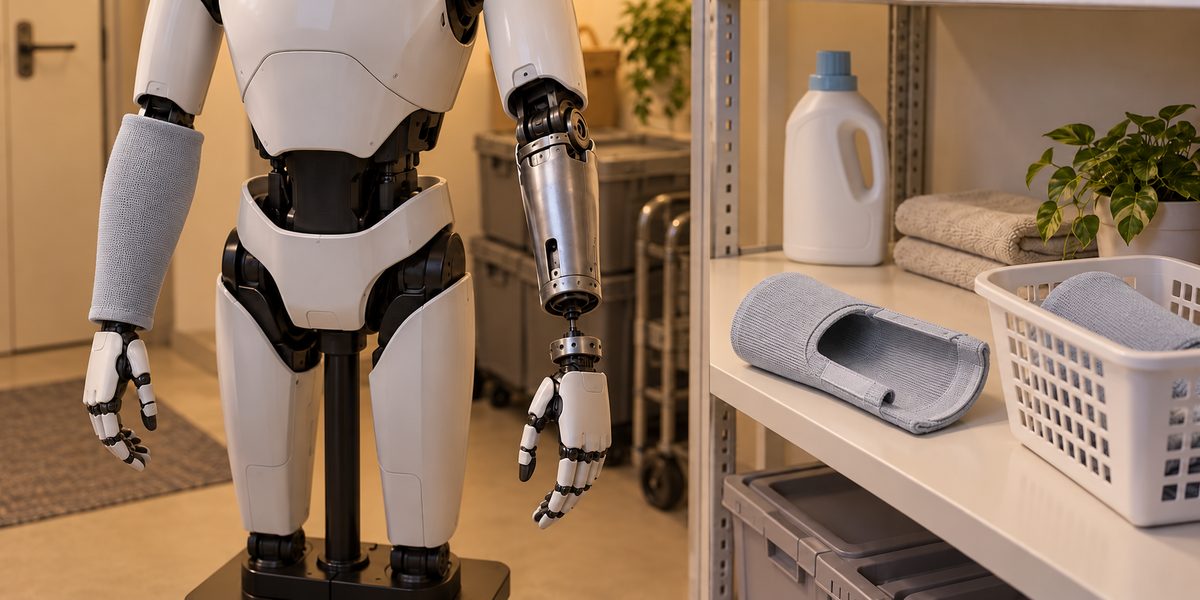
A close-fitting sleeve becomes awkward to remove when the hand is wider than the opening. A forearm wrap that opens along its underside offers another approach: it unfolds around the shell while leaving the contact face smooth. The removable PE forearm-cover concept follows that idea through material and pattern choices.
Leave the wrist and elbow clear through movement, and preserve cooling outlets and service access. If the textile lies above a tactile sensor, assess the actual layers with that sensor: thickness and stiffness change how a touch reaches it. Soft feel alone does not establish sensing performance or pinch protection.
Turn One Design Idea into a First Sample
For textiles for humanoid robots, a small contact panel is a useful place to start. Compare a simple reference fabric with one specialist candidate on the same pattern. Keep the early question narrow: does the PE option improve the intended contact feel, or does the easy-clean option better suit the stain and care routine?
On the platform, follow its operating limits and compare the covers under the same workload, ambient conditions and airflow. Look at the component and accessible-surface temperatures, the panel’s position during movement, and its fit after cleaning. Those observations tell you what to change next: fabric structure, an edge, an opening or the material itself.
You can begin the material discussion with a sketch of the part, its main contact or cleaning problem, and the intended care method. A precise drawing can come later as the construction takes shape.
Have a robot contact panel in mind? Share your application sketch with Annie’s Smartex to discuss PE cooling and easy-clean polyester yarn candidates for a first fabric sample.

Related Posts

How to Choose the Right Cooling Fabric: A Buyer’s Guide to PCM Nylon, Cool-Touch Nylon & 8C Pro Polyester
The Problem With “Cooling” as a Category Walk into any trade show in 2025 and half the booths will have...

Insulation ≠ Heating! How to Choose the Right Thermal Technology for Fall/Winter Textiles
When shopping for winter clothing, have you ever noticed labels claiming “thermal insulation,” “heat generation,” or “warming technology”? Many people...

Beyond Cooling: Why UV Protection and Solar Heat Management Matter in Next-Generation Summer Textiles
“Cool touch” solves what happens the instant fabric meets skin. It does not solve what happens after — sustained sweat,...

Easy Clean Fabric Solution for Kids’ School Uniforms
Cleenzo™ Soil-Release Technology · Surviving Lunch, Recess, and 30+ Washes The Challenge “Every parent’s inbox looks the same by Friday:...