 English
 Español
 Português
 Deutsch
 한국어
한국어 日本語
日本語 Italiano
 Français
 العربية
 Türkçe
Here’s something most activewear brands won’t tell you: that “fresh out of the dryer” smell doesn’t last because your fabric has a bacteria problem — and washing doesn’t fix it.
Think about it. You finish a hard session. You toss your shirt in the wash. It comes out clean. But twenty minutes into your next workout, that sharp, sour gym funk is back — sometimes worse than before. You’re not imagining it. A 2014 study in Applied and Environmental Microbiology tested polyester T-shirts after a single cycling session and found that synthetic fibers selectively trap odor-producing bacteria like Micrococcus — strains that survive standard wash cycles and repopulate the moment conditions get warm and wet again. Detergent cleans the surface. It doesn’t reach what’s living inside the fiber.
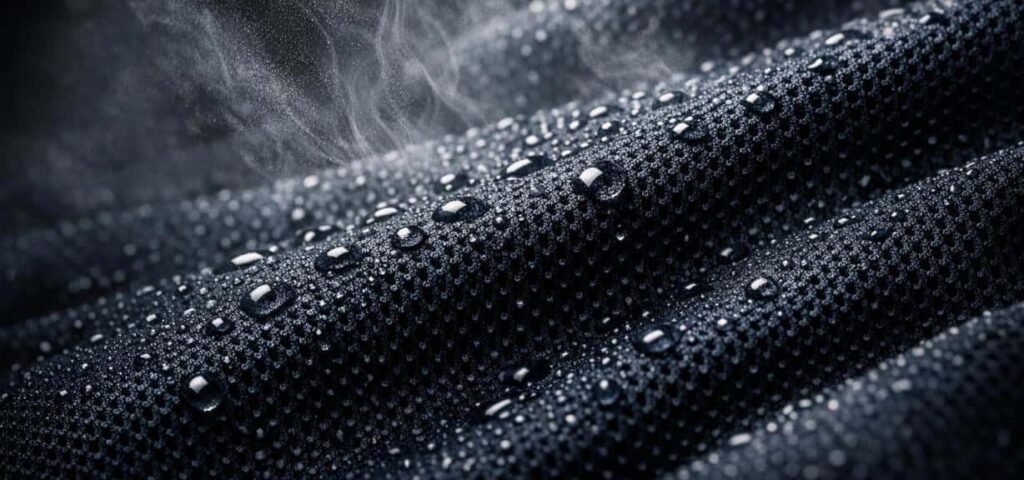
That’s the real problem. And it’s exactly what antibacterial yarn was engineered to solve. Unlike surface-treated “antibacterial” finishes that wash off within 20–30 cycles, ion-embedded technologies — like nano zinc fused directly into the fiber during spinning — inhibit bacterial growth from inside the material itself. The antimicrobial effect doesn’t degrade because it was never a coating to begin with. Verified under ASTM E2149-20, a dynamic contact test that simulates real-world mechanical stress, ion-embedded antibacterial yarn maintains its efficacy after 50+ wash cycles. If your performance apparel still smells after a month of use, the yarn is the problem. Here’s how to identify what actually works — and what doesn’t.
Sweat Doesn’t Smell. Bacteria Do.
Here’s what’s actually happening inside your workout shirt.
Sweat itself is odorless — it’s mostly water, salt, and trace proteins. The smell comes from bacteria on your skin and fabric breaking down those proteins into volatile compounds like isovaleric acid and ammonia. That’s the sharp, sour smell you can’t wash out.
A 2014 study published in Applied and Environmental Microbiology tested T-shirts from 26 people after an intensive cycling session. Polyester shirts showed significantly higher odor intensity than cotton — because synthetic fibers selectively harbor Micrococcus bacteria, which are among the most aggressive odor producers.
A 2022 study in Heliyon further identified the dominant bacteria on worn T-shirts as Staphylococcus (21.66%), Enhydrobacter (13.81%), and Pseudomonas (6.18%) — with polyester fabrics showing selective enrichment of environmental bacteria that cotton did not.
So when your gym shirt smells, you’re essentially smelling bacterial metabolic waste. Washing removes surface bacteria. It doesn’t remove the ones embedded deeper in the fiber structure.
Why Washing Doesn’t Fully Fix It
Bacteria form biofilms — thin protective layers that bond to fabric fibers at a microscopic level. Standard detergent disrupts the surface, but biofilm colonies can survive routine wash cycles and repopulate within hours of your next sweat session.
A comprehensive 2023 review in iScience confirmed that sportswear fabric becomes a persistent breeding ground for skin microbiome bacteria, and that odor management requires addressing the textile material itself — not just washing frequency or detergent choice.
Washing more often isn’t the answer. Using a fabric that doesn’t let bacteria thrive in the first place is.
What Antibacterial Yarn Actually Does
Antibacterial yarn is engineered to inhibit bacterial growth at the fiber level — before odor has a chance to form.
There are two fundamentally different approaches, and the difference matters:
Surface coating applies an antimicrobial chemical to the outside of finished fabric. It works initially. But every wash cycle degrades the coating. By wash 20–30, most of the antibacterial effect is gone — right around the time a garment is breaking in.
Ion-embedded technology fuses antimicrobial ions — nano zinc, nano silver, or nano copper — directly into the fiber during the spinning process. The ions become part of the fiber’s molecular structure. They can’t wash out because they were never on the surface to begin with.
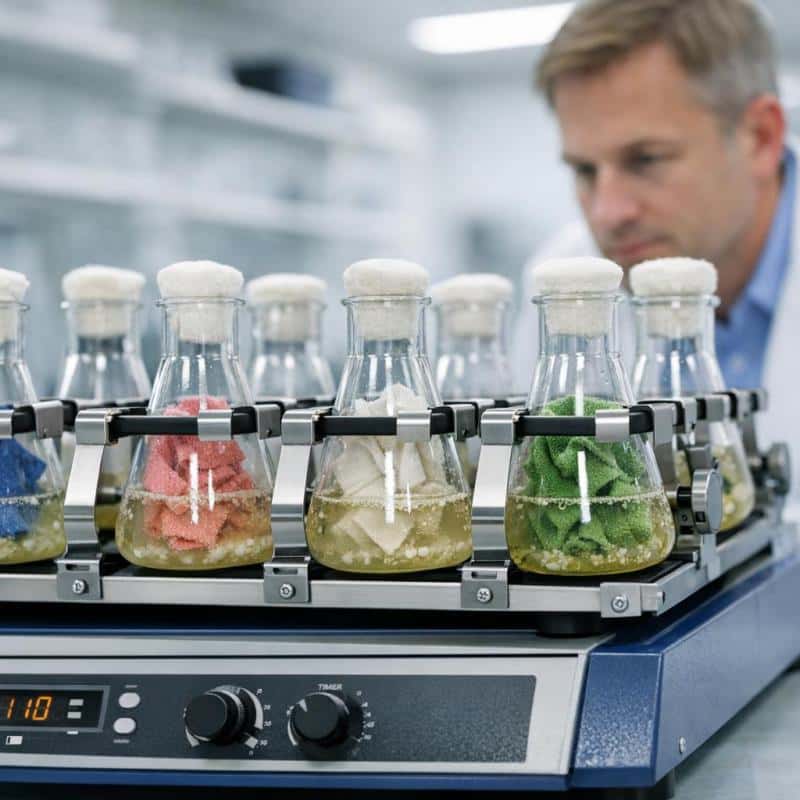
The practical difference: a surface-coated shirt loses its antibacterial protection within a season. An ion-embedded yarn like 8C Pro maintains performance after 50+ wash cycles.
How Nano Zinc Ions Stop Bacteria
Zinc ions disrupt bacterial cell membranes on contact, interfering with the bacteria’s ability to reproduce. No reproduction means no metabolic byproducts. No byproducts means no odor — even after hours of heavy sweating.
8C Pro yarn embeds nano zinc ions directly into the fiber structure. Its antibacterial efficacy is verified through ASTM E2149-20 — a dynamic contact test method, also known as the “shake flask test,” where fabric samples are continuously agitated in a concentrated bacterial suspension for a specified contact time. Unlike static methods, ASTM E2149-20 simulates real-world mechanical stress conditions, making it particularly suited for evaluating non-leaching, substrate-bound antimicrobial agents in textiles.
The test measures both percent reduction and log reduction of bacterial colonies — comparing treated fabric against untreated controls run simultaneously — to produce quantifiable, reproducible antimicrobial efficacy data.
How to Tell If an Antibacterial Claim Is Real
This matters more than most brands admit.
| What to check | What it means |
|---|---|
| ASTM E2149-20 certification | Dynamic shake flask test — evaluates substrate-bound antimicrobials under mechanical stress |
| AATCC 100 certification | Static 24-hour contact test — widely used but less suited for hydrophobic or irregular surfaces |
| ISO 20743 certification | International equivalent, widely accepted in Asian markets |
| Post-wash testing | Was the fabric tested after 50 washes, or only when new? |
| Specific bacteria tested | Staphylococcus aureus and Klebsiella pneumoniae are the benchmark strains |
| Ion-embedded vs. coating | Ask directly — most brands won’t volunteer this information |
If a supplier can’t provide a third-party test report with post-wash data, the antibacterial claim is almost certainly a surface treatment. ASTM E2149-20 is specifically designed for non-leaching antimicrobial surfaces — meaning it confirms the active agent stays in the fiber rather than dissolving into sweat or wash water.
Where It Makes a Real Difference
Antibacterial yarn matters most in situations where you can’t just wash the problem away.
Multi-day hiking trips. Back-to-back training sessions with no time to wash between. Long-haul flights in the same clothes. Team uniforms shared across a season. Medical and care uniforms worn through 12-hour shifts.
In all of these scenarios, the fabric’s built-in bacterial resistance is the only line of defense. A garment that smells fine after one wear but deteriorates by the third is functionally useless for anyone with a serious use case.

Compression wear and athletic base layers are particularly high-stakes — prolonged skin contact, high sweat volume, and tight fit create exactly the warm, moist conditions bacteria need to multiply fastest.
8C Pro: Antibacterial Built Into a Multi-Function Yarn
8C Pro was developed for performance apparel brands that need more than one function from a single yarn.
The nano zinc ion antibacterial system is the foundation. On top of that, 8C Pro integrates:
- Cool Touch — Taiwanese jade, crystal, and mica minerals embedded in the fiber create a measurable cooling sensation against skin. No chemical agents, no skin irritation.
- 8C Microporous Moisture Wicking — The patented 8C-shaped channel structure moves sweat away from skin 7x faster than conventional fabric — in 2 seconds versus the 10–15 seconds of standard materials.
- UPF 100+ UV Protection — The same zinc ions that fight bacteria also block UVA and UVB radiation, making 8C Pro viable for outdoor apparel without adding a separate UV treatment.
Four verified functions. One yarn. No surface coatings that wash out.
View 8C Pro Technical Specifications and Test Reports →
Frequently Asked Questions
Does antibacterial clothing actually work, or is it just a marketing claim?
It depends entirely on the technology. Ion-embedded antibacterial yarns — where antimicrobial agents like nano zinc are fused into the fiber during manufacturing — have strong independent test data behind them. Fabrics certified under ASTM E2149-20 undergo a dynamic shake flask test that measures quantifiable bacterial reduction rates against specific strains like Staphylococcus aureus and Klebsiella pneumoniae. Surface-coated “antibacterial” fabrics are a different story: the coating degrades with washing and the claims are rarely backed by post-wash test data. Ask for the test report. If there isn’t one, treat the claim skeptically.
Why do my gym clothes still smell even after washing?
Because bacteria form biofilms inside fabric fibers that standard detergent can’t fully eliminate. Research published in Applied and Environmental Microbiology found that polyester sportswear selectively harbors odor-producing bacteria like Micrococcus, which survive wash cycles and repopulate rapidly during the next sweat session. The fix isn’t washing harder — it’s using fabric with built-in bacterial resistance.
How many washes does antibacterial yarn last?
For ion-embedded yarns, the antibacterial effect is tied to the fiber itself, not a surface treatment — so it lasts the functional lifespan of the garment, typically verified to 50+ wash cycles. Surface-coated alternatives typically lose meaningful antibacterial performance within 20–30 washes. ASTM E2149-20 specifically tests non-leaching antimicrobial agents — confirming the active ingredient stays bound to the fiber rather than washing out over time. Always ask whether the supplier’s test data was collected on new fabric or after repeated washing.
Is antibacterial yarn safe for skin contact?
Nano zinc ion yarns are non-leaching — the ions don’t dissolve out onto skin during wear. ASTM E2149-20 actually includes a leach test as part of its protocol: if antimicrobial agents are detected leaching into the solution during testing, results are flagged as unreliable until neutralization is confirmed. This built-in verification step is one reason ASTM E2149-20 is considered particularly rigorous for substrate-bound antimicrobials.
What’s the best antibacterial fabric for workout clothes?
For high-performance athletic use, look for ion-embedded antibacterial yarn with ASTM E2149-20 certification and documented post-wash performance. Nano zinc and nano silver are the most widely tested options. Nano zinc has the added benefit of UV-blocking properties, making it more versatile for outdoor apparel. Avoid fabrics that only list “antibacterial finish” without specifying the technology or providing third-party test documentation.
Does antibacterial yarn help with athlete’s foot or fungal issues?
Standard antibacterial yarns target bacteria specifically. For antifungal protection, look for yarn tested against fungal strains under ISO 20743 or AATCC 30. Some nano zinc formulations show broad-spectrum antimicrobial activity, but always verify with the supplier’s specific test reports rather than assuming antibacterial coverage extends to fungi.
References
- Callewaert, C. et al. (2014). Microbial Odor Profile of Polyester and Cotton Clothes after a Fitness Session. Applied and Environmental Microbiology. https://pmc.ncbi.nlm.nih.gov/articles/PMC4249026/
- Chang, Y. & Wang, X. (2023). Sweat and odor in sportswear – A review. iScience. https://pmc.ncbi.nlm.nih.gov/articles/PMC10391722/
- Yan, H. et al. (2022). Microbial profile of T-shirts after a fitness session of Chinese students. Heliyon. https://www.sciencedirect.com/science/article/pii/S2405844022036672
- QIMA. (2025). Antimicrobial Fabric Testing: Overview of Test Methods. https://blog.qima.com/textile/antimicrobial-fabric-testing-importance-and-methods
- NAMSA. ASTM E2149 Test Method — Antimicrobial Efficacy Under Dynamic Contact Conditions. https://namsa.com/services/testing/tests/astm-e2149-time-points/
- Microchem Laboratory. ASTM E2149 — Determining the Antimicrobial Activity of Immobilized Antimicrobial Agents Under Dynamic Contact Conditions. https://microchemlab.com/test/astm-e2149/
- Resinova Labs. ASTM E2149-20 Standard Test Method for Determining the Antimicrobial Activity of Antimicrobial Agents Under Dynamic Contact Conditions. https://resinnovalabs.com/tests/astm-e2149-standard-test-method-for-determining-the-antimicrobial-activity-of-antimicrobial-agents-under-dynamic-contact-conditions/

Related Posts

Best Fabric for Summer Workout Clothes: How to Choose Performance Fabrics That Actually Work
Why Your Expensive Workout Gear Might Be Failing You You’ve invested in “premium” athletic wear with promises of moisture-wicking and...
Bamboo Charcoal Yarn: The Secret to Odor-Free, Antibacterial Clothes
Why this odor-fighting yarn is replacing traditional polyester in athletic wear, bedding, and everyday clothing Let’s be honest – we’ve...

The 5 Ways Fabrics Actually Keep You Cool—How to Easily Beat the Upcoming Hot Weather
42°C Peak temps in Southern Europe, Summer 2026 <5% Homes with A/C in the UK & Germany 2027 Projected hottest...

Antibacterial Fabric Complete Guide: 8 Technologies Compared by Metal, Mineral & Plant Origins (2026)
The global demand for antibacterial fabric has surged in recent years — not just in medical settings, but across sportswear,...