 English
 Español
 Português
 Deutsch
 한국어
한국어 日本語
日本語 Italiano
 Français
 العربية
 Türkçe
Creative Textile Lab · Electronics workwear
At an electronics assembly bench, a short-sleeve polo stops being a simple uniform choice. When the wearer leans into the task, the sleeve moves, the layer underneath becomes part of the clothing system, and the side seams and placket interrupt what looked like a continuous conductive grid on a fabric swatch. That is why an ESD polo shirt project should begin with the garment’s role at the workstation—not with a request for “anti-static fabric” alone.
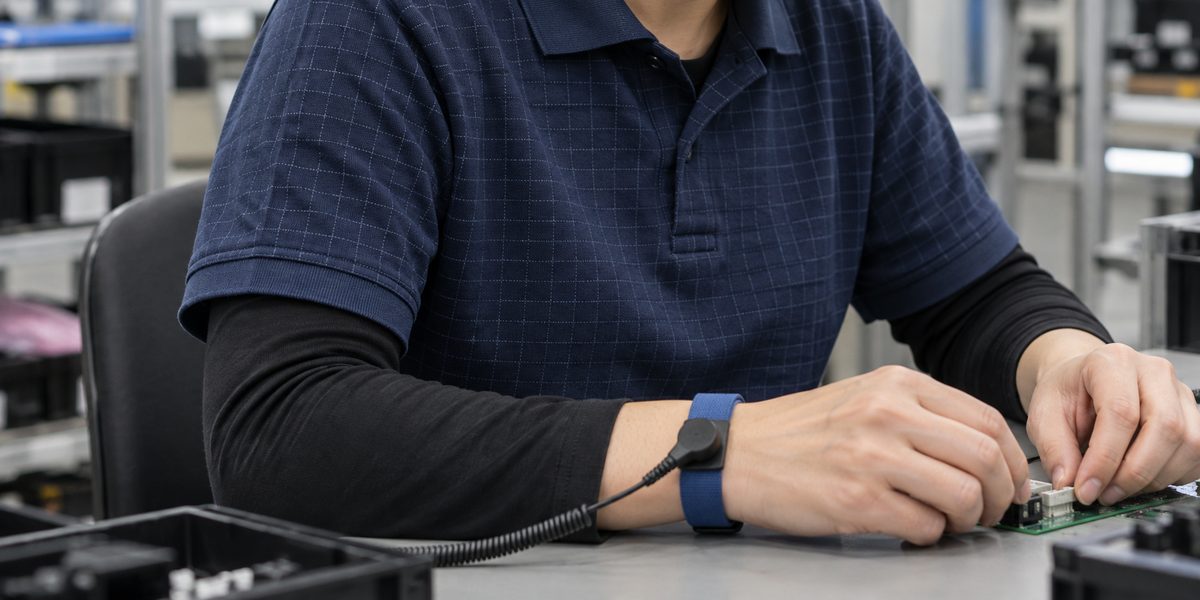
Illustrative application scene. The wrist strap remains a separate part of the workstation’s personnel-grounding controls.
The challenge: a familiar polo in an unfamiliar control role
A polo is easy to issue, easy to recognize and usually more acceptable to wear than a specialist smock. The difficult question is what the site expects it to do. Is it simply a uniform made with a static-dissipative fabric? Is it intended to reduce charge on clothing worn underneath? Does the facility require a groundable garment, defined coverage or a particular resistance evaluation? Those are different briefs, even when the shirts look similar.
The short sleeve makes the conflict visible. It may improve comfort and mobility, yet it leaves more of the underlayer and wearer exposed than a full-coverage garment. Conductive yarn cannot resolve that conflict by itself. Before knitting begins, the buyer needs the facility’s ESD coordinator to confirm whether the polo format belongs in the approved control plan and which garment paths actually matter.
Before choosing conductive yarn, define the job of the shirt
A useful development brief describes the assembly task, the clothing worn underneath, the workstation controls already in use and the person who will approve the garment. It should also state whether the polo is replacing an existing garment or simply introducing a more wearable uniform within an unchanged control system.
The better sourcing question is not “Do you have ESD yarn?” It is “Which garment function are we trying to verify after knitting, sewing, decoration and laundering?”
This distinction prevents an expensive shortcut. A buyer may be tempted to approve a conductive fabric swatch because its measured behavior looks promising. Once that swatch becomes a polo, however, the grid direction, separate front and back panels, sleeve joins, collar, placket and sewing thread create a different article. If the site needs continuity across a particular path, that path has to exist in the construction and be evaluated on the finished garment.
Building the first ESD polo shirt prototype
Start with a fabric route the garment maker can reproduce
One route is to introduce a regular conductive-yarn grid into a knit selected for weight, opacity, stretch and next-to-skin comfort. Annie’s Smartex can discuss carbon/polyester or carbon/nylon conductive yarn as a material starting point. The grid spacing, base fiber, knit structure and finish still need to be chosen together; changing any one of them can affect both garment behavior and production handling.
A useful control sample is the same polo pattern made in a conventional knit. It will not serve as a qualified ESD garment, but it helps the development team separate ordinary fit, shrinkage and sewing issues from questions introduced by the conductive construction.
Let the seams reveal the weak assumptions
Turn the first prototype inside out. Follow the conductor direction from the body toward the shoulder, underarm and sleeve. Look at where the front and back panels meet and what happens around the placket. Ordinary sewing thread should not be treated as proof of an electrical connection. If a path matters to the brief, the pattern and joining method must be designed so that it can be examined and measured.
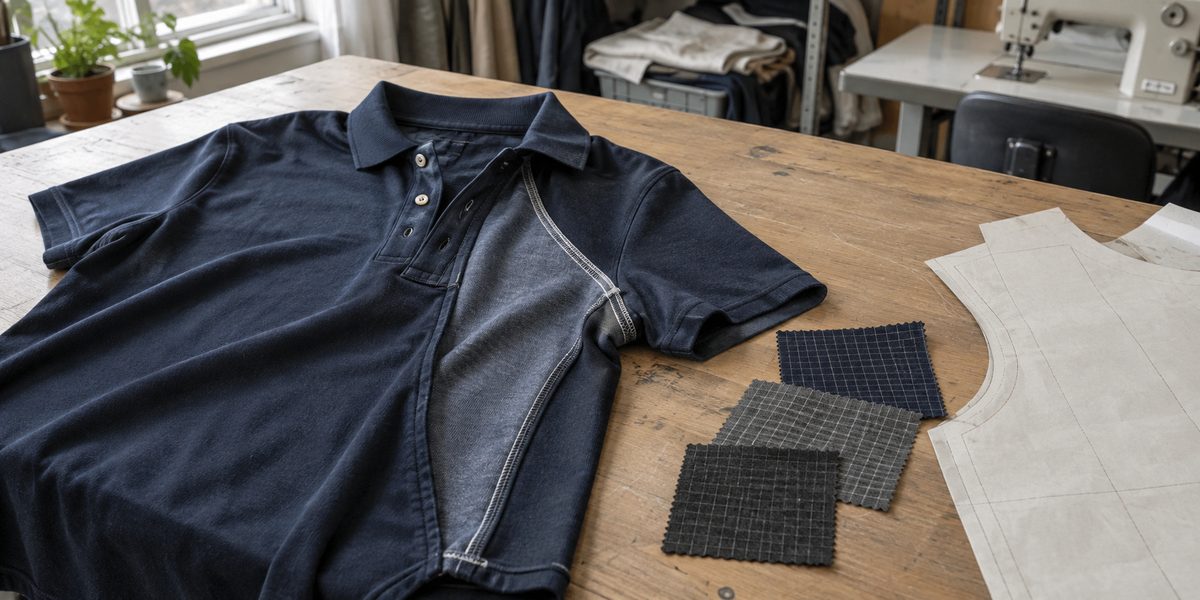
Concept image: the inside of the garment is where panel joins, conductor direction and sewing choices become visible.
Put the real logo and care route into development
An undecorated navy prototype is not the final uniform. Embroidery, heat transfers, seam tape, softeners, dyeing and laundering can alter local construction or material behavior. Rather than adding these processes after approval, include the proposed shade, logo method and care route in the sample plan. The purpose is not to assume that every decoration causes a problem; it is to avoid qualifying a simpler article than the one workers will actually wear.
A small sample comparison can answer the useful questions
Three traceable garments are often more informative than a large set of loosely documented swatches. Keep the pattern, size and shade as consistent as practical, change one meaningful construction variable, and record the yarn lot, knitting, finishing, sewing and care history for each sample.
| Sample | What changes | What the team can learn |
|---|---|---|
| Control polo | Conventional knit in the same garment pattern | Establishes a baseline for fit, sewing, appearance and care; it is not an ESD qualification sample. |
| Conductive-knit polo | Selected conductive grid in the proposed production construction | Shows how the material route behaves after panels, seams, placket and sleeves are assembled. |
| Construction-adjusted polo | One defined change, such as conductor direction or a panel join | Tests whether that change addresses the specific garment path or production concern behind it. |

Concept image: compare a controlled number of construction variables rather than approving a generic fabric swatch.
What finished-garment evaluation needs to cover
IEC 61340-4-9:2024 describes resistance-characterization methods for static-control garments. The evaluator should decide which measurements are relevant to the polo’s assigned role, how the garment is conditioned and which conductive components can be assessed with the selected method. A number copied from a yarn or fabric sheet does not replace that garment-level decision.
The evaluation plan should also reflect the intended care process. Compare relevant garment measurements before and after agreed laundering milestones, while separately reviewing dimensional change, appearance, seam condition and wear comfort. None of those checks, by itself, qualifies the workstation or personnel-grounding system.
An ESD polo should not be presented as automatically equivalent to a full-coverage smock, flame-resistant clothing, arc protection or cleanroom apparel. If contamination control is part of the brief, use the separate cleanroom garment development concept. For an earlier comparison of material routes, see the anti-static yarn buyer’s guide for industrial workwear.
What to send with an ESD polo shirt RFQ
Before asking for a sample, prepare the assembly task, the polo’s expected control role, required coverage, underlayers, existing grounding controls, base fiber preference, target fabric weight, stretch, shade, size range, logo method, care process and the garment evaluation your site plans to use. Also identify the pilot quantity and who will approve the finished garment.
With that information, Annie’s Smartex can discuss a conductive-yarn and fabric starting point without pretending that one stock polo fits every electronics assembly program.

Related Posts

PCM Thermoregulation Technology · Nylon-Modal-Tencel Blend Men’s Summer Shirt Fabric
The Summer Shirt That Feels Cool Against Skin — and Stays Comfortable Through the Heat The Challenge “Our men’s summer...

Multi-Day Travel Shirt Case
The Travel Shirt That Stays Fresh for 3 Days — No Washing, No Odor, No Compromise The Challenge “We’re building...

Replacing Foam Insulation in Air-Laid Cold Chain Liners with Aerogel Fiber
Cold Chain Thermal Management · Air-Laid Nonwoven Innovation The Challenge “Our current insulation liners are too heavy, too thick, and...

High-Performance Athletic T-Shirt
The Challenge “Create athletic wear that keeps athletes cool and dry during intense physical activity.” University of Moratuwa’s textile research...