 English
 Español
 Português
 Deutsch
 한국어
한국어 日本語
日本語 Italiano
 Français
 العربية
 Türkçe
CREATIVE TEXTILE LAB · MATERIAL-TO-APPLICATION CONCEPT
A soft surface for a visitor’s hand. An opening that makes the cover easier to remove.
A visitor touches a robot’s forearm in a showroom. Later, someone has to take that contact panel off and clean it. A neat stretch sleeve may look like the obvious choice—until the robot’s hand is wider than the opening.
This concept explores removable robot covers that open around the forearm instead. PECooX Super Soft PE yarn is the starting candidate for the contact face; a thin knit and an underside opening give it a specific role. The design question is simple: how do you make that surface pleasant to touch without making care awkward?

Removable Robot Covers: Start with the Way They Come Off
A tighter sleeve can sit neatly on the shell, but it has to pass over the hand during removal. A looser one is easier to pull off, yet can fold or shift. More stretch does not automatically solve both problems.
You can see a similar tradeoff when pulling a close-fitting cuff over your hand. On a robot, rigid hardware, joint gaps and service openings add constraints that a person’s sleeve does not share. That makes the removal path a pattern decision worth settling early.
For this proposed panel, the cover ends on the straight, stationary shell between the wrist and elbow. Its purpose is a soft contact face, with the moving regions left clear. Keeping that job small makes it easier to explore one material and one opening before designing a whole outfit.
Why Start with PECooX Super Soft PE?
PECooX PE cooling yarn provides a specific candidate for this contact surface. The product literature describes the Super Soft series in terms of adjustments to filament strength and modulus—a measure of stiffness—to support soft, smooth fabrics. That is the reason to begin with it here.
The proposed fabric is a thin, fine-gauge filament knit. Keep the edge low in bulk, because a hand resting on the panel may reach its binding as well as its face. You can compare a flat swatch with a sewn piece before changing the yarn: if the swatch feels right and the edge feels firm, the seam is the part to develop.
Compare the proposed PE fabric with the reference during initial touch as well as after the robot has been operating. It does not establish continuous heat removal from the forearm assembly. Thickness, backing and contact with the shell still shape the heat path, so the first sample can remain a simple fabric-and-closure construction.
For color, discuss a dope-dyed PECooX option against a physical reference. Color is introduced during fiber production. The specific color and Super Soft specification need to be agreed together; the range’s options are not automatically combined in every yarn.
Put the Opening Underneath the Forearm
An underside opening lets the wrap unfold around the shell. The operator can remove it without stretching the panel across the hand, while the upper contact face stays uninterrupted. A flat overlapping edge is one starting construction.
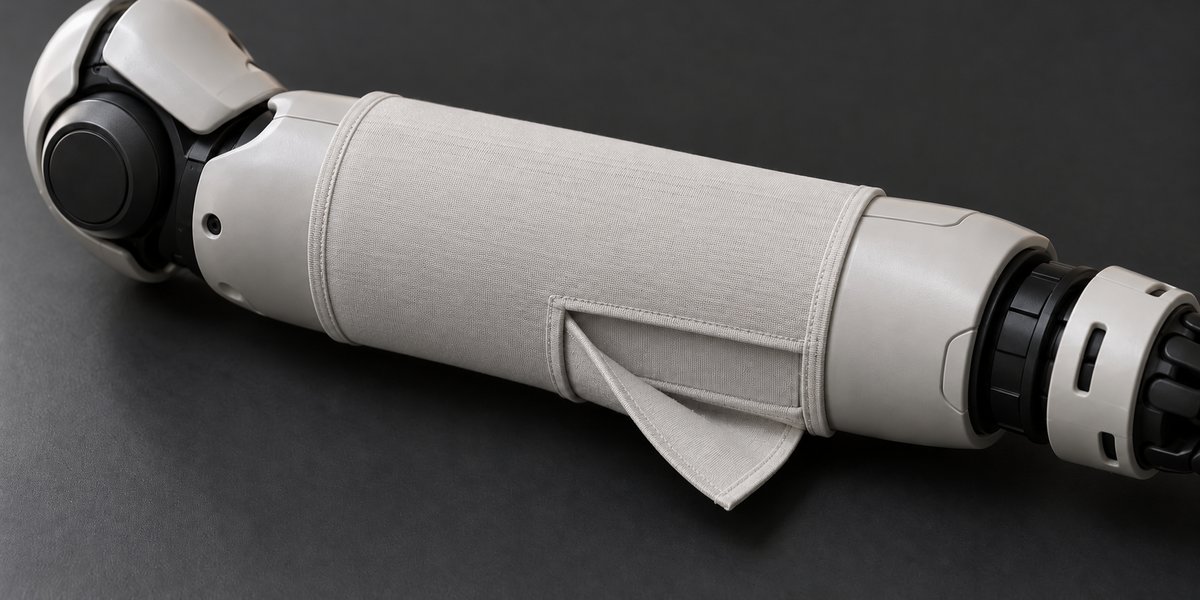
That changes what you ask the fabric to do. It needs enough conformability to sit on the shell, but removal no longer depends on expanding a cuff over hardware. Excess closure tension could still make the panel feel firm or pull it out of position. Locating the fastening away from the touch area gives you a separate detail to adjust.
The robot’s service position determines whether the underside is accessible. Keep the pattern off vents, sensor fields and inspection points, with clearance at the wrist and elbow throughout movement. If the shell has no suitable place to attach the wrap, a separately mounted contact panel is a reasonable alternative to explore.
The useful design change: open around the forearm. It separates the removal problem from the question of how much the fabric can stretch.
What If Cleaning Matters More Than Cooling Touch?
A showroom contact panel might be chosen mainly for feel. A forearm used around food or frequent hand contact may face a harder cleaning problem. That changes the material comparison.
Cleenzo easy-clean polyester filament yarn is the alternative to include when stain removal leads the brief. Keep the same proposed pattern and closure, and make the candidate fabrics reasonably comparable in mass and thickness. Any remaining differences should stay in the sample record so they can be considered alongside the yarn.
| Proposed sample | Why include it? | What could change the design? |
|---|---|---|
| Conventional polyester reference | Show how the pattern and opening behave without a specialist yarn. | Folding or shifting that appears across the samples points back to construction. |
| PECooX Super Soft PE | Explore a smooth contact face and initial cooling touch. | A firm seam may call for a different binding rather than a new yarn. |
| Cleenzo easy-clean polyester | Explore removal of the representative stain. | A clean panel that changes shape still needs a care or construction adjustment. |
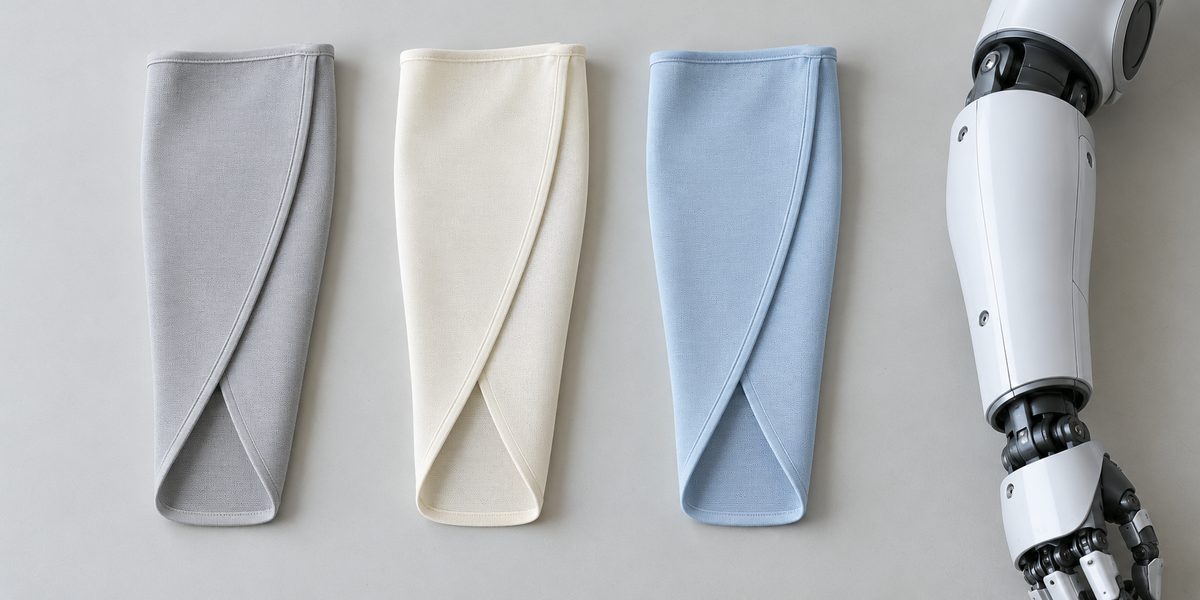
The comparison gives you a choice rather than a feature list. You may keep PE on a lightly soiled contact face or give the easy-clean fabric priority where care is harder. The useful sample is the one that helps settle the requirement of this part.
Let the First Wrap Tell You What to Change
With the cover fitted, watch where it moves as the forearm changes position. If the edge approaches a joint or the fastening rotates onto the contact face, revise the pattern or attachment. Adding another function to the yarn will not resolve that geometry.
Temperature and cleaning belong in the same sample round. Under the platform’s operating limits, compare the reference and candidates using the same operating sequence, ambient conditions and airflow. Check the assembly and accessible-surface temperatures. Any covered or nearby sensor needs its own assessment with the actual layers.
Apply the representative soil and use the intended care routine. Wiping, laundering and disinfectant exposure are different conditions. Once the fabric is dry, put the panel back on: remaining marks, a rough edge or changed fit each suggest a different next step.
These are proposed observations, not project results. Their purpose is to keep development focused: change the binding when the edge is the problem, the opening when removal is awkward, or the fabric when its care behavior does not suit the part.
Development concept notice. This case presents a material-and-application development concept informed by anonymized market inquiries and Annie’s Smartex technical research. It is not an offer for an off-the-shelf product and does not state that a specific finished product is commercially available or validated for this use. Sample availability, specifications, performance, compliance, manufacturability and care durability must be confirmed through project-specific development and testing. No confidential customer or project details are disclosed.
Start with One Forearm and One Contact Problem
For removable robot covers, a sketch of the stationary shell, the proposed contact area and the way you expect to clean the panel is enough to begin discussing materials. Add the main movement, vent and sensor constraints as the pattern develops.
The cooling and easy-clean textiles guide for humanoid robots explores the broader yarn choices. This concept offers a smaller starting point: a thin contact wrap with an opening you can develop alongside the fabric.
Have a forearm contact panel to explore? Share your application sketch with Annie’s Smartex to discuss a PECooX or easy-clean polyester fabric sample.

Related Posts

How to Choose the Right Cooling Fabric: A Buyer’s Guide to PCM Nylon, Cool-Touch Nylon & 8C Pro Polyester
The Problem With “Cooling” as a Category Walk into any trade show in 2025 and half the booths will have...
Sun Hoodie Fabric: Balancing UV Coverage and Sweat Comfort
Develop sun hoodie fabric with a clearer sample plan. Compare IcSnow nylon, UV coverage, heat shielding and fit using matched...

Solving Odor, Static & Skin Irritation in Post-Surgical Recovery Garments
Graphene Poly/Viscose Antibacterial Anti-Static Spun Yarn · Ne32s/1 Client Challenge “Our recovery garments trap odor, cause static cling, and patients...
Pineapple Leaf Fiber Kidswear: Balancing Natural Texture and Everyday Softness
See how a 10% PALF / 90% Modal yarn could be evaluated for lightweight kidswear through controlled samples, fabric checks...