 English
 Español
 Português
 Deutsch
 한국어
한국어 日本語
日本語 Italiano
 Français
 العربية
 Türkçe
How One-Way Moisture Transfer Works | SiPHONiX®
One-way moisture transfer technology aims to move liquid preferentially from the skin-facing surface to the outer surface of a textile. SiPHONiX® is a modified polyester yarn route for this development. The result depends on yarn placement, fabric geometry, wetting behavior and finishing. This page explains the mechanism and the limits of the available evidence; use the product pages for yarn or fabric procurement.
How yarn, construction and finishing work together
Capillary pathways and differences in surface wetting can favor liquid movement through the fabric thickness. Plated or double-face structures can place different yarns at the skin and outer surfaces. Dyeing, scouring, heat setting and softeners may change that behavior, so a yarn specification alone does not prove the final direction or drying rate.
Wicking, one-way transfer, drying and vapor
| Property | Meaning | Separate evidence needed |
|---|---|---|
| Moisture wicking | Capillary movement along fibers, yarns or a fabric surface | Does not establish a preferred through-thickness direction |
| One-way moisture transfer | Preferential liquid movement between fabric faces | Record top/bottom and intended skin-side orientation |
| Quick drying | Loss of retained liquid under stated conditions | A separate drying method and environmental conditions |
| Water-vapor transmission | Movement of moisture as vapor | Does not demonstrate liquid-sweat transfer |

Published test excerpts and their limits
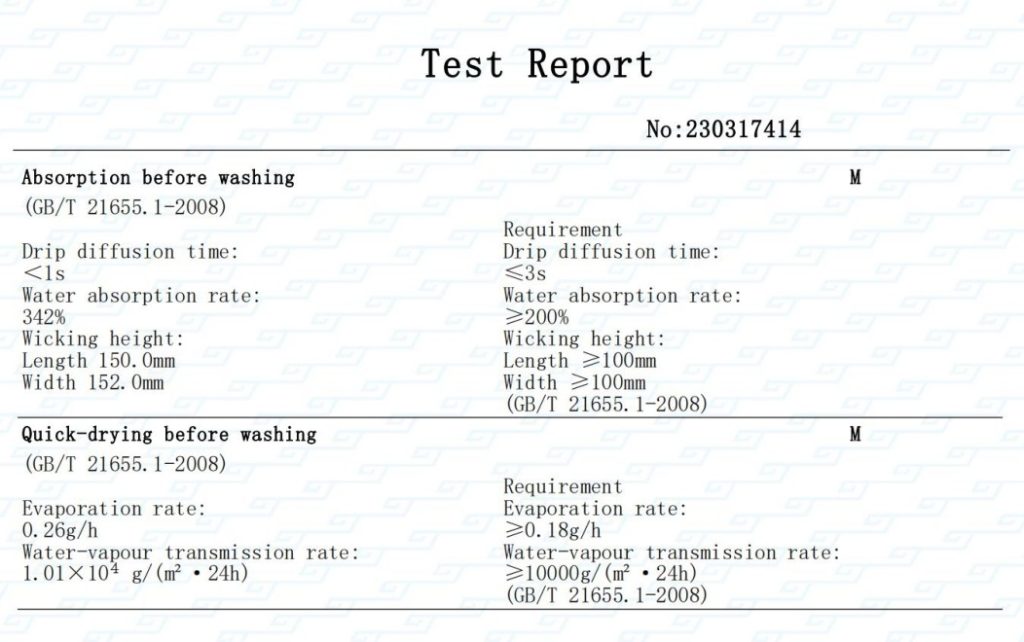
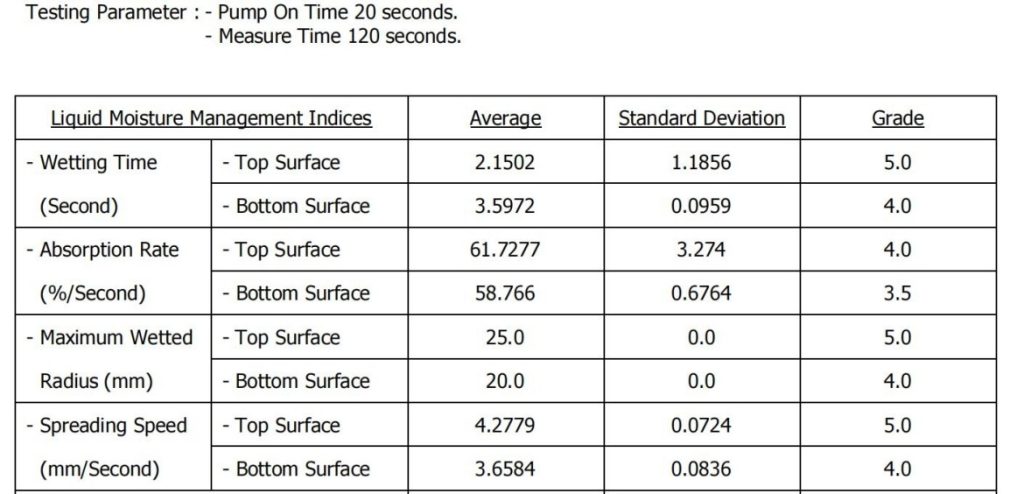
The images below are partial historical report excerpts, not a certificate covering every SiPHONiX yarn, fabric or garment. Sample identity, full construction, laboratory details, full method and conditioning records are not visible here. Request the complete report and confirm that it matches your proposed material.
Absorption and quick-drying excerpt: report 230317414
The excerpt cites GB/T 21655.1-2008, Textiles — Evaluation of absorption and quick-drying — Part 1: Method for combination tests, and labels the results as before washing. That edition is withdrawn and replaced by GB/T 21655.1-2023; these historical results must not be relabeled as testing to the newer edition. See the official standard record.
| Visible measurement | Reported value | Boundary |
|---|---|---|
| Drip diffusion time | <1 s | Before washing; sample-specific |
| Water absorption rate | 342% | Report terminology; not the MMT absorption-rate unit |
| Wicking height | Length 150.0 mm; width 152.0 mm | Full procedure not visible in the crop |
| Evaporation rate | 0.26 g/h | Conditions require the complete report |
| Water-vapor transmission rate | 1.01 × 10⁴ g/(m² · 24 h) | Vapor measurement; not proof of one-way liquid transfer |
Liquid moisture management excerpt
The second crop shows pump-on time 20 seconds and measurement time 120 seconds. Its report number, method edition, sample orientation, one-way transport index and overall moisture management capacity are not visible. Do not infer them from the values below.
| Measurement | Top average | Bottom average |
|---|---|---|
| Wetting time (s) | 2.1502 | 3.5972 |
| Absorption rate (%/s) | 61.7277 | 58.766 |
| Maximum wetted radius (mm) | 25.0 | 20.0 |
| Spreading speed (mm/s) | 4.2779 | 3.6584 |
What a new test should establish
AATCC TM195-2011e2(2017)e5, Liquid Moisture Management Properties of Textile Fabrics covers liquid moisture management in knitted, woven and nonwoven fabrics. Request the complete results, face orientation, sample identity and wash history; do not assume the historical crop used this edition. Drying, vapor transmission and air permeability need their own agreed measurements. Neither crop alone proves wash durability or guarantees one-way transfer in your finished garment.
Compare development routes under matched conditions
| Decision | Polypropylene route | SiPHONiX polyester route |
|---|---|---|
| Color | Confirm available coloration route with the grade supplier | Confirm dye recipe and colorfastness on the selected yarn |
| Heat processing | Use the grade-specific processing window | Confirm dyeing and heat-setting limits for the exact construction |
| Ventilation | Test the finished structure | Test the finished structure |
| Directional transfer | Requires an appropriate construction and validation | Requires an appropriate construction and validation |
Choose a route by color requirements, processing compatibility, fabric construction and matched test results. The available excerpts do not establish that SiPHONiX outperforms every polypropylene or conventional polyester fabric. Confirm the processing window for the actual grade and construction.
From mechanism to a sportswear sample
For yarn selection and listed DTY specifications, see SiPHONiX polyester filament yarn. For finished weight, width, stretch and side marking, see SiPHONiX sportswear fabric. The moisture-wicking yarn selection guide compares conventional capillary wicking, 8C development and directional moisture transfer.
Test the exact dyed and finished fabric with the intended skin-facing side identified. Liquid transfer, drying, air permeability and water-vapor transmission are separate properties. Agree the test method, edition, conditioning, orientation and wash milestones with the laboratory before comparing samples.


Request a testable development plan
Use the enquiry form to provide end use, yarn specification or fabric composition, construction, GSM, width, skin-facing side, dyeing and finishing route, test method and edition, wash milestones, sample quantity and timing. Request a full report tied to the exact sample before approving a performance claim.