 English
 Español
 Português
 Deutsch
 한국어
한국어 日本語
日本語 Italiano
 Français
 العربية
 Türkçe
Water-repellent polyester yarn can help an outdoor fabric resist surface wetting, but the yarn alone does not make a backpack, jacket or tent waterproof. The result still depends on yarn specification, fabric construction, dyeing and finishing, plus any membrane, coating and seam treatment used in the final product. This buyer guide explains how to evaluate water-repellent polyester yarn for outdoor fabrics, what to put in an RFQ and which tests belong at fabric or finished-product level. For the available yarn and sample enquiry, see our water-repellent polyester yarn product page; for the separate technology comparison, read water-repellent yarn vs DWR finish.
Is Water-Repellent Polyester Yarn Suitable for Outdoor Fabrics?
Yes—when your goal is to reduce surface wetting in a fabric designed for splashes, light rain or wet handling. It can be relevant to backpack shells, luggage, footwear uppers, webbing, soft accessories and selected outerwear constructions. It is not a stand-alone substitute for a waterproof membrane or coating when the product must resist prolonged rain, hydrostatic pressure or leakage through seams.
That distinction gives you a practical starting point. If a product specification says only “waterproof yarn,” the requirement is too vague to source responsibly. Define whether you need droplets to bead on the face, limited water penetration under rain, a hydrostatic-pressure target, or a complete waterproof product. Each claim belongs to a different test and development level.
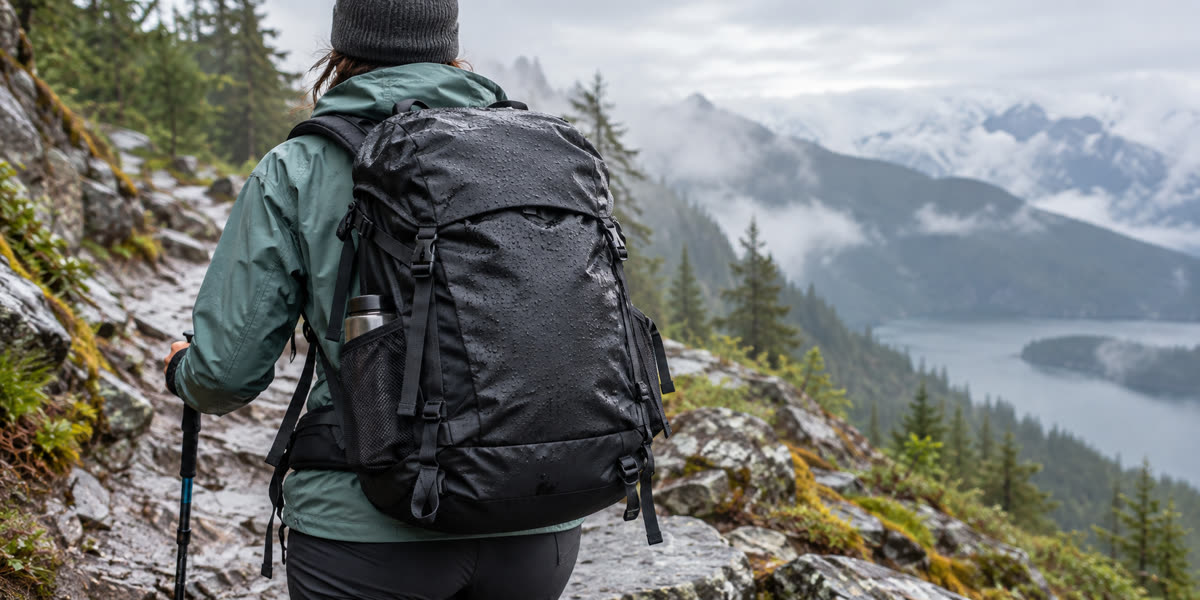
How Fiber-Level Water Repellency Changes the Development Route
Conventional DWR is normally applied as a finish to a fabric surface. With fiber-level water-repellent polyester, the functional component is introduced during fiber production rather than added only after the fabric has been made. Annie’s Smartex currently offers a water-repellent polyester yarn described as a DTY, solution-dyed option. Exact denier, filament count, colour availability and processing route should be confirmed for each enquiry.
This route can give a developer a useful base material for constructions where reduced wetting is required. It does not remove the influence of fabric geometry. Cover factor, yarn spacing, knit or weave structure, surface roughness, calendaring and other finishes determine how water meets the textile. A hydrophobic filament in an open construction may still allow water to pass through the gaps; a dense construction can behave differently even when the yarn chemistry is unchanged.
Solution dyeing is another separate decision variable. Adding colour during fiber production can support colour consistency and may change the downstream processing route, but colourfastness must be verified for the selected shade, exposure and care condition. Do not infer a colourfastness grade from the water-repellent function.
Specifications to Put in a Water-Repellent Yarn RFQ
A useful RFQ connects the yarn to the fabric you intend to build. Sending only an application name—for example, “yarn for waterproof bags”—leaves the supplier guessing about count, construction and performance. The following format makes sample selection more efficient.
| RFQ field | Why it matters | How to state it |
|---|---|---|
| End use and exposure | Separates incidental splashes from prolonged rain or pressure. | “Daypack outer fabric for intermittent light rain” |
| Polymer and yarn form | Affects processing, hand and compatibility with the mill. | “Polyester DTY; supplier to propose available construction” |
| Yarn count and filament count | Influences cover, texture, strength and fabric weight. | Provide the current yarn specification or target fabric construction. |
| Colour route | Determines whether existing solution-dyed colours can be used or development is needed. | Colour reference, tolerance and required colourfastness tests. |
| Fabric structure | Repellency cannot be predicted from yarn alone. | Woven/knitted, density, GSM, face/back orientation and any calendaring. |
| Surface-wetting target | Turns “water repellent” into an agreed fabric-stage criterion. | Named method, edition, initial target and post-care target. |
| Care and durability | Wash chemistry, temperature, drying and abrasion can change results. | State the exact care cycle and number of cycles required by your market. |
| Chemical documentation | “Fluorine-free” and “PFAS-free” require a defined scope. | Restricted-substance list, declaration format, test method and detection limits. |
| Sample quantity and timeline | Existing stock and custom colour routes have different constraints. | Required kilograms/cones, sample deadline and bulk forecast; supplier to confirm feasibility. |
Where Water-Repellent Polyester Yarn Fits—and Where It Needs Support
The most suitable construction depends on the water exposure and the cost of failure. A damp travel bag and a rain shell may both use polyester, but they should not share the same performance claim.
| Application | Useful role for the yarn | Additional development focus |
|---|---|---|
| Backpacks and daypacks | Reduce wetting of the outer woven face during splashes or short showers. | Check seam, zipper and back-coating requirements; test the assembled pack for the intended claim. |
| Luggage and travel bags | Support a cleaner, less readily wetted exterior in routine transit exposure. | Evaluate abrasion, surface soil, colourfastness and water entry through openings. |
| Footwear uppers | Reduce wetting in woven or knitted upper components. | Assess flexing, abrasion, lining, bonding and complete-footwear construction. |
| Softshells and light outerwear | Support water beading for light precipitation without automatically adding a membrane. | Balance air permeability, moisture transport, hand and post-wash repellency. |
| Rain shells, tents and covers | Contribute to face-fabric wetting control. | A coating or membrane, seam design and water-penetration testing are usually needed for a waterproof claim. |
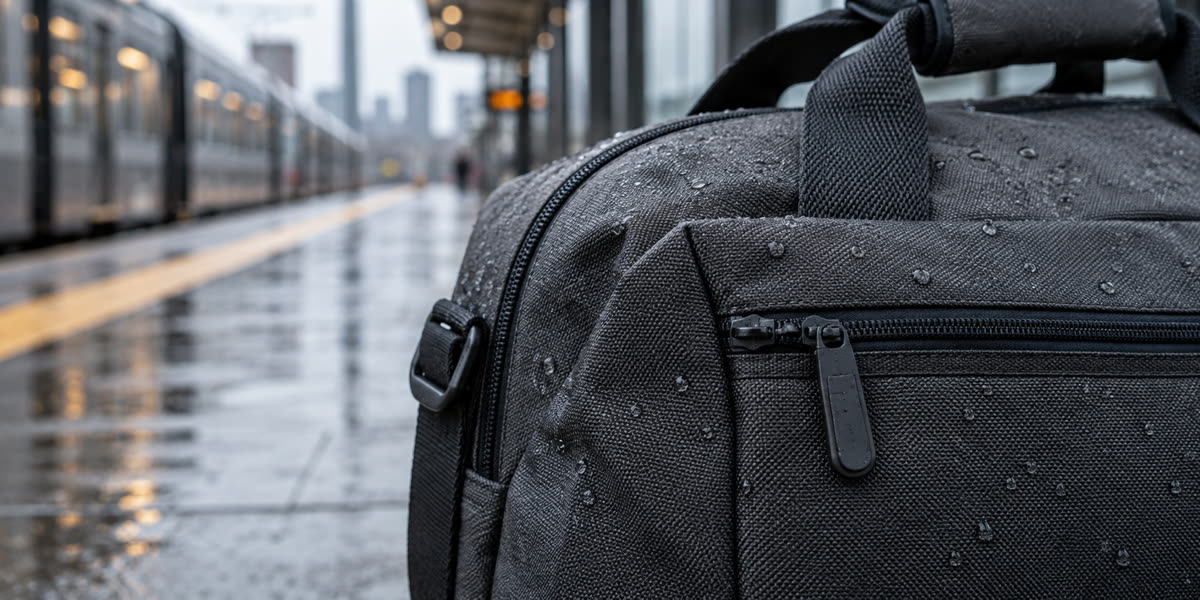
Water-Repellent Yarn, DWR Finish and Waterproof Construction Are Not the Same
Water-repellent describes resistance to surface wetting. DWR means durable water-repellent or durable water-repellency treatment and commonly refers to a finish on the outer fabric. Waterproof refers to resistance to water penetration under defined conditions. In a waterproof jacket, for example, a DWR-treated face fabric can wet out while a separate membrane continues to resist penetration. GORE-TEX explains this same division between its outer-fabric DWR treatment and the waterproof layer beneath it.
Fiber-level modification and a DWR finish are therefore alternative or complementary processing routes, not universal performance rankings. Either route should be evaluated on comparable fabrics using the same care history and test method. If your fabric mill proposes removing a finishing step, run a controlled trial with the target construction before changing the bulk specification.
How to Test Fabric Made with Water-Repellent Polyester Yarn
The main screening method should match the claim. AATCC TM22, Water Repellency: Spray, evaluates how a fabric surface resists wetting. AATCC’s published visual guide is based on TM22-2017e; your purchase contract and laboratory should identify the edition they will use. The method applies to textile fabrics, including fabrics with or without a water-repellent finish. It is not a yarn-cone test.
ISO 4920:2012, Textile fabrics—Determination of resistance to surface wetting (spray test), is another fabric-level spray method; ISO confirmed this edition in 2023. Importantly, ISO states that the method is not intended to predict resistance to rain penetration because it does not measure water passing through the fabric.
If your claim involves water penetration, add a suitable rain or hydrostatic-pressure method, such as an agreed edition of AATCC TM35, TM42 or TM127, selected with the laboratory for the end use. The AATCC standards index lists surface repellency, rain, impact penetration and hydrostatic pressure as distinct test methods. That separation prevents a high spray rating from being presented as proof of waterproofness.
A practical comparison plan
- Produce a control and candidate fabric with the same yarn count, construction, dyeing/heat-setting route and finishing variables wherever possible.
- Record the initial surface-wetting result on the conditioned finished fabric.
- Apply the exact care or abrasion sequence expected in the product specification, not an undefined “wash durable” claim.
- Repeat the relevant tests and report the complete sample description with the result.
- For waterproof products, test the final layered and assembled construction, including vulnerable seams and closures where applicable.

Build a Sample Matrix Before Setting MOQ or Bulk Terms
MOQ, colour minimum, sample availability and lead time depend on whether your project can use an existing yarn specification or needs a custom count, colour or formulation. Those numbers should be confirmed for the actual enquiry rather than copied from an unrelated product.
A compact sample matrix gives you better evidence before bulk negotiation. Keep the fabric construction constant while comparing the candidate water-repellent yarn with the current control. If the project also considers a topical finish, add matched versions with and without that finish. Test all candidates initially and after the agreed care condition. This isolates the material and processing decisions more effectively than comparing unrelated commercial fabrics.
Send the supplier your target construction, intended end use, required test method, care protocol, colour reference, sample quantity and target launch date. If you are combining several functions or developing a new structure, review the options on our custom yarn and fabric development page.
Frequently Asked Questions
Does water-repellent yarn make a fabric waterproof?
No. It can help the textile resist surface wetting, but waterproofness depends on the finished construction and its resistance to water penetration. Dense structures, coatings, membranes and seam treatments may still be required.
Is water-repellent yarn the same as DWR?
No. DWR commonly describes a durable water-repellent finish applied to fabric. The yarn discussed here uses a fiber-production route. Both approaches target wetting behaviour, but they enter the supply chain at different stages.
Can fiber-level water repellency eliminate fabric finishing?
It can in selected constructions. Run a matched fabric trial before removing the finish because fabric density, surface, colour processing and the required end-use claim all affect the decision.
How should wash durability be specified?
Use a complete protocol. State the wash method and edition, number of cycles, detergent, temperature, drying route, conditioning and the required post-wash test result. “Wash durable” or “50 washes” without those conditions is not a complete specification.
Can the yarn be described as PFAS-free?
Only with an agreed definition and supporting documentation. Ask whether the statement means no intentionally added PFAS, compliance with a restricted-substance list, total fluorine below a defined limit, or analysis for a named PFAS panel. Yarn documentation does not automatically establish compliance for dyes, finishes, coatings or the complete product.
Specify the End Use First, Then Select the Yarn
Water-repellent polyester yarn for outdoor fabrics is most useful when it is tied to a defined product, construction and validation plan. Start with the exposure you need to manage, translate it into a surface-wetting or water-penetration requirement, and test the dyed and finished fabric under the expected care conditions. That gives your mill a workable specification and prevents “water repellent” from being mistaken for a complete waterproof system.
Request a Water-Repellent Yarn Sample
Prepare your intended product, yarn count or current sample, fabric construction, colour, target test method, care condition, sample quantity and bulk forecast. Annie’s Smartex can then review the available polyester DTY route and identify which specifications still need development or testing.

Related Posts

How PCM Cooling Fabric Works: Phase Change, Thermal Buffering and the Questions Buyers Should Ask
Cooling Textile Series | 02 A practical explanation of what phase change material can do in a textile, where its...

Water-Repellent Yarn vs DWR Finish: How the Two Approaches Differ
There’s a moment every outdoor gear brand dreads: a customer emails in, three months after purchase, saying their “waterproof” jacket...

How Jacket Manufacturers Specify Aerogel Insulation Material: GSM, Testing and MOQ
Learn how to specify aerogel insulation for winter jackets by GSM, thickness, thermal testing, quilting, washability, samples and MOQ.

Why You Should Choose Moisture-Wicking Fabrics for Sportswear
Ever started a workout feeling great, only to end up looking like you jumped into a pool fully clothed? Or...