Smart Thermal Regulation for Equine & Companion Animal Gear · PCM Phase Change Material Fabric
The Challenge
“Our competition horses arrive at the venue already stressed from heat exposure during transport. By the time we get the ice blankets on, we’re managing damage, not preventing it.”
An equine equipment brand serving competition stables and transport operators faced a recurring welfare problem: horses regulate heat far less efficiently than humans, and conventional cooling methods — ice blankets, wet towels, fans — are reactive, heavy, water-dependent, or simply unavailable during trailer transport and stall confinement. Horses can heat up 3 to 10 times faster than humans under equivalent conditions, and once their skin surface temperature, heart rate, and respiratory rate climb, cortisol-driven stress compounds quickly. The brand needed a wearable textile that could passively buffer temperature spikes during transport, competition warm-up, and stall rest — without ice, water refills, or power sources — while remaining light enough for everyday use.
Our Innovation Journey
1
Why Ice Blankets and Fans Aren’t Enough for Everyday Equine Welfare
Horses maintain body temperature between 37.5°C and 38.5°C only within a narrow thermoneutral zone of roughly 5–25°C; outside that range, or under transport stress, heat accumulation outpaces dissipation quickly, since horses have a high metabolic rate but comparatively small surface area for heat loss. Ice vests and water-based cooling are proven effective in clinical settings, but they require constant refilling, add significant weight, and are impractical for daily transport, stabling, or travel between competitions — leaving a gap for passive, always-on thermal buffering.
2
How PCM Temperature Regulation Fabric Works — From Melting Point to Microclimate
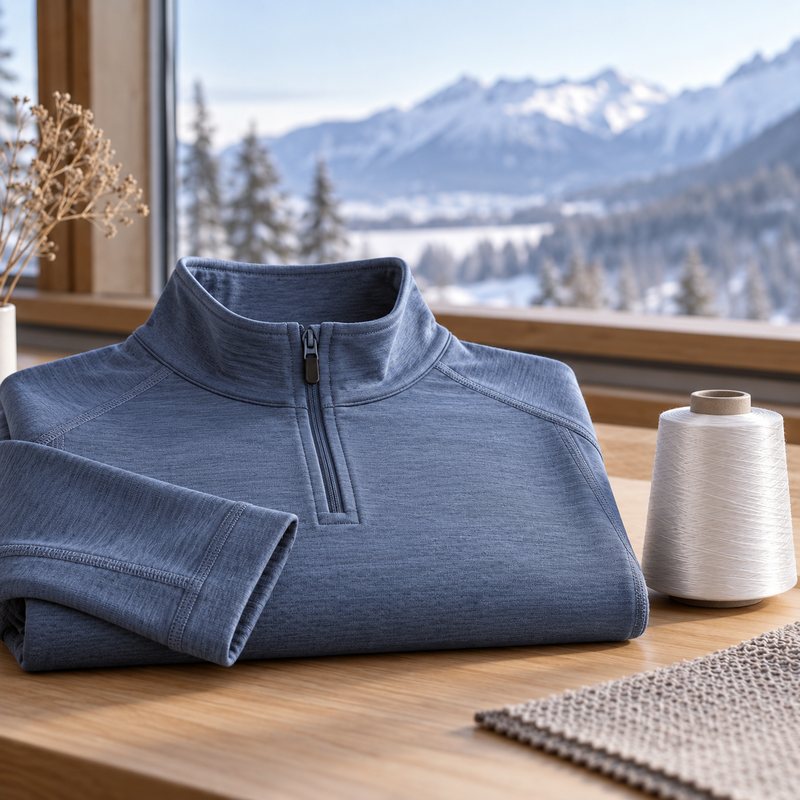
Phase Change Materials (PCM) Temperature Regulation Fabric embeds microencapsulated PCM particles directly into the fiber structure. As the horse’s skin surface temperature rises above the PCM’s melting point, the microcapsules absorb excess heat and transition from solid to liquid — pulling thermal energy away from the body. As ambient or skin temperature drops, the PCM resolidifies, releasing that stored heat back. This latent-heat exchange creates a responsive thermal buffer requiring zero water, zero ice, and zero external power — with microencapsulated finishes reaching 40–60 J/m² of heat storage capacity.
3
What the Science Says About Cooling and Equine Stress Markers
Published research on cooling interventions in horses provides the physiological rationale this application builds on. A 2022 cross-over trial published in Animals (MDPI) measured 20 horses with and without a cooling blanket in hot, humid stall conditions: skin surface temperature declined only in the cooled group, alongside measurable drops in heart rate, respiratory rate, and plasma cortisol — a direct stress hormone marker. This confirms that garment-level cooling meaningfully reduces physiological heat load, giving textile engineers a validated framework for designing PCM-based blankets that target the same skin-surface cooling pathway passively, without water or ice replenishment.
4
One Fiber Platform, Many Animals: From Stable Blankets to Working Dog Vests
The same PCM microencapsulation platform that regulates thermal load in human activewear adapts directly to animal welfare textiles. Woven into a fitted horse blanket, it buffers heat during trailer transport and competition warm-up. Knitted into a lighter jacket construction, it supports working dogs, livestock handling gear, or kennel bedding exposed to fluctuating outdoor temperatures. Because the cooling mechanism is passive and fiber-embedded rather than mechanical, the same base textile scales across species and product formats without redesigning the cooling system itself.
The Result: PCM Equine & Companion Animal Cooling Textile
Passive latent-heat buffering during transport, warm-up, and rest. No ice, no water, no batteries. A welfare-driven cooling story backed by measurable physiological cooling data — built into the fiber.
✓ Microencapsulated PCM: 40 J/m² – 60 J/m² heat storage capacity
✓ Natural PCM Nylon/Polyester: avg. 39 J/m², peak 60 J/m²
✓ Zero external power, zero water/ice replenishment required
✓ Passive solid-liquid phase transition at body-relevant temperatures
✓ Compatible with moisture-wicking finishes for combined comfort
✓ Adaptable across blankets, jackets, vests & bedding for multiple species
📋 A Note on Application Scope & Veterinary Guidance
PCM Temperature Regulation Fabric provides passive latent-heat buffering and is designed to support thermal comfort during transport, light activity, and rest — it is not a substitute for veterinary intervention in cases of heat stroke, anhidrosis, or acute heat stress requiring active cooling (water immersion, ice, forced air). Cooling performance depends on the PCM melting point selected, garment fit, coat length, and ambient humidity. The physiological benefits referenced (reduced skin temperature, heart rate, respiratory rate, cortisol) are drawn from published research on cooling-blanket interventions and illustrate the cooling pathway targeted, not a direct performance claim for this specific fiber construction. Field and veterinary-supervised trials are recommended before scaled production for any animal welfare application.
Why It Matters: The Physiology Behind the Problem
3–10x
Faster Heat Accumulation
in Horses vs. Humans
37.5–38.5°C
Narrow Healthy Body
Temperature Range in Horses
40–60 J/m²
Heat Storage Capacity of
Microencapsulated PCM Finish
↓ Cortisol
Measured Drop in Stress Hormone
with Garment-Level Cooling
Developing equine cooling blankets, working dog vests, or livestock transport gear? Let’s discuss how PCM Temperature Regulation Fabric can bring a science-backed, passive cooling story to your animal welfare product line.
Request Fabric Samples →