 English
 Español
 Português
 Deutsch
 한국어
 日本語
 Italiano
 Français
 العربية
 Türkçe

Un visiteur pose la main sur l'avant-bras d'un robot de service. La surface doit être accueillante, mais le tissu doit aussi pouvoir être retiré pour le nettoyage et laisser les voies de refroidissement de la machine dégagées. C'est un point de départ utile pour la conception de textiles rafraîchissants et faciles à nettoyer pour robots humanoïdes : développer un tissu qui réunit les fonctions requises, puis l'adapter aux zones de contact, aux mouvements et aux voies de refroidissement du robot.
A single fabric can be developed to combine cooling touch, antibacterial activity and easy-clean properties. The combination starts with the yarn formulation and components, then takes shape through knitting or weaving. UHMWPE yarn and easy-clean polyester offer starting points for a fabric brief that combines the functions you need. Research on oriented UHMWPE textiles also makes heat spreading worth exploring. In a finished cover, yarn direction, shell contact and airflow help shape the heat path. Here is how to turn the material brief into a thin, soft cover, and where a seam, opening or air gap matters as much as the yarn.

Textiles pour robots humanoïdes : commencer par la surface de contact
When developing humanoid robot clothing, begin with a part that has a clear job. A forearm panel, a torso contact area or a removable pad gives the textile a defined job. On a forearm, the visitor encounters the surface. Around an elbow, the assembly needs clearance. Beside an air outlet, an opening may do more for heat removal than a different fiber.
Figure Figure 03 Introduction describes textile coverings and washable soft goods that can be removed without tools. That makes removal and cleaning part of the design brief: decide how an operator reaches the shell and takes off a panel before settling its fabric and fastening.
For your design, mark the places people touch, the parts that move and the panels an operator needs to open. That drawing turns “soft wearables for embodied AI” into a set of manageable material decisions. A soft contact fabric and a clear service opening can work together without becoming one continuous garment.
Un contact frais n'est que le début.
Une surface peut paraître froide au toucher car la chaleur de la main se transmet au textile. La question de savoir si ce même textile contribue à l'évacuation de la chaleur d'un robot en fonctionnement est distincte : la chaleur du boîtier doit pouvoir se dissiper vers une surface plus froide ou un courant d'air.
A kitchen countertop offers a familiar comparison. Its initial feel can be cooler than a towel in the same room because they exchange heat with your hand differently. For a textile cover over a working robot, also examine how heat moves during sustained operation. Fabric thickness, contact with the shell, backing and ventilation all belong in that design decision.
Si la housse repose sur une surface chaude, réfléchissez à la manière dont la chaleur peut se propager une fois au contact du tissu. Un revêtement isolant risque d'interrompre ce processus. Un textile qui conduit davantage la chaleur vers l'extérieur peut également rendre cette surface plus chaude pendant son utilisation. L'objectif est d'obtenir simultanément une circulation de chaleur efficace et une température au toucher appropriée.
Research on UHMWPE fibers and woven fabrics reports substantial heat transport along aligned yarn directions. That makes yarn orientation worth exploring in a robot cover. The next question is how much heat the proposed fabric can move once its backing, contact with the shell and airflow are included.
UHMWPE Yarn: Design the Contact Face and Heat Path Together
Smartex UHMWPE yarn is the material starting point for this robot-cover concept. Highly oriented UHMWPE fibers can conduct heat effectively along the fiber direction, which makes yarn alignment and fabric construction worth investigating for a panel near a warm shell. Compare actual yarn and fabric samples under the intended construction before estimating the cover’s operating temperature.
Think of a thin removable forearm panel with a smooth outer face and an opening underneath. Compare a UHMWPE-containing construction with a reference fabric at similar mass and thickness. Yarn direction, knit or weave, backing and contact with the shell all affect where heat can travel. A bulky seam or insulating layer may matter more than the fiber choice.
Ask the knitting or weaving supplier about the available yarn count, construction and finishing route for the selected UHMWPE specification. Check any processing temperature, bonding, coating and care conditions against the yarn’s limits. If a cooler accessible surface is part of the brief, assess it during the robot’s intended operating cycle alongside component temperature; better heat spreading can also make a touch surface warmer.
Un nettoyage facile commence par la tache
A reception robot may collect hand oils. A robot carrying food may encounter grease or sauce. The stain tells you more about the cleaning requirement than a broad “washable” label does.
For a washable fabric for robot covers, separate three questions: does a liquid wet the surface, does the mark come out during cleaning, and does the panel still fit afterward? Repellency, soil release and washability describe those different tasks. An antibacterial requirement addresses a different part of the brief; visible stains call for a soil-release and cleaning check.
Le fil de polyester Cleenzo Easy-Clean constitue un point de départ pour aborder la question du détachage, ainsi que les autres exigences relatives à la housse. Pour un avant-bras fréquemment manipulé, comparez le tissu proposé avec un polyester classique, en respectant les conditions d'entretien prévues. Examinez à la fois le détachage et la capacité de la housse nettoyée à conserver le toucher et l'ajustement nécessaires.
La norme AATCC TM130-2025, « Élimination des salissures : Méthode d'élimination des taches grasses » , traite de l'élimination des taches grasses après le lavage domestique. Elle peut servir de référence pour la rédaction d'un cahier des charges de lavage. L'utilisation d'une lingette désinfectante représente une exposition différente, avec son propre agent désinfectant, sa propre concentration et son propre temps de contact.
| Idée de design | Candidat au fil | Un choix qui façonne le tissu |
|---|---|---|
| Panneau de contact lisse pour l'avant-bras | UHMWPE-containing fabric | Yarn count, fabric thickness, low-bulk edges and accessible-surface temperature. |
| Un panneau amovible fréquemment taché | Polyester Cleenzo facile à nettoyer | Le type de saleté représentatif, la routine d'entretien et l'ajustement après nettoyage. |
| A heat-path comparison | UHMWPE-containing and reference fabrics | Comparable mass, thickness, backing and airflow; measure both component and touch-surface temperatures. |
These starting ideas can also be combined in one fabric brief. Functional powders can be incorporated through a customized masterbatch and spinning formulation; yarn components and fabric construction provide further ways to combine properties. Copper- or zinc-based additives can support an antibacterial requirement, while an elastane component can provide stretch. The roles differ: elastane contributes stretch as a yarn or fabric component, while the additive package supports the specified material function. The selected combination should be agreed for the chosen polymer and processing route.
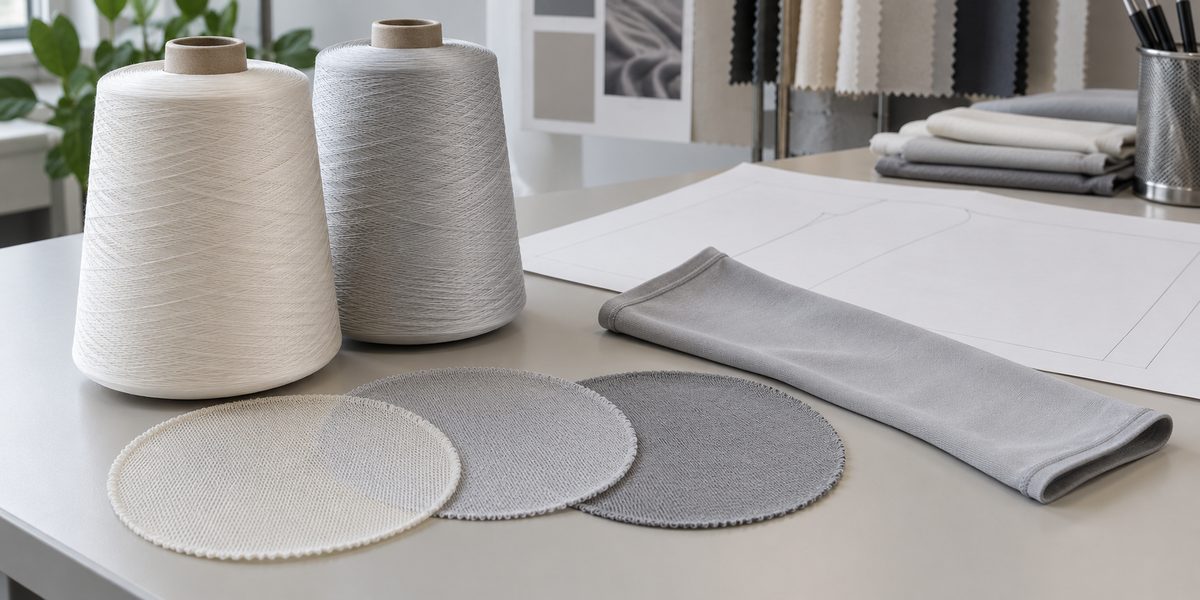
Le Tissu multifonctionnel XOY Alpha illustrates this broader approach. Its product description combines functional powders in the polyester matrix with a shaped fiber cross-section, bringing several properties into one textile. For a robot cover, the useful lesson is to write a combined material brief, then assess heat transfer under the robot’s own contact and airflow conditions.
Un tissu fin peut tout de même paraître rigide au niveau de la couture.
Le poignet d'une chemise peut être confortable au toucher et ferme au niveau d'une couture repliée. Un panneau de robot présente le même problème de conception textile : la main touche à la fois le bord assemblé et le tissu. Un échantillon lisse n'est que le point de départ.
Lors de la conception de tissus pour vêtements de robots, comparez un échantillon à plat avec un exemplaire fini ou cousu. Si le bord présente la plus grande difficulté, il peut être plus efficace de modifier sa position ou d'en réduire l'épaisseur que de changer de fil. Notez les spécifications du filament, la structure du tricot, la masse et l'épaisseur du tissu afin que le fournisseur textile puisse reproduire la construction souhaitée.
Stretch also comes from the whole construction. Yarn elasticity, knit recovery and fastening tension affect how the panel moves. A robot-cover pattern needs to follow the rigid shell and preserve joint clearance, even when a familiar apparel construction inspires its shape.
Laissez la couverture s'éloigner du robot
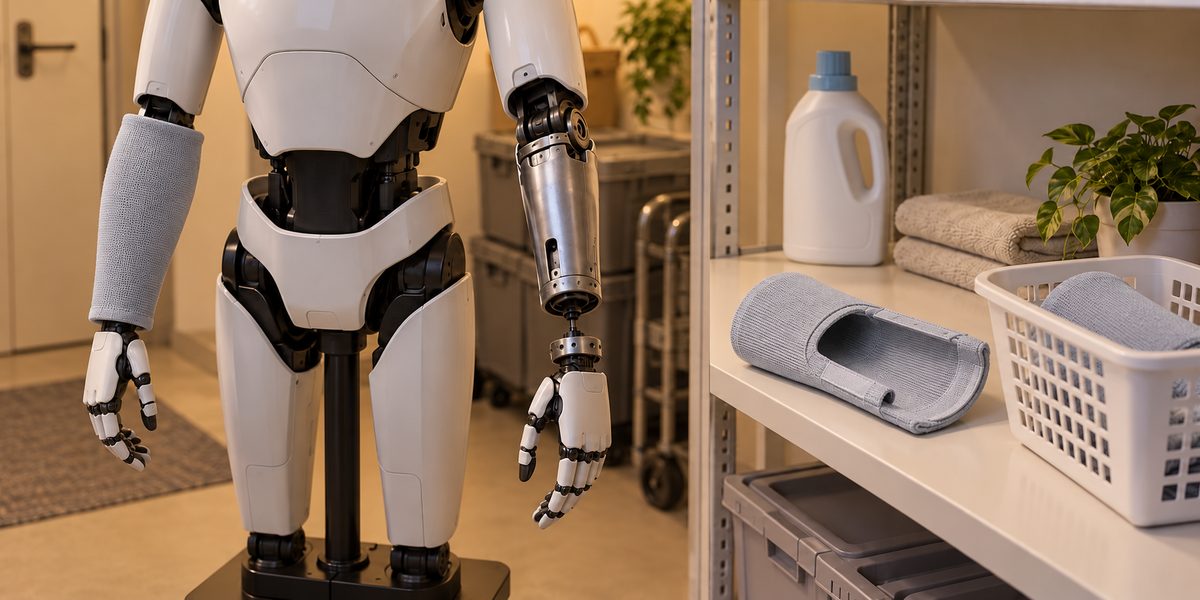
Une manchette ajustée devient difficile à retirer lorsque la main est plus large que l'ouverture. Une attelle d'avant-bras qui s'ouvre par le dessous offre une autre solution : elle se déplie autour de la coque tout en laissant la surface de contact lisse. removable forearm-cover concept Cette idée se reflète dans le choix des matériaux et des motifs.
Leave the wrist and elbow clear through movement, and preserve cooling outlets and service access. If the textile lies above a tactile sensor, assess the actual layers with that sensor: thickness and stiffness change how a touch reaches it. Include sensing response and pinch-zone checks when evaluating the assembled cover.
Transformer une idée de conception en un premier prototype
Pour les textiles destinés aux robots humanoïdes, un petit échantillon de contact est un bon point de départ. Comparez un tissu de référence avec un échantillon personnalisé sur le même motif. Si votre cahier des charges exige un toucher frais, un nettoyage facile et des propriétés antibactériennes, regroupez ces exigences dans le cahier des charges de l'échantillon. Notez la composition, les additifs et la construction afin de pouvoir identifier l'impact de chaque modification sur le toucher, l'entretien ou l'ajustement.
Sur la plateforme, respectez ses limites de fonctionnement et comparez les revêtements dans des conditions de charge, d'ambiance et de flux d'air identiques. Observez la température des composants et des surfaces accessibles, la position du panneau en mouvement et son ajustement après nettoyage. Ces observations vous indiqueront les points à modifier : la structure du tissu, un bord, une ouverture ou le matériau lui-même.
Vous pouvez entamer la discussion sur les matériaux par un croquis de la pièce, des fonctions que vous souhaitez combiner et du mode d'entretien prévu. Indiquez tout besoin d'élasticité, de couleur particulière ou de surface de contact lisse. Un dessin précis pourra être réalisé ultérieurement, au fur et à mesure que la conception se précise.
Vous envisagez de créer un panneau de contact pour robot ? Partagez votre schéma d'application avec Annie's Smartex pour discuter d'un fil et d'un tissu fonctionnels personnalisés pour votre premier échantillon.

Articles similaires
Comment choisir le tissu rafraîchissant adapté : Guide d’achat du nylon PCM, du nylon Cool-Touch et du polyester 8C Pro
Le problème de la catégorie « Refroidissement » : Entrez dans n’importe quel salon professionnel en 2025 et la moitié des stands auront…

Isolation ≠ Chauffage ! Comment choisir la bonne technologie thermique pour les textiles automne/hiver
Lorsque vous achetez des vêtements d'hiver, avez-vous déjà remarqué des étiquettes vantant « isolation thermique », « génération de chaleur » ou « technologie chauffante » ? Beaucoup de gens…

Au-delà du simple rafraîchissement : pourquoi la protection UV et la gestion de la chaleur solaire sont importantes dans les textiles d’été de nouvelle génération
L’effet « frais au toucher » résout le problème du contact immédiat du tissu avec la peau. Il ne résout pas le problème de la transpiration prolongée qui suit…
Solution textile facile à nettoyer pour les uniformes scolaires des enfants
Technologie Cleenzo™ anti-salissures · Résiste au déjeuner, à la récréation et à plus de 30 lavages Le défi « La boîte mail de tous les parents se ressemble le vendredi :… »