 English
 Español
 Português
 Deutsch
 한국어
한국어 日本語
日本語 Italiano
 Français
 العربية
 Türkçe
Lorsqu'on achète des vêtements de protection solaire, l'indice UPF 50+ est omniprésent. On le retrouve sur les étiquettes des maillots de bain, des t-shirts de randonnée et des équipements de plein air de toutes les grandes marques. La plupart des gens pensent que l'UPF 50+ représente la protection maximale, le maximum qu'un tissu puisse offrir.
Ça ne l'est pas.
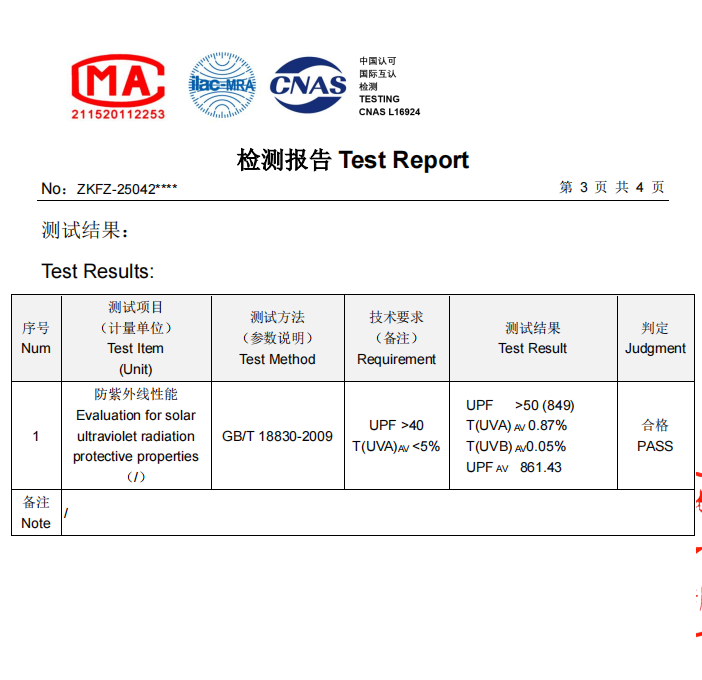
Le tissu XOY Alpha bénéficie d'une certification UPF 861, validée selon la norme GB/T 18830-2009. Ce chiffre n'est pas un argument marketing : il s'agit d'un résultat de laboratoire. Comprendre la différence entre un indice UPF 861 et un indice UPF 50 permet de mieux appréhender le fonctionnement de la protection UV dans les textiles.
Que signifie réellement l'indice UPF ?
L'UPF (facteur de protection contre les ultraviolets) mesure la quantité de rayonnement UV qu'un tissu laisse passer jusqu'à votre peau. Le calcul est simple :
| Classement UPF | Rayons UV bloqués | Rayons UV atteignant la peau |
|---|---|---|
| FPU 15 | 93.3 % | 6.7 % |
| FPU 30 | 96.7 % | 3.3 % |
| FPU 50 | 98.0 % | 2.0 % |
| FPS 50 + | % 98.0 + | |
| FPU 861 | 99.88 % | 0.12 % |
La plupart des organismes de certification, y compris la Skin Cancer Foundation et les recommandations de REI en matière de protection solaire, classent l'UPF 50+ comme une « excellente protection ». Techniquement, tout indice supérieur à 50 est regroupé sous cette même appellation « 50+ » à des fins commerciales. Cependant, les chiffres de transmission réels révèlent une réalité différente. Avec un UPF 50, 2 photons UV sur 100 atteignent encore la peau. Avec un UPF 861, ce chiffre chute à environ 1 sur 861, soit une réduction de la transmission des UV d'un facteur 16 par rapport à un tissu UPF 50 standard.
Pour un usage quotidien, un indice UPF 50 est suffisant. En revanche, pour la randonnée en haute altitude, les sports de plein air prolongés, les voyages en zone équatoriale ou pour les personnes souffrant de photosensibilité cutanée, cette différence devient cliniquement significative.
Pourquoi la plupart des vêtements anti-UV perdent leur protection après lavage
Voici un point que la plupart des marques omettent de mentionner : la majorité des vêtements anti-UV disponibles sur le marché doivent leur protection à des traitements de surface , c’est-à-dire un revêtement bloquant les UV appliqué après le tissage. Ce revêtement est efficace au départ, mais son efficacité diminue à chaque lavage, à chaque heure d’exposition au soleil et à chaque usure.
Des tests indépendants ont systématiquement démontré que les tissus traités anti-UV en surface peuvent perdre une part importante de leur protection après seulement 20 à 30 lavages. L'indice UPF 50+ indiqué sur l'étiquette correspond à la performance du premier jour, et non à celle du sixième mois.
XOY Alpha adopte une approche structurellement différente. La protection UV n'est pas un revêtement : elle est directement intégrée au mélange-maître de polyester lors de la production de la fibre. Il n'y a donc aucune couche superficielle susceptible d'être éliminée par lavage.
La technologie derrière l'UPF 861 : intégration de nano-TiO₂ et d'ions zinc
Les performances UV de XOY Alpha reposent sur deux ingrédients actifs intégrés au niveau de la fibre :
Le dioxyde de titane nanométrique (nano-TiO₂) est l'un des matériaux anti-UV les plus étudiés en science textile. Son indice de réfraction élevé lui permet de diffuser et de réfléchir le rayonnement UV sur un large spectre (UVA et UVB), au lieu de simplement l'absorber. Intégré de façon permanente aux fibres synthétiques, le nano-TiO₂ offre une atténuation des UV photostable et durable, qui ne se dégrade pas au lavage ni avec l'exposition aux UV. Une étude publiée par Chang et al. (2020) a confirmé que le nano-TiO₂ intégré aux fibres conserve ses performances d'atténuation des UV nettement plus longtemps que les traitements appliqués en surface.
Poudres fonctionnelles enrichies en ions zinc : Les ions zinc offrent une double fonction : blocage des UV et activité antimicrobienne. Comme l’ont démontré Liao et al. (2018), les composés de zinc présentent une absorption efficace des UV dans la gamme UVB tout en inhibant la croissance bactérienne, ce qui en fait un complément naturel au nano-TiO₂ dans un système de fibres multifonctionnelles.
La combinaison de ces deux matériaux, intégrés de façon permanente dans la matrice de fibres, est ce qui produit le T(UVA)ₐᵥ de 0.87 % et le T(UVB)ₐᵥ de 0.05 % enregistrés dans les résultats de tests certifiés de XOY Alpha.
L'indice UPF 861 est-il maintenu après lavage ?
Oui — et c'est là que l'intégration au niveau de la fibre optique devient concrètement significative.
La protection UV du tissu XOY Alpha a été testée et conserve ses performances même après 50 lavages en machine. Grâce à l'intégration des nanoparticules de TiO₂ et des ions zinc dans la structure de la fibre, et non à leur application en surface, l'eau, la lessive et le lavage mécanique ne peuvent les éliminer. L'indice UPF 861 témoigne de la performance durable du tissu, et non de ses caractéristiques initiales.
Qui a réellement besoin d'une protection UPF 861 ?
L'indice UPF 50+ est suffisant pour la plupart des activités de plein air occasionnelles. La protection UPF 861 de XOY Alpha est conçue pour les situations d'exposition prolongée ou intense aux UV, ou lorsque la sensibilité de la peau rend la protection standard insuffisante.
- Sports de haute altitude et de montagne — L'intensité des UV augmente d'environ 10 à 12 % par tranche de 1 000 mètres d'altitude.
- Environnements équatoriaux et tropicaux — là où l'indice UV dépasse régulièrement 11 (extrême)
- sports nautiques et de neige — les surfaces réfléchissantes peuvent effectivement doubler l'exposition aux UV
- personnes photosensibles — y compris les personnes sous traitement médicamenteux augmentant la sensibilité aux UV, ou atteintes de maladies comme le lupus ou le xeroderma pigmentosum
- Journées de travail prolongées en extérieur — applications dans les secteurs de la construction, de l'agriculture, de la défense et de la recherche sur le terrain, où les vêtements constituent la principale barrière contre les UV
Au-delà des UV : quelles sont les autres fonctionnalités de XOY Alpha ?
La protection UV est la principale caractéristique du XOY Alpha, mais la même architecture de fibres qui lui confère un indice UPF 861 lui permet également d'offrir d'autres performances : une technologie de refroidissement par rainures en δ pour une régulation thermique optimale, une émission d'infrarouges lointains favorisant la récupération musculaire et une efficacité antibactérienne supérieure à 94 % contre le Staphylococcus aureus après 50 lavages. Ces caractéristiques sont décrites en détail dans des articles techniques distincts.

Si la protection UV est votre principale exigence, XOY Alpha offre la certification la plus élevée actuellement disponible dans la production textile commerciale, avec des données de durabilité à l'appui.
Conclusion
L'indice UPF 50+ est une norme. L'indice UPF 861 correspond à une protection UV intégrée dès la conception de la fibre, et non appliquée a posteriori.
La différence ne se limite pas à un chiffre plus élevé. Il s'agit d'une réduction de 16 fois de la transmission des UV, d'une protection permanente qui résiste à plus de 50 cycles de lavage et d'une approche à double mécanisme — nano-TiO₂ et ions de zinc — qu'aucun revêtement de surface ne peut reproduire.
Découvrez les spécifications du tissu XOY Alpha et demandez des échantillons →
Références
- Chang, Y. et al. (2020). Photostabilité du nano-TiO₂ dans les applications de protection UV des fibres synthétiques. Journal de recherche textile.
- Liao, X. et al. (2018). Poudres fonctionnelles à base d'ions zinc dans les applications textiles anti-UV et antimicrobiennes. Journal des sciences appliquées des polymères.
- Conseils d'experts REI : Comment choisir des vêtements de protection solaire. https://www.rei.com/learn/expert-advice/sun-protection.html
- Fondation contre le cancer de la peau : Vêtements de protection solaire. https://www.skincancer.org/skin-cancer-prevention/sun-protection/sun-protective-clothing/

Articles similaires
Au-delà du simple rafraîchissement : pourquoi la protection UV et la gestion de la chaleur solaire sont importantes dans les textiles d’été de nouvelle génération
L’effet « frais au toucher » résout le problème du contact immédiat du tissu avec la peau. Il ne résout pas le problème de la transpiration prolongée qui suit…

Fil microporeux 8C Pro Performance : solution 4 en 1 pour l’évacuation de l’humidité, le refroidissement, les propriétés antibactériennes et la protection UV des vêtements de sport
Vous connaissez ce moment, pendant un entraînement intense, où votre chemise est humide, votre peau moite, et vous attrapez…
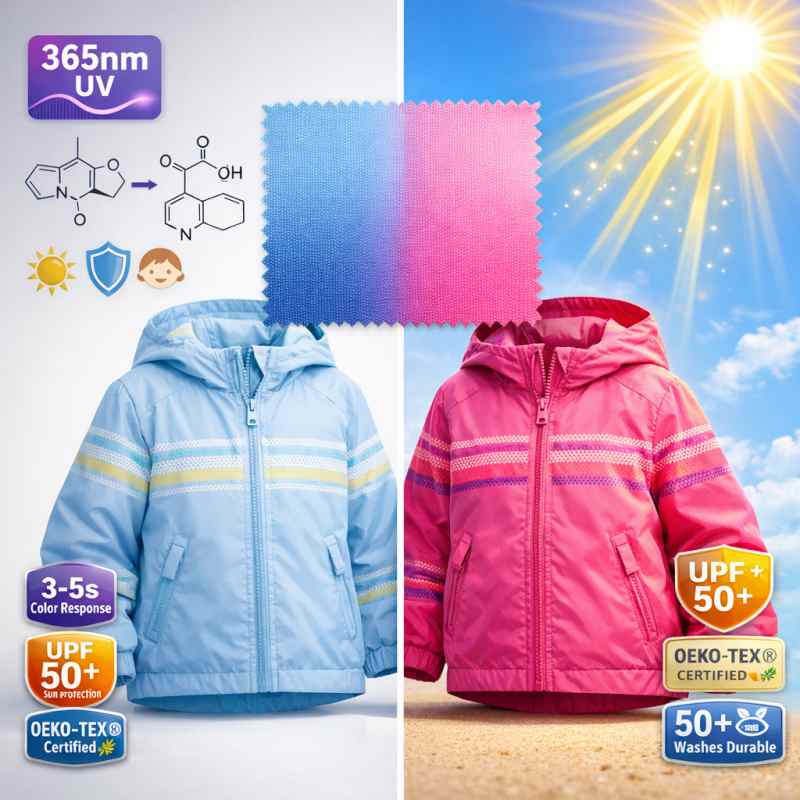
Solution de fil photochromique pour vêtements de protection UV pour enfants
Technologie d'indicateur visuel d'UV pour la protection solaire des enfants : Défi client : « Les parents ne savent pas quand leurs enfants ont besoin de protection solaire. »
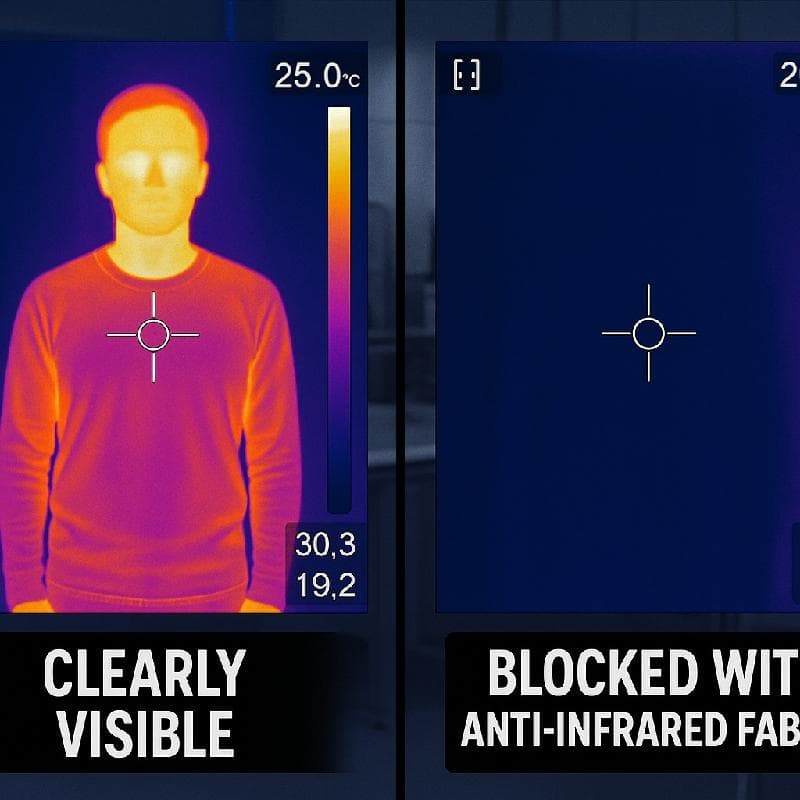
Tissu anti-infrarouge : la protection de la vie privée révolutionnaire dont vous ignoriez l’existence
Imaginez la scène : vous vous changez dans votre chambre d’hôtel après une longue journée, sans vous douter un instant que quelqu’un avec 200 $…