 English
 Español
 Português
 Deutsch
 한국어
한국어 日本語
日本語 Italiano
 Français
 العربية
 Türkçe
In the summer of 2026, heat alerts swept across Spain, France, Italy, and the UK. Temperatures in parts of Southern Europe pushed past 42°C. In cities like Paris and London — where fewer than 5% of homes have air conditioning — millions of people had no mechanical cooling to fall back on.
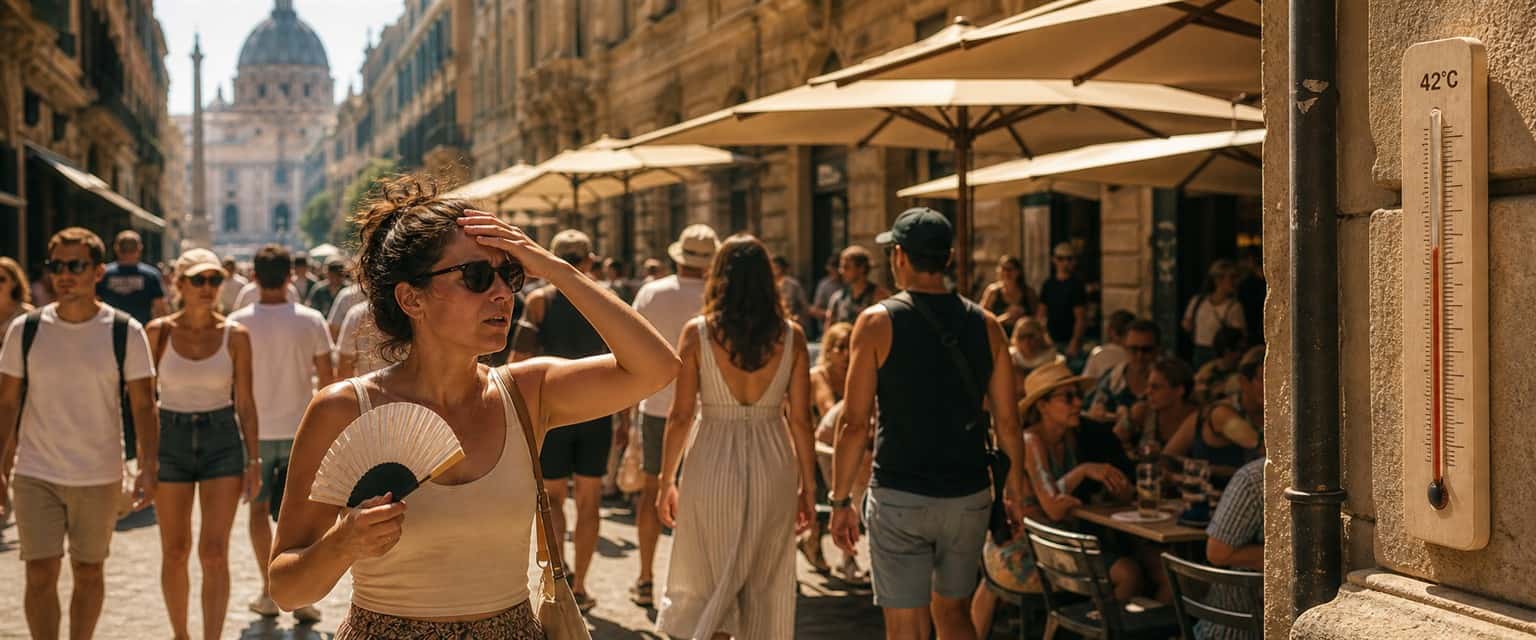
And according to climate scientists, this is just the beginning. A new El Niño cycle is building, with its peak land-surface heat impact projected to hit between February and April 2027. If this cycle is as strong as models suggest, 2027 could become the hottest year in recorded human history.
People are searching for air conditioners they can’t install, in apartments that weren’t built for them. But here’s what most people don’t realize: what you wear matters more than you think.
The right fabric can make a 35°C afternoon feel manageable. The wrong one turns your own body into a heat trap. And not all “cooling fabrics” work the same way — in fact, most products on the market only use one of five fundamentally different cooling mechanisms.
Contact Cool-Sense — The “First Touch” Effect
Walk into any sports store and pick up a fabric labeled “ice touch” or “cool feel.” That instant chill you feel? That’s contact cool-sense — and it lasts approximately 0.2 seconds.
The physics behind it is called non-steady-state heat conduction. The key metric is thermal effusivity:
Fabrics with high mineral content — jade powder, mica, hexagonal boron nitride (h-BN) — or unique fiber cross-sections pull heat away faster than standard polyester or cotton. The industry measures this with a Q-max value:
| Standard | Country | Temperature Differential | Pass Threshold |
|---|---|---|---|
| GB/T 35263 | 🇨🇳 China | 15°C | ≥ 0.15 J/(s⋅cm²) |
| JIS L 1927 | 🇯🇵 Japan | 10°C | ≥ 0.10 J/(s⋅cm²) |
Best for: Bedding, casual wear, retail shelf appeal, short-duration heat exposure.
At Annie’s Smartex, we measure contact cooling performance using the Qmax value — the higher the number, the more heat is pulled away from skin on first touch. Standard cotton sits around 0.10–0.15 J/(s⋅cm²). Our IcSnow® Nylon reaches a Qmax of 0.28, driven by jade mineral modification that permanently alters the fiber’s thermal conductivity — not a surface coating that washes off. For brands that need a step further, 8C Pro delivers a Qmax of 0.32, combining contact cooling with built-in antibacterial and UPF 100+ protection in a single yarn. If sustainability is part of your brief, PECooX® HDPE — made from 100% recycled polyethylene — achieves a Qmax of 0.25, leveraging polyethylene’s naturally high thermal conductivity. All three are available as filament yarn and can be knitted directly into your existing fabric construction.
Heat Shielding / NIR Reflection — Blocking the Sun’s Energy

Most people think of sunscreen when they think of UV protection. But the sun’s heat doesn’t come primarily from UV rays — it comes from near-infrared radiation (NIR), which accounts for 52% of total solar energy in the 700–2500 nm wavelength range.
Heat-shielding fabrics use metal oxide particles — primarily TiO₂ (rutile form, refractive index 2.70) and ZnO — embedded in or coated onto fibers. These particles scatter and reflect NIR radiation before it converts to heat on your skin.
Best for: Outdoor workwear, cycling jerseys, sun-protective clothing, desert environments.
Evaporative Cooling — Your Sweat Is the Engine

This is the mechanism behind every “moisture-wicking” claim you’ve ever seen. When sweat evaporates from your skin, it carries heat with it — approximately 2,430 kJ per kilogram of water evaporated. At peak exertion, the human body can generate 600–800 W of cooling power through sweat alone.
The engineering challenge is getting sweat off your skin and into the air as fast as possible. This is where fiber cross-section geometry matters enormously. An 8-core microporous cross-section creates a siphon effect — capillary channels that pull moisture away from skin and spread it across a larger surface area for faster evaporation.
Evaporative cooling efficiency drops sharply when relative humidity exceeds 60–70%. Above that threshold, the air is already near saturation and cannot accept more moisture. In coastal Mediterranean cities, humid summer nights, or tropical climates, this mechanism approaches zero effectiveness.
For Northern Europe (lower humidity), evaporative cooling is highly effective. For Southern Europe in peak summer, it’s unreliable.
Best for: Dry-heat climates, endurance sports, high-intensity workouts, low-humidity environments.
Phase Change Materials (PCM) — The Thermal Buffer

Phase change materials work on a different principle entirely: instead of moving heat away, they absorb and store it. Materials like paraffin wax undergo a solid-to-liquid transition at a precisely engineered temperature (typically 28–34°C for body-contact applications). During this phase change, they absorb large amounts of latent heat without changing temperature — acting as a thermal buffer that delays the rise in skin temperature.
| PCM Type | Phase Change Temp | Latent Heat | Textile Suitability | Cooling Effect |
|---|---|---|---|---|
| Paraffin | −20 to 100°C | 200–280 J/g | Excellent | 1–4°C / 30min–2hr |
| Fatty Acids | 7 to 187°C | 90–250 J/g | High (bio-based) | 1–3°C |
| PEG | 5.8 to 62°C | 100–200 J/g | Medium | Supercooling issue |
Best for: Airline uniforms (tarmac → cabin transitions), office-to-outdoor commuting, moderate activity in variable temperatures.
Most cooling fabrics react to heat — PCM fabric anticipates it. SkinKey® PCM Lyocell achieves a Qmax of 0.55 J/(s⋅cm²) — nearly 4× that of standard cotton — but the more important number is its phase-change threshold: the microcapsules begin absorbing excess body heat at a precise temperature, holding your microclimate stable rather than simply conducting heat away. We chose Lyocell as the host fiber specifically for next-to-skin applications: botanically derived from eucalyptus, produced through a closed-loop solvent process, and soft enough for intimate apparel and premium sleepwear. This is not a yarn for commodity cooling products. It is designed for brands building around genuine skin-climate management — where the fabric does the work so the wearer doesn’t have to think about it.
Radiative Cooling — The Only Technology That Cools Below Air Temperature
Fabrics engineered from materials like PVDF (whose C–F bond vibrations align with the atmospheric window) and BaSO₄ (which eliminates solar absorption while maintaining emissivity >0.95) can radiate body heat directly to space — achieving sub-ambient cooling: temperatures measurably below the surrounding air.
| Performance Metric | Value |
|---|---|
| Theoretical cooling power | 100–150 W/m² |
| Solar reflectance (DREAM fabric) | 95.6% |
| Mid-infrared emissivity | 95.4% |
| Daytime sub-ambient cooling | 6.8°C below ambient |
| Current fabric cost | $17–25/m² |
| Commercial readiness (2032) | 70% probability |
Current status: Primarily available in white/light colors. Commercial-scale availability projected by 2028–2032. Annie’s Smartex is actively monitoring this space with ShowarmX® and PECooX® as thermal management foundations.
Matching Technology to Your Climate
No single cooling mechanism works everywhere. The right choice depends on where you are and what you’re doing.
Hot & Humid
Southeast Asia, Mediterranean coast, Southern Europe summers
Hot & Dry
Middle East, inland Spain & Italy, desert climates
Temperate with Heat Spikes
Northern Europe, UK, Central Europe
High-Intensity Sport
Any climate — marathon, CrossFit, cycling
❓ Frequently Asked Questions
These are the questions people are asking AI assistants and search engines about cooling fabrics. Here are the science-backed answers.
Not Sure Which Cooling Technology Fits Your Product?
Every climate is different. Every application has different demands. Our team helps brands and manufacturers match the right cooling mechanism to their specific use case — from athletic wear to airline uniforms.
Talk to Our Team →
Related Posts
Best Fabric for Summer Workout Clothes: How to Choose Performance Fabrics That Actually Work
Why Your Expensive Workout Gear Might Be Failing You You’ve invested in “premium” athletic wear with promises of moisture-wicking and...

How Heat Generating Fabrics Work: Smart Heating Technology for Cold Weather Comfort
When winter hits and you’re tired of layering bulky sweaters just to stay warm, heat-generating fabrics offer an elegant solution....
How Does Hollow Polyester Yarn Keep Fabrics Warm Without Bulk?
When can hollow polyester yarn make a winter fabric lighter? Compare knit construction, solid polyester alternatives and finished-fabric warmth before...
Water-Repellent Polyester Yarn for Outdoor Fabrics: What Buyers Should Specify and Test
Water-repellent polyester yarn can reduce surface wetting, but it does not automatically make outdoor fabric waterproof. Learn what to specify,...